Climate change is increasingly affecting coffee production in Kenya, with rising temperatures creating conditions that encourage pests and diseases while putting pressure on water and soil resources.
With climate-related challenges placing increasing pressure on coffee production, farmers and other players in the coffee industry are turning to regenerative agriculture as a way of restoring essential natural resources while enhancing productivity and strengthening the resilience of farms.
Coffee farmers are therefore being encouraged to adopt regenerative agriculture practices that restore soil health, conserve water, improve biodiversity, and build resilience in the sector.
The approach has gained momentum through a collaborative initiative bringing together the Rainforest Alliance, Coffee Management Services (CMS), Kiganda Estate, and other industry stakeholders.
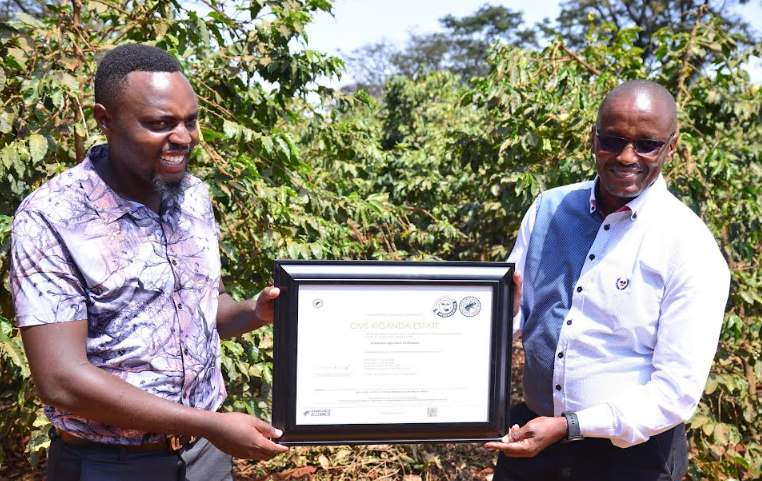
The partnership has culminated in a significant achievement, with Kiganda Estate, a 65-hectare coffee farm located in Thika, Kiambu County, becoming the first farm in Africa to receive certification under the Rainforest Alliance Regenerative Agriculture Standard.
Regenerative Agriculture Certification supports and rewards the adoption of growing practices that boost climate resilience and soil fertility, while also increasing access to specialised markets.
Speaking during the certificate handing over ceremony in Kiganda Estate, Group General Manager at Coffee Management Services Martin Ngare said regenerative agriculture seeks to restore soil to a healthy condition while improving water conservation and biodiversity.
He said the approach involves ensuring that resources on the farm are used efficiently while creating a healthy ecosystem that supports both production and the wellbeing of workers.
“Regenerative agriculture is about improving soil health, managing and conserving water, increasing biodiversity and ensuring that all resources within the farm are used efficiently,” Ngare said.
Kiganda Estate produces an average of 110 to 120 tonnes of clean coffee annually, equivalent to about six containers, with most of its produce exported to Europe and America.
Ngare said regenerative agriculture is helping the farm address the traditional biennial nature of coffee production, where a high crop in one year is often followed by a significant decline the following year.
He said healthier soils and trees have enabled the farm to maintain more consistent production, making its supply more reliable for international buyers.
Ngare said regenerative agriculture has also contributed to improved coffee quality and better returns, noting that certified coffee can generally attract a premium of about one dollar per kilogramme compared with other coffees.
Senior Director Impact Programs in East and Southern Africa at Rainforest Alliance Julius Ng’ang’a said climate change was forcing farmers to change how they produce crops.
He said regenerative agriculture involves restoring soil health, improving irrigation, providing shade, using pest- and drought-resistant crops, protecting biodiversity and improving the livelihoods of farmers and workers.
“Kiganda’s certification offers a practical example of how regenerative agriculture can be integrated into coffee production while addressing soil degradation, climate pressures and the need for more resilient and sustainable farms” he said.
Ng’ang’a said buyers also have a role to play by supporting certified farms through better prices and premiums to enable producers to recover investments made in regenerative practices.
Chairman of the Kenya Coffee Platform Karugu Macharia said regenerative agriculture builds on farming practices that were traditionally used by Kenyan farmers, including intercropping, maintaining ground cover, and applying organic matter.
“Soil conservation remains particularly important because fertilisers can be lost through erosion where soils are not adequately protected,” he said, adding that improving organic matter makes the soil more productive.
Macharia urged smallholder farmers to focus on proper coffee management, including pruning and feeding trees appropriately to support flowering and production.
Deputy Institute Director at the Coffee Research Institute Dr. Tony Maritim said the institute is focusing on developing climate-resilient coffee varieties.
“Research into adaptable and climate-resilient varieties will be critical as Kenya expands coffee production into new regions and embraces regenerative agriculture,” he said.
He said the institute is also screening new varieties and exploring the integration of Arabica and Robusta coffee to develop varieties that are adaptable to different regions and resistant to pests and diseases.
On his part, Kiganda Estate Farm Manager Paul Kabubi said the certification awarded represents a formal recognition of the dedicated efforts of its workforce to adopt and maintain practices that promote environmental sustainability and improve coffee production.
“This certification is an important milestone for the farm. Achieving the required standards involved considerable effort and commitment from the team,” he said while encouraging farmers to adopt regenerative agriculture practices.
By Anita Omwenga