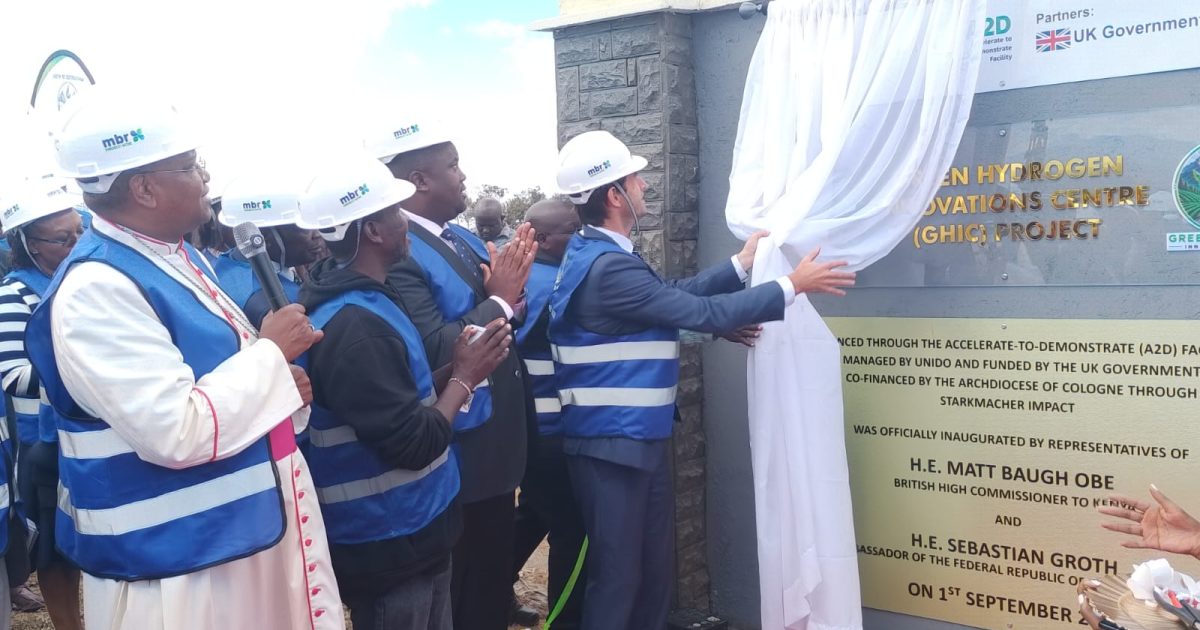
In a bid to reduce reliance on imported fertilizer as well as cutting down on healthcare costs, the Catholic Diocese of Nyeri has launched a green hydrogen project, that will use solar energy to produce ammonia fertilizer and medical oxygen for healthcare facilities that are run by the Diocese.
The project will see the Diocese Construct the Green Hydrogen Innovation Centre at the Nyeri Hill Farm in the outskirts of Nyeri town, where solar energy will be harnessed to power an electrolyzer that will separate water molecules into green hydrogen and oxygen.
The hydrogen will then be combined with nitrogen to produce green ammonia fertilizer, while the oxygen will be purified for medical use at Consolata Hospital Mathari, while the excess will be sold to neighbouring medical facilities in the county.
Speaking during the ground breaking ceremony at the Nyeri Hill Farm, Nyeri Diocese Catholic Archbishop, Anthony Muheria, said the initiative will significantly reduce the cost of sourcing oxygen for Consolata Hospital Mathari, which currently spends between Sh2.5 million and Sh3 million every month on the commodity.
He described the project as a demonstration of the Catholic Church’s commitment to environmental stewardship by implementing practical solutions to climate change.
Archbishop Muheria noted that the initiative is also reflecting the church’s commitment to caring for creation, while embracing technology that can reduce greenhouse gas emissions.
“We have initiated one of the most innovative projects which show the collaboration of the Catholic Church and other players in order to address the issue of climate change and the stewardship of the environment,” Archbishop Muheria said.
“We believe that the mandate of Christ to care for creation included not only the animals and vegetables and forests. It gives us a mandate to enter into the effective engagement to reduce the climate change problem that we have and so this is one of the 360 degrees response that were implementing in order to bring a lot of new technology into care for environment and using what God has blessed us,”he added
According to the Chairman of the project’s technical committee, Engineer Joseph Njoroge, the facility will comprise a 550-kilowatt-peak solar photovoltaic plant, an Anion Exchange Membrane electrolyzer, green ammonia production facilities and medical oxygen production facility. It will also incorporate battery and hydrogen storage systems.
He said the project is designed to produce approximately 56.8 million litres of green ammonia fertilizer annually and about 56.7 million litres of medical oxygen annually which he said will be sufficient to meet the fertilizer requirements for the 825 acres of Arabica coffee farm surrounding the project.
“The concept behind the project is both innovative and practical.The sun that shines on Nyeri Hill, can help us grow food and coffee, reduce dependence on imported agricultural inputs, support a patient who needs oxygen, reduce greenhouse gas emissions, and build new technical capabilities for our young people. That is what makes this project very unique and very special,” noted Eng Njoroge.
The event also saw the Dedan Kimathi University of Technology sign a partnership agreement with the project to support research and training.
In his remarks, University’s Vice Chancellor, Prof Peter Muchiri, described the Centre as an important development for Kenya’s energy sector.
He said the University’s Centre for Energy Studies would contribute technical expertise and support research in green hydrogen while at the same time offer a platform for training of graduates who will Kenya’s emerging green hydrogen industry.
Prof Muchiri said that the project will provide young people with opportunities to develop skills in the emerging sector while preparing engineers and scientists to exploit green energy for agriculture, healthcare among other applications.
“Considering that as a University one of our key areas is research and education, this centre will help in the training and development of the talents that are required in the energy sector. That also includes production of research material which can be used in the development of this sector,” said Prof Muchiri.
Principal Secretary (PS), State Department for Energy, Alex Wachira, described the project as a significant milestone in the country’s efforts to move its green hydrogen agenda from policy to practical implementation. He said in addition to addressing challenges in the agriculture and healthcare sectors, the project could potentially revolutionize the renewable energy sector in the country.
“This project is an important milestone for Kenya.We are living towards a very decisive transformation of the global energy landscape, driven by the transition from fossil risk systems towards green and low carbon energy. This transformation is being shaped not only by climate imperatives, technology advancements, but also by the growing importance of energy security, resilience, and economic competence,” Wachira said.
He noted that Kenya is well positioned to benefit from the emerging green hydrogen industry because more than 90 per cent of the country’s electricity is generated from renewable sources, principally geothermal, hydro, wind and solar.
Wachira said green hydrogen and its derivatives, including green ammonia, could help Kenya reduce its dependence on imported agricultural inputs while creating opportunities for industrialisation, investment, exports, skills development and employment.He also stressed the importance of energy security, noting that disruptions in global markets can quickly affect Kenya through higher fuel and electricity prices.
“Knowing well what is happening in the world such that just a little disruption and we are heavily affected here in Kenya through high fuel and electricity prices.This vulnerability to external forces underscores the importance of energy security which is something that we cannot continue to take for granted as a country,” he said.
To ensure the realisation of energy security, the PS said that the Government will continue working with the private sector, development partners, universities and communities to create an enabling environment for green hydrogen investment.
By Wangari Mwangi