Kenya must strengthen digital literacy and embrace practical science education to prepare learners for a rapidly changing world of work, education scholars have said.
Speaking during the International Workshop on Advancing Digital Literacy for Competency-Based STEM Education at the Centre for Mathematics, Science and Technology Education in Africa (CEMASTEA) in Nairobi, CEMASTEA, Acting Chief Executive Officer (CEO), Gladys Masai, urged teachers to rethink how Artificial Intelligence (AI), digital technology, and STEM are incorporated into classroom teaching.
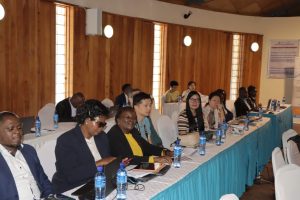
The two-day workshop, between September 3 and 4, 2026, brought together about 100 Junior and Senior School teachers, university lecturers, and STEM education specialists to explore innovation, artificial intelligence, and practical classroom applications.

Ms. Masai described the workshop as an important moment in Kenya’s ongoing transformation of education under the Competency-Based Education system, adding that digital literacy is one of the key competencies learners must acquire and arguing that teachers themselves must possess strong digital skills if they are to effectively support students.
“Teachers require not only knowledge, but they do require digital literacy,” Acting CEO said, urging participants to use the workshop to strengthen their skills and return to their schools better equipped to enhance STEM learning.
Ms. Masai noted the rapid emergence of Artificial Intelligence has made digital literacy even more urgent.
She acknowledged the enormous potential of AI to make work easier and enable people to accomplish more within a shorter period.
However, she warned that overdependence on AI could have an unintended consequence: weakening people’s ability to think independently.
AI, she cautioned, could make the mind ‘lazy’ if users simply accept its output without applying their own judgment, advising teachers to be innovative and ‘humanize’ AI.
She explained that this would mean ensuring that human thinking remains part of the process whenever AI is used.
Teachers and learners should not simply allow Artificial Intelligence to think on their behalf, but should interrogate, evaluate, and improve the information and solutions generated by digital tools.
Ms. Masai’s message comes at a time when AI is increasingly finding its way into classrooms, with teachers and learners using digital platforms for research, lesson preparation, assessment, and content creation.
She also used the workshop to highlight the importance of strengthening Kenya-China cooperation in digital education, saying the meeting offered an opportunity for institutions from the two countries to deepen collaboration in teacher professional development, research, and innovation.
Ms. Masai noted that proposed institutional partnerships, including a Memorandum of Understanding (MoU), could provide opportunities for continued cooperation and enable teachers to benefit from international experiences in digital education.
While Masai focused on the responsible adoption of AI and digital literacy, Prof. Catherine Ngila, placed practical STEM education and innovation at the centre of solving Africa’s education and employment challenges.
African Foundation for Women and Youth in Education, Science, Technology, and Innovation (AFoWYESTI), Executive Director, Prof. Catherine Ngila, argued that STEM should not be understood simply as a collection of subjects such as chemistry, physics, biology, mathematics, and technology.
“STEM is merely a collection of subjects. But most important, it is a way of thinking,” she emphasised.
According to Prof. Ngila, who is a chemistry scholar, the learners must be encouraged to integrate knowledge from different disciplines and apply it to real-life challenges.
The Professor said Competency-Based Education provides an opportunity to achieve academic excellence by shifting attention from memorising information to developing practical competencies, critical thinking, and innovation.
She urged teachers to help learners develop innovative, logical, and analytical ways of thinking, so that education can become a foundation for entrepreneurship and self-employment.
“Because employment seems to be getting thinner and thinner. And so we should have innovative, logical, and analytical ways of thinking. So that’s the knowledge that we have; we can be able to utilize it,” said the Professor.
The Chemistry Expert said a person trained in chemistry would use their knowledge to manufacture products such as soap and detergents and turn scientific skills into a business.
Prof. Ngila warned that Africa’s STEM ambitions could be undermined by inadequate investment in laboratories, equipment, technology, and other learning facilities.
She said learners cannot develop strong practical skills if their education consists mainly of copying diagrams from a blackboard without opportunities to experiment.
Digital technologies, she argued, can help bridge some of these gaps. Simulations, videos, gamification, coding, and other digital tools can give learners opportunities to explore scientific concepts even where physical resources are limited.
However, she stressed that technology should complement rather than replace hands-on learning.
Prof. Ngila noted that learners from different parts of Kenya have unequal exposure to laboratories, digital devices, connectivity, and other educational resources, saying it is essential for competency-based education to deliver equitable opportunities.
The workshop, therefore, sought to equip teachers with both the skills and mindset needed to navigate the changing education environment.
Its objectives included strengthening digital teaching competencies, improving understanding of AI in teaching, learning, and assessment, providing practical exposure to digital and STEM technologies, and sharing international experiences.
The experts said the future of STEM education belongs to learners who can question, innovate, create, and apply digital knowledge to solve current problems.
By Ian Chepkuto