Murang’a County has stepped up preparations for this year’s Mazingira Day celebrations, with authorities aiming to mobilize about 6,700 people to plant 200,000 tree seedlings in one hour as part of a national environmental restoration drive.
The county has already identified about 100 hectares of land for the exercise, with the main planting sites located on land belonging to Delmonte and the Kenya Agricultural and Livestock Research Organisation (KALRO).
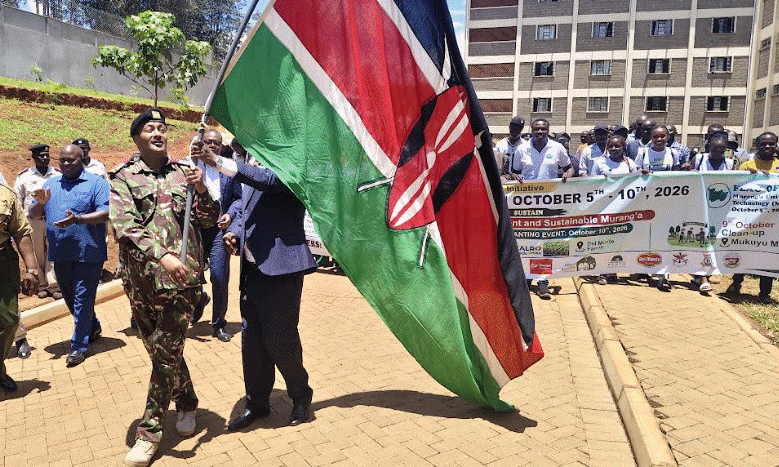
Speaking during the launch of Mazingira Week at Murang’a University of Technology, County Commissioner Hassan Bule said the week-long activities would bring together government agencies, learning institutions, private organisations, communities and other stakeholders in a coordinated effort to increase tree cover and promote environmental conservation.
Bule observed that the activities would include tree planting in schools, along highways and on farms, as well as a town clean-up exercise aimed at promoting proper waste management and maintaining clean public spaces.
He explained that the activities would culminate on October 10 during Mazingira Day, when Murang’a will join other selected counties in a synchronized tree-growing exercise targeting six million seedlings across the country within one hour.
“Murang’a is among the counties selected to participate in this national exercise. We are expected to plant 200,000 seedlings within one hour as Kenya seeks to set a world record for the largest number of trees planted simultaneously within that period,” added Bule.
He noted that preparations for the exercise were already at an advanced stage, with land preparation underway and seedlings and manpower being mobilized.
The national challenge is part of Kenya’s wider tree-growing and ecosystem restoration programme, which seeks to increase the country’s tree cover to 30 per cent by 2032.
The government has also set a target of growing 15 billion trees by 2032 as part of efforts to address climate change, restore degraded ecosystems and strengthen environmental resilience.
Bule said the scale of the Murang’a exercise required close coordination among all participating organisations to ensure that the targeted number of seedlings was planted within the stipulated time.
He urged residents to treat tree growing as a long-term environmental responsibility rather than an activity limited to Mazingira Day.
Murang’a University of Technology Vice Chancellor Prof. Dickson Nyariki said the institution was ready to work with the government and other stakeholders to ensure the county achieves its target.
Nyariki said the university would mobilize its staff and students to support the tree-growing exercise, noting that institutions of higher learning had an important role to play in promoting environmental awareness and practical conservation initiatives.
He further observed that the university would continue with tree-growing activities beyond Mazingira Week as part of its contribution to mitigating the effects of climate change.
“Environmental conservation should be a continuous exercise if we are to effectively address the adverse effects of climate change,” remarked Nyariki.
Engineer Peter Karenju of Murang’a Water and Sanitation Company (Muwasco) called for greater protection of forests, rivers and water catchment areas, saying environmental degradation directly affects access to water.
Karenju said tree growing should be prioritized in catchment areas because forests play an important role in regulating water flows, protecting soils and supporting the recharge of water sources.
“We get water from various sources, including rivers, and it is important to conserve our water catchment areas so that residents can continue accessing this crucial commodity,” he said.
The October 10 exercise will therefore provide Murang’a with an opportunity not only to contribute to the national tree-growing target but also to strengthen local efforts to protect the environment and water resources.
The county is expected to continue with tree-growing and environmental restoration activities in schools, farms, public institutions and other identified sites beyond Mazingira Week.
by Bernard Munyao