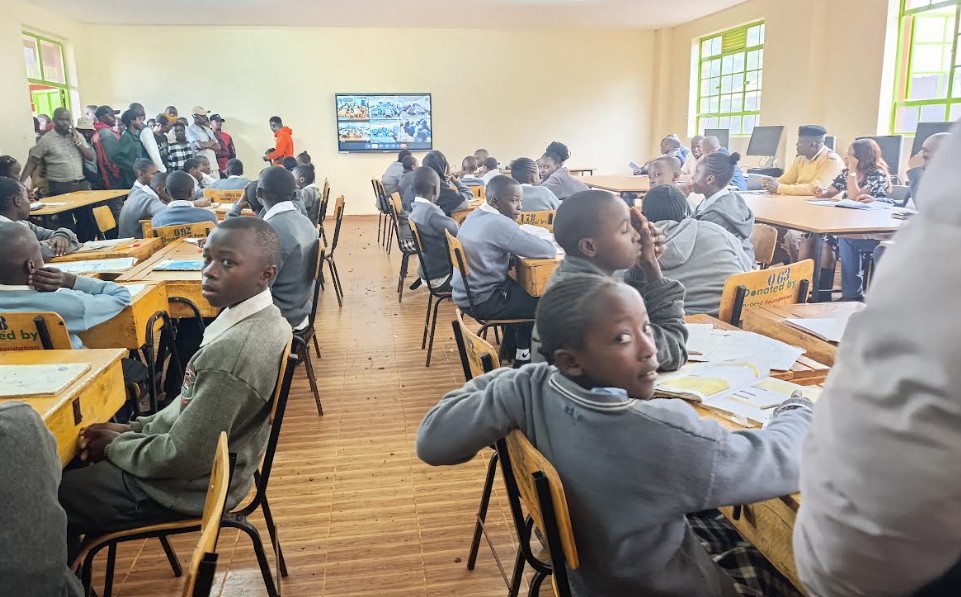
The government has taken digital learning to junior schools across the country through a National Digital Class Experience, aimed at demonstrating how technology can transform teaching and learning.
The exercise was conducted simultaneously in all 47 counties, with the Tharaka-Nithi event being held at Chuka Township Junior School in Chuka-Igambang’ombe Constituency.
Principal Secretary, State Department for Blue Economy and Fisheries, Betsy Njagi, who presided over the event, said the initiative seeks to ensure learners across the country have equal opportunities to access digital learning and develop skills required in the digital economy.
“Today we are ensuring the digital economy comes to the schools. The initiative is aligned with the government’s digitalisation agenda,” said Njagi.
The PS said more than 64,000 teachers had been trained nationally to equip them with skills to integrate digital technology into classroom instruction.
She said more than 60 teachers had so far been trained in the skills required to use the digital learning technology, while 33 interactive smart boards had been distributed to schools in the county.
She said the government would continue expanding the programme to ensure schools are equipped with the necessary digital devices and teachers have the skills required to use them effectively.
Njagi said the initiative would promote knowledge exchange and collaborative learning by enabling teachers and learners to interact through digital platforms regardless of their physical location.
She said digital learning would also expose learners to opportunities beyond their immediate classrooms and help prepare them for an increasingly technology-driven economy.
The interactive smart boards support live lessons, handwriting recognition and annotation, wireless sharing between teachers’ and learners’ devices and audio-visual links between classrooms.
The digital classroom initiative is being implemented under the Kenya Digital Economy Acceleration Project (KDEAP), a government programme supported by the World Bank, which seeks to expand digital infrastructure, skills and access to digital services.
Chuka-Igambang’ombe MP, Patrick Munene, described the initiative as a major milestone in the education sector, saying technology would enhance collaborative learning and enable teachers to deliver lessons to learners in different locations.
Munene said the adoption of digital technology in schools would equip learners with skills needed to participate effectively in the country’s growing digital economy.
The national digital class experience comes amid the government’s rollout of interactive smart boards and teacher laptops to public junior schools, accompanied by training of teachers on how to integrate the technology into teaching and learning.
Njagi also urged parents to closely monitor their children’s use of digital devices, particularly during the forthcoming school holiday, and protect them from accessing inappropriate online content.
She encouraged learners to use digital platforms responsibly and take advantage of technology to enhance their learning.
By Dickson Mwiti and Christine Ngitori