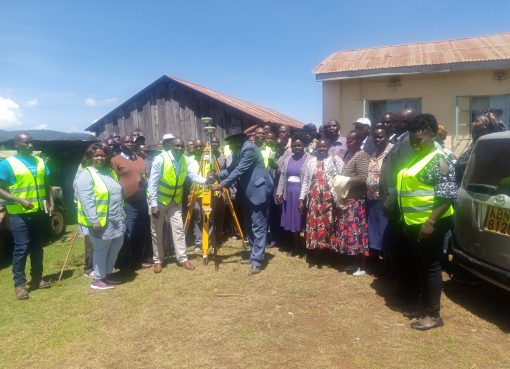
The National Government has rolled out the second phase of the Digital Literacy Programme (DLP) in Nakuru County, aimed at equipping public junior schools with modern technology to drive digital learning.
Implemented by the ICT Authority under the Kenya Digital Economy Acceleration Project (KDEAP), the programme seeks to modernise teaching practices as the government expands the use of technology in teaching and learning across public junior schools.
The rollout, launched at Kampi ya Moto Comprehensive School in Rongai Sub-county in Nakuru County, forms part of a nationwide initiative across all 47 counties targeting 10,382 public junior schools with interactive smart boards and teacher laptops to support the competency-based education (CBE) curriculum.
The programme seeks to bridge the digital divide in public institutions by expanding access to technology, strengthening teachers’ capacity to deliver interactive lessons, and equipping learners with foundational skills for a technology-driven global economy.
Complemented by teacher training to strengthen digital skills and support the meaningful integration of technology in classrooms, the roll-out is helping prepare learners for opportunities in an increasingly digital economy.
Speaking during the launch, ICT Authority Director Bernard Rotich said the initiative demonstrates the government’s commitment to modernising the education sector and preparing young Kenyans to compete globally.
“Digital technology is transforming how knowledge is acquired and shared. By equipping schools with interactive smart boards and teacher laptops, we are empowering teachers to deliver lessons in more engaging and practical ways while giving learners an opportunity to develop essential digital skills,” Rotich said.
He clarified that the digital equipment is designed to complement teachers rather than replace them, enabling educators to seamlessly integrate approved digital content, visual demonstrations, and interactive learning tools into daily instruction.
Rotich emphasised that the sustained success of the initiative relies on continuous teacher capacity building, relevant digital content, a reliable power supply, and proactive equipment maintenance.
Rongai Sub-county Director of Education, William Kipchumba, noted that the digital devices would enhance CBE execution by shifting teaching methodologies toward learner-centred, practical approaches that foster creativity and critical thinking.
He noted that digital learning provides teachers with additional tools to explain concepts through illustrations, videos, and interactive content.
Kipchumba said this makes lessons more practical and gives learners opportunities to understand and apply what they learn rather than relying solely on memorisation.
He urged teachers to embrace the technology and integrate it into lesson planning to boost learner engagement and academic performance.
Deputy County Commissioner Rongai Sub-County, Ronald Mwiwawi, reiterated that the intervention ensures equal technological opportunities for children in public schools regardless of their geographic location.
He explained that every learner deserves an opportunity to acquire the skills required in today’s digital world, regardless of their background or where they attend school.
Mwiwawi emphasised that the programme is helping expand access to technology and preparing young people for future education, employment, and innovation.
He called upon school managers, teachers, parents, and local communities to protect the equipment from loss or damage and support its effective application for educational growth.
Kampi ya Moto Comprehensive School Headteacher, Elizabeth Mutari, welcomed the rollout, stating that the smart board and teacher laptop already installed at the institution are already transforming daily classroom instruction.
She noted the technology has enabled teachers to present lessons in far more engaging ways, helping learners grasp complex concepts easily through visual and practical examples.
Mutari added that the school is committed to ensuring the equipment is fully utilised to strengthen learning outcomes.
Initiated in 2013 under the popular brand name DigiSchool, the Digital Literacy Programme forms a cornerstone of Kenya’s broader education reforms aligned with Kenya Vision 2030 to build a knowledge-based economy.
The programme adopts a multi-agency approach involving government ministries and key state corporations, including the Kenya Institute of Curriculum Development (KICD), which curates and approves curriculum-aligned learning materials across text, audio, video, graphics, and animations.
While Phase One focused on primary schools, Phase Two extends digital infrastructure to junior schools, providing adapted learning resources for learners with special educational needs and creating inclusive learning environments.
Learners at Kampi ya Moto Comprehensive School expressed optimism about the new digital tools, stating that interactive smart boards would make difficult subjects easier to understand through videos and visual illustrations.
They noted that gaining hands-on digital skills in junior school would build their confidence in technology and better prepare them for advanced studies and career opportunities in the digital age.
By Caroline Nyakio and Jefther Afuyo