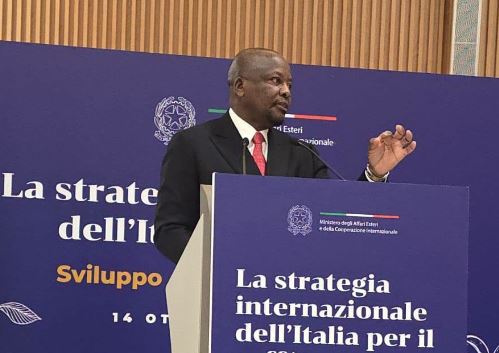
Cabinet Secretary (CS) for Agriculture and Livestock Development Mutahi Kagwe has called for a fundamental transformation of the global coffee industry, emphasising that its long-term sustainability depends on protecting farmers, strengthening regulatory frameworks, and ensuring coffee production remains economically viable.
Speaking at the International Coffee Strategy Forum in Rome, Italy, CS Kagwe highlighted the need for stronger partnerships between producing and consuming countries to address declining production, improve farmer earnings, and expand global coffee markets.
Citing Kenya’s experience, the CS noted that the country’s coffee production has declined from approximately 150,000 metric tonnes to 50,000 metric tonnes, underscoring the need for policies that make coffee farming competitive against alternative agricultural enterprises.
Consequently, he pointed to Kenya’s Coffee Act as a key step towards strengthening the regulation of domestic and export markets while advancing coffee research to improve productivity and sector performance.
“The entire global coffee value chain depends on the farmer,” stressed Kagwe, warning that without sustainable returns at the production level, the industry risks undermining its own future.
He therefore challenged international coffee companies to invest in the welfare of producers, noting that their long-term commercial interests are directly linked to the prosperity of the farmers who supply their raw materials.
The CS also called for deliberate investment in growing the Kenya Coffee brand internationally, drawing parallels with efforts to promote Kenyan tea and urging governments, industry players, and processors to work together to increase global coffee consumption.
On international trade regulations, including the European Union Deforestation Regulation (EUDR), Kagwe called for policies that reflect the realities of agricultural production, highlighting the importance of recognising coffee as a tree crop and ensuring that compliance requirements account for conditions on the ground.
The CS further underscored the potential of digital transformation to modernise coffee trading by connecting smallholder farmers more directly with international buyers, improving market access, and creating greater transparency across the value chain.
He also mentioned that Kenya’s collaboration with Italy and the UNIDO – United Nations Industrial Development Organization – to establish the Coffee Research and Training Institute in Nairobi also reflects the importance of international partnerships in strengthening research, skills development, and the sector’s long-term competitiveness.
By Michael Omondi