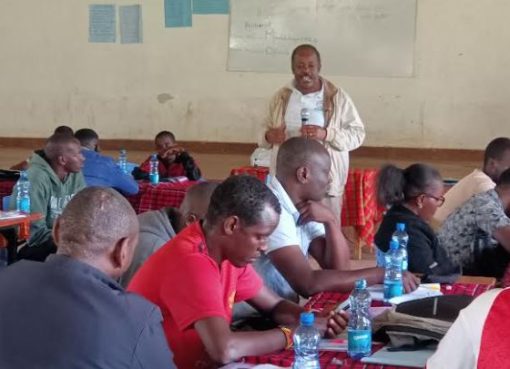
The Principal Secretary (PS) for the State Department of Irrigation, Ephantus Kimotho, has revealed that the government is planning to put 1.5 million acres of land under irrigation in a bid to counter climate change in the country.
Climate change has led to more frequent extreme weather like intense drought, irregular and unpredictable rainfall, floods and increased temperatures leading to water scarcity and low food production, thus negatively impacting food security in the world.
Speaking during a public participation exercise on various irrigation projects in Nandi Hills, Aldai and Emgwen constituencies, Kimotho noted that in Nandi County the government has started 15 water projects across the county with the aim of benefitting a population of 30,000 people.
Kimotho noted that with proper irrigation in the country there will be an increase in food exports as well as an enhanced agro-processing industry across the country, noting that 50 per cent of manufacturing depends on agro-processing.
“In the national sector of irrigation, the government has come up with a plan of sh600 billion, of which 40 per cent will be done by the national government and development partners while 60 per cent will be done by the private sector,” revealed Kimotho.
National irrigation secretary John Tanui, who accompanied the PS, divulged that the department is focusing on reviving colonial dams to enable irrigation in the region, which will in return make the counties prosper and thus improve food production.
“We want to revive the colonial dams that were abandoned and destroyed so that we can use them for irrigation and thus prosper in the agricultural sector,” stated Tanui.
Nandi Hills constituency member of parliament Benard Kitur and Emgwen constituency MP Joses Lelmengit lauded the initiative, noting that there is limited underground water within the county; thus, dams will be the best in enhancing irrigation as well as providing enough water to the residents.
“We want to thank our government for initiating these irrigation projects. In our region there is limited underground water; thus, boreholes cannot serve the community needs,” noted MP Lelmengit.
Residents lauded the initiative, saying this is a great boost to the agricultural sector that will go a long way in increasing our produce, watering our animals and ensuring regular agricultural produce even during the dry season.
By Ruth Mainye