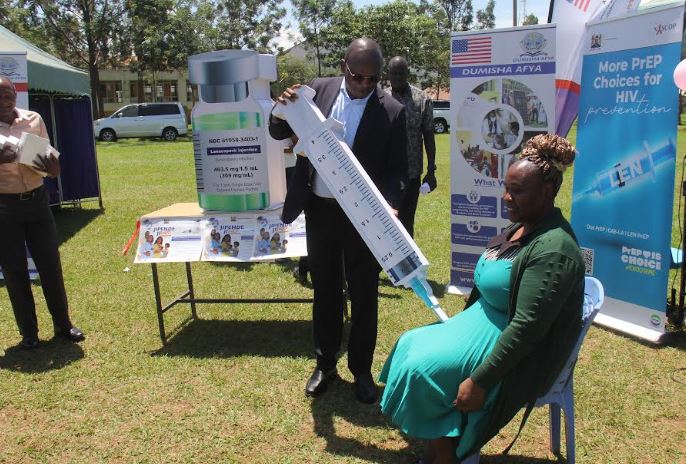
Busia County has stepped up efforts in the fight against HIV/AIDS following the launch of the Lenacapavir injection, a long-acting prevention drug aimed at reducing new infections, especially among adolescents and young people.
The launch, held at Busia KMTC, comes at a time when the county continues to record a higher HIV prevalence compared to the national average, raising concern among health stakeholders.
Speaking during the event on Wednesday, Busia Deputy Governor and CECM for Health Arthur Odera termed the introduction of Lenacapavir as a significant milestone in the county’s HIV prevention strategies.
He noted that Busia’s HIV prevalence currently stands at 5.3 per cent, higher than the national rate of 3.0 per cent, although it has improved from 7.7 per cent recorded in 2017.
“The introduction of Lenacapavir injection is a major step forward in helping to reduce new infections even as we continue to strengthen our prevention and control measures across the county,” said Odera.
The DG added that the county government is working towards ensuring the drug is widely accessible, with plans already underway to distribute it across all health facilities. According to Odera, the uptake of the injection has been impressive, with initial stocks nearly running out within three weeks of introduction.
“The uptake has been very fast. Our people have embraced the need to protect themselves, and this shows the growing awareness on HIV prevention. We already have the drug in all sub-county hospitals and are now scaling up distribution to all health facilities for ease of access,” he said.
He further urged members of the public, particularly those at risk and sexually active individuals, to take advantage of the long-acting pre-exposure prophylaxis (PrEP), which offers protection for up to six months.
Busia County HIV Coordinator Constance Were expressed optimism that the new intervention will play a key role in further reducing infections in the region. She revealed that, based on 2025 HIV estimates, about 43,155 people are living with HIV in Busia County.
“Out of these as at October 2025, 38,114 were on antiretroviral therapy (ART), translating to an 88.3 percent treatment coverage.”
She noted that the county has made notable progress in reducing new infections, which have dropped to 886 cases compared to 1,601 cases reported in 2017. Similarly, HIV-related deaths have declined to 564 in 2024 from 829 in 2015.
The official also highlighted progress in the prevention of mother-to-child transmission (MTCT), with the rate reducing to 6.5 per cent from 20 per cent in 2014.
Despite these gains, the coordinator raised concern over the high infection rates among adolescents and young people, who account for 34 percent of new infections.
“Between January and October 2025, a total of 1,410 people tested positive for HIV, with 227 of those cases recorded among individuals aged between 15 and 24 years.This shows that young people remain the most vulnerable group, and there is a need for targeted interventions to address the challenge,” she said.
Dr Everlyne Ashiono, Chief of Party at Dumisha Afya, lauded the county for embracing the approaches in HIV prevention, terming the launch as timely and impactful.
“This is an important step forward in expanding HIV prevention options and ensuring that individuals and communities have access to effective, innovative, and person-centred services,” she said.
She explained that Lenacapavir complements existing prevention methods such as daily oral PrEP, CAB-LA, and the Dipivefrine ring, giving individuals more choices depending on their needs and circumstances.
Dr Ashiono further noted that long-acting HIV prevention options have the potential to transform the fight against new infections, particularly for individuals who face challenges with daily medication adherence.
“This approach addresses key barriers such as pill burden, the inconvenience of carrying medication, and frequent health facility visits, which often come with additional transport costs,” she added.
By Salome Alwanda and Rodgers Omondi