Uptake of digital skills by schools has been cited as a critical tool in ensuring equality in access to education for learners.
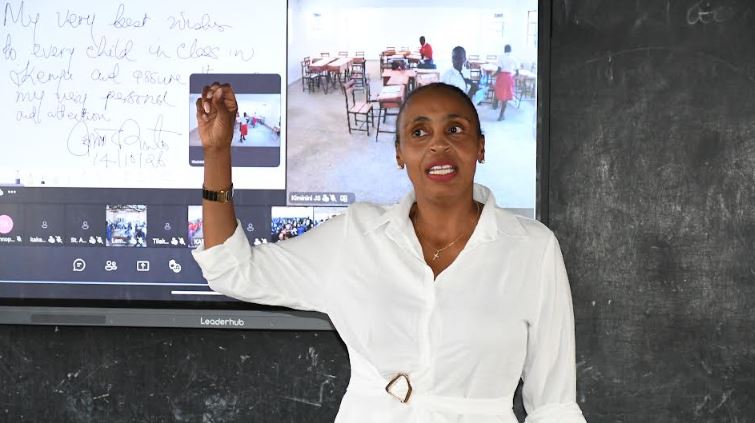
Speaking during the launch of the Second Phase of Kenya’s Digital Literacy Programme (DLP) for schools at Nyaribo Junior School in Kieni, East Africa, ASAL PS Dr Carol Karugu said teaching through digitally enabled devices is an ideal strategy in ensuring every learner has access to quality education.
Dr Karugu noted that with the properly trained teachers and relevant digital tools fully connected to reliable internet supply, learners will be able to interact with other learners not only within their localities but from across the border.
The launch was a follow-up to the nationwide launch that was presided over by President Dr William Ruto yesterday (Wednesday) at Kiminini Junior School in Trans Nzoia.
Eight other schools in Nyeri county also held a similar launch.
“For a long time in Kenya we have had inequality in access to education in that even if we had said education is free for all, maybe it was not free after all. Maybe some people pay more, while some children have had to pay a little bit more than others. The President has been very deliberate about ensuring the environment is equal to all our children. And he is not doing this not for any political expediency because the children have no votes by all intents and purposes,” said Dr Karugu.
The PS similarly termed the launch a milestone in the provision of best global practices in learning for both teachers and learners compared to the traditional modes of teaching.
Dr Karugu noted that with the fast-paced growth in high-end tech, both teachers and learners need to be at the forefront in catching up with the rest of the world in the acquisition of new ways of doing things.
“He (Dr Ruto) is anchoring them (pupils) to the promise of a future that is equitable and has access to global opportunities. These children have interacted with a smart board. Today a teacher in Singapore can teach a student at Nyaribo Junior School. A teacher in New York can teach a child at Nyaribo Primary School. We can therefore be able to share the resources we have and ensure that all these children have an equal opportunity and an equal shot at global opportunities,” added Dr Karugu.
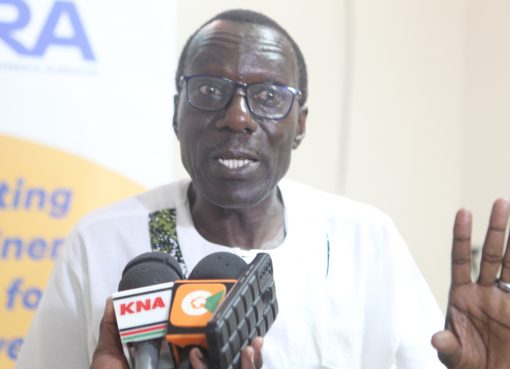
For his part, ICTA Board Director Savio Wambugu said the government has so far distributed a total of 178 smart boards to 178 junior schools within Nyeri county under DLP.
In addition, a total of 534 teachers have been taken through comprehensive training in digital literacy skills to enable them to use the smart screen devices for content delivery.
“Today we came here (Nyaribo Junior School) to witness the activation of the smart screen devices. As an authority, we have already deployed 10,300 smart boards to 10,300 schools in the country, and each was accompanied with a laptop to make sure the teachers also have some devices to create content and to utilise the smart screen. In Nyeri County we have deployed 178 devices in 178 schools, and we can look at the devices as one of the digital transformation activities,” said Mbugua.
Overall, the government through ICTA has supplied a total of 10,300 smart boards to 10,300 schools across the 47 counties under the Kenya Digital Economy Acceleration Project (KDEAP).
Unlike DPL phase I, which largely provided green tablets for primary school learners, this phase targets to reach a total of 10,382 public junior schools across the country with interactive smart boards and laptops for teachers.
Mbugua said the government would also ensure all JSS are connected to a reliable internet supply as a matter of priority in the digital transformation agenda.
In terms of curriculum digitisation for JSS, the official confirmed that the government was moving with speed to ensure the process is completed within the shortest time possible.
“We have been able to do digitisation for the Grade 7 curriculum and Grade 8. Grade 7 has already been in inclusion and is ready. Grade 8 has also been rolled out, and Grade 9 has also been translated, and its adoption is ongoing. I also want to indicate that even for the teachers, they have been able to upskill in terms of digital transformation and digital skilling to make sure they are able to teach and create content using these devices (laptops),” he pointed out.
By Samuel Maina and Silvia Mwangi