Cabinet Secretary for Energy and Petroleum Opiyo Wandayi has expressed hope that the country may start experiencing a significant drop in fuel prices from next month following a newly signed United States–Iran peace agreement that is expected to end the Middle East crisis.
CS Wandayi explained the truce is expected to lead to the reopening of the crucial Strait of Hormuz maritime route, which handles a substantial portion of Kenya’s fuel imports.
The CS assured Kenyans that the government has stepped up to ensure that the country continues to receive a continuous supply across the 47 counties.
He pointed out that the government is actively cushioning consumers from Middle East oil shocks by deploying a Sh10 billion subsidy from the Petroleum Development Levy and halving the Value-Added Tax (VAT) on petroleum products to 8 per cent.
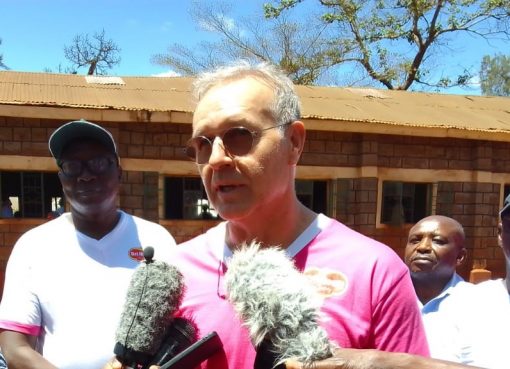
Speaking in Dorobo Village within Mosiro Ward in Narok East Constituency, where he presided over the launch of the last mile connectivity project, the Cabinet Secretary noted that the fuel crisis is a global thing, adding that countries have introduced emergency measures to address the crisis.
He stated that other countries have ended up instructing citizens to work from home in order to reduce fuel consumption.
“We have stepped up to ensure Kenyans continue to receive a stable, continuous fuel supply within the country and to cushion Kenyans as much as possible from the full impact of this global crisis,” Wandayi stated.
He observed that the government has fulfilled its promise to reduce fuel prices following the latest monthly review by the Energy and Petroleum Regulatory Authority (EPRA) for the June 15 to July 14, 2026 cycle.
This price drop directly honors a state directive issued by President William Ruto to mitigate the high cost of living and resolve transportation sector gridlocks.
In the newly released pricing framework, EPRA implemented a notable cut for diesel, alongside a minor adjustment for petrol.
Diesel decreased by Sh10.00 per liter, dropping the price in Nairobi to Sh222.86. Super petrol decreased by a marginal Sh0.22 per liter, lowering it to Sh214.03 in Nairobi. Kerosene remains completely unchanged, retailing at Sh191.38 per liter.
Wandayi stated that the reductions were made possible through specific economic interventions, including the government-to-government petroleum import deal with Gulf oil giants, which allowed Kenya to lock in favorable supply terms and bypass volatile international spot markets.
He added that the steady performance of the Kenyan Shilling against the US Dollar kept landing and importation costs manageable and noted that by maintaining the Value Added Tax (VAT) on petroleum products at 8 percent rather than the standard 16 percent rate, an estimated Sh28 billion in annual revenue was forfeited to shield consumers.
The CS, however, cautioned that a more permanent, significant decline relies heavily on global dynamics and explained that because Kenya’s fuel pricing formula relies on international benchmark prices from the preceding month, the financial relief will not be immediate.
“Kenya’s fuel supply chains remain heavily secure with nationwide storage facilities fully stocked through the end of July 2026, mitigating any threat of domestic shortages. We are working with the private sector to ensure there are adequate strategic petroleum reserves,” said Wandayi.
“We are in talks to establish a regional petroleum refinery on the East African coastline that will in the long term cut the cost of fuel in this region,” he stated.
Wandayi further said the government is actively rolling out an ambitious Sh64 billion National Electrification Strategy to connect 2.3 million additional households to the electricity grid by 2027, aiming to raise the country’s electrification rate to 95 percent.
Under the administration’s Bottom-Up Economic Transformation Agenda (BETA), national data indicates that total connectivity has already surpassed 10.2 million households, bringing the country’s national electricity access rate above 75 percent.
“The government has intensified efforts to ensure all households in Kenya are connected to electricity by 2030, in a bold plan aimed at accelerating economic growth and improving livelihoods across the country. The national electrification programme has already made significant strides, with 10.3 million households currently connected to power out of a total of 15.6 million households nationwide,” said Wandayi.
He noted that 1.4 million of these connections have been achieved between 2023 and now, reflecting the government’s renewed push to expand access to electricity.
The CS said the government is keen on ensuring that the remaining households are connected within the next four years.
He disclosed that in Narok County alone, ongoing electrification projects are targeting to connect an additional 22,000 households at a cost of Sh3 billion.
The investments, he said, are part of the broader Last Mile Connectivity Programme, which seeks to extend electricity to rural and peri-urban areas that remain underserved.
The project is expected to connect small businesses and public institutions to the national grid, a reliable source of power which is expected to enhance productivity and quality of services.
Wandayi emphasized that universal electricity access is a cornerstone of Kenya’s development agenda, terming it a critical enabler in the country’s journey towards industrialization and economic transformation.
“Electricity is no longer a luxury but a basic necessity that drives modern economies. Our goal is to ensure that every Kenyan household has access to reliable and affordable power,” he said.
He added that electrification is a key driver in achieving the government’s vision of transforming Kenya into a first-world economy, noting a reliable power supply will spur manufacturing, support agribusiness, and enhance the growth of the digital economy.
The CS was accompanied by Narok Senator Ledama Ole Kina and Narok East legislator Ken Aramat.
By Emily Kadzo