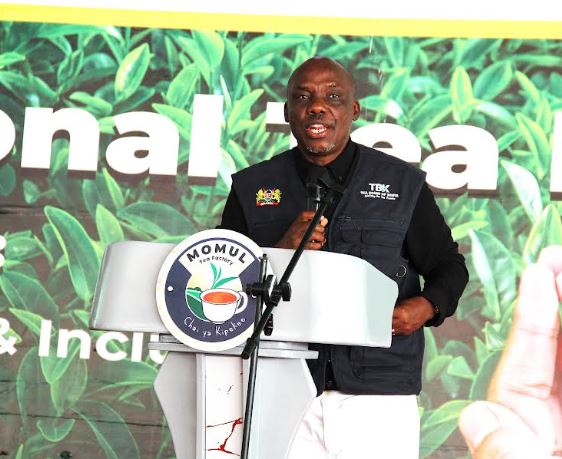
The government, through the Ministry of Agriculture and Livestock Development, is mobilizing Sh4.5 billion to modernize tea processing and expand value-addition infrastructure in a move aimed at boosting farmers’ earnings, lowering production costs, and strengthening Kenya’s position in the global tea market.
The upgrade programme, which targets aging factories and weak value addition capacity within the smallholder tea subsector, was unveiled during this year’s International Tea Day celebrations held at Momul Tea Factory in Kericho County.
Speaking during the event, Principal Secretary for Agriculture Dr. Paul Rono said the government has already secured Sh1 billion towards the program, while discussions were ongoing through the sector working group and budget committee to raise the remaining Sh3.5 billion.
Rono said the planned investment seeks to modernize tea factories, reduce production costs, improve operational efficiency and strengthen value addition in a sector that remains one of Kenya’s leading foreign exchange earners and a critical source of livelihood for millions of households.
“The sector working group through the budget committee is working on the Sh4.5 billion programme. Already Sh1 billion has been secured and efforts are ongoing to mobilize the remaining funds so that we can upgrade and improve tea value addition infrastructure for the benefit of farmers,” said Dr Rono.
Kenya is among the world’s leading exporters of black tea, with the crop playing a central role in the country’s economy through foreign exchange earnings, employment creation and rural development.
Tea supports millions of Kenyans directly and indirectly, particularly in counties within the Rift Valley, Central Kenya and parts of Western Kenya where smallholder farming dominates the sector.
The tea industry has, over the years, remained a major pillar of Kenya’s agricultural economy, contributing significantly to export revenues while sustaining thousands of jobs across farming, transport, auctioning, warehousing and processing chains.
However, despite the sector’s importance, tea stakeholders have continued to grapple with rising production costs, aging processing infrastructure, volatile international prices and limited value addition, challenges that have in some instances reduced returns to farmers.
Dr. Rono said the government was now prioritizing reforms that would not only protect tea quality but also enhance processing efficiency and maximize earnings for growers through modernization and diversification.
According to the PS, part of the planned funding will support the rehabilitation of older tea factories whose outdated machinery has contributed to high operational costs and inefficiencies in processing.
He noted that strengthening value addition remained critical if Kenya was to earn more from its tea exports instead of relying heavily on bulk tea sales in international markets.
“Many small tea factories are unable to put up modern value addition infrastructure on their own. Through this programme, we want to create stronger support systems that will help farmers benefit more from their produce,” he stated.
The PS further revealed that the government was keen on strengthening tea sector institutions and improving infrastructure that supports smallholder factories across tea-growing regions.
He said the reforms being implemented by the Ministry of Agriculture were geared towards ensuring sustainability within the sector while cushioning farmers from market shocks and increasing production costs.
Dr Rono also lauded tea farmers for maintaining the quality standards that have continued to position Kenyan tea favourably in international markets despite growing global competition.
“When we started discussing quality concerns some years back, there were huge disparities in standards, but farmers have worked hard to maintain and improve quality. That is why Kenyan tea continues to command respect globally,” he added.
The PS at the same time challenged hotels and hospitality establishments across the country to use International Tea Day celebrations as an opportunity to promote local tea consumption and market Kenyan tea products.
He said increased domestic consumption would complement export markets and help create additional opportunities for tea farmers and processors.
“We want every hotel and hospitality facility to proudly serve Kenyan tea and showcase the quality that our farmers continue to produce,” he said.
Kericho Senator Aaron Cheruiyot welcomed the proposed modernization programme, saying investments in processing infrastructure would significantly improve the sustainability and profitability of the tea sector.
The senator observed that reforms introduced in recent years had already started yielding positive results, particularly through fertilizer subsidies, improved governance structures and reforms in tea payment systems.
“That programme has changed the lives of tea farmers. Many farmers who previously struggled to access fertilizer can now maintain their farms properly and improve production,” he said.
The senator noted that increased fertilizer accessibility had contributed to higher tea production across many regions, describing it as “a good problem” that now requires stronger market systems and value addition mechanisms to absorb increased output.
He further praised reforms undertaken within the Tea Board of Kenya and the broader tea subsector, saying they had helped restore order and improve coordination within the industry.
Cheruiyot recalled that tea reforms initiated in recent years had addressed several longstanding challenges that had affected the sector, including delayed farmer payments and governance disputes.
According to the senator, tea farmers previously experienced uncertainty due to delayed monthly earnings, but reforms within management and payment systems had improved predictability and efficiency.
“Farmers today have greater confidence because payment timelines have improved and sector management has become more organized,” he stated.
The Senator also called for another national tea stakeholders’ conference to evaluate the progress achieved since the 2023 tea reforms conference held in Kericho.
He said continuous engagement between government, tea factories, marketers, buyers and farmers was necessary in addressing emerging challenges facing the sector.
Cheruiyot, at the same time, applauded Momul Tea Factory for diversifying its investment portfolio beyond tea farming through initiatives such as avocado farming, beekeeping and bottled water production.
He noted that diversification was becoming increasingly important for tea factories seeking to create alternative income streams and shield farmers from overreliance on tea earnings alone.
“Factories that diversify are creating additional revenue for farmers and improving long-term sustainability,” he said.
Leaders attending the celebrations said the proposed Sh4.5 billion modernization programme would play a major role in revitalizing the tea sector by lowering production costs, improving efficiency and enhancing farmer returns.
They noted that beyond agriculture, a stronger tea sector would stimulate rural economies through job creation, improved household incomes and expanded business opportunities in tea-growing counties.
The celebrations brought together tea stakeholders, county leaders, tea factory directors, buyers, exporters, private sector players and farmers from different parts of the country in recognition of the contribution made by tea farming to Kenya’s economy and livelihoods.
As the country marked International Tea Day, leaders expressed optimism that ongoing reforms, increased government support and strategic investments in modernization and value addition would help secure a more profitable and sustainable future for tea farmers.
By Gilbert Mutai