The Government is stepping up efforts to strengthen child protection systems and keep children within safe family environments, as part of reforms aimed at reducing unnecessary institutional care and addressing the growing cases of child neglect and abuse.
Principal Secretary (PS) for Children Services CPA Carren Achieng Ageng’o noted that the reforms require stronger government institutions, adequate resources, and coordinated partnerships to ensure children across the country are protected and their rights upheld.
Since taking charge of the State Department for Children Services, Ageng’o has prioritised resource mobilisation and engagement with development partners to support the Government’s child-protection mandate.
Further, the PS revealed that she reached out to partners and the National Treasury to secure resources, while using international platforms, including United Nations General Assembly engagements, to highlight the situation of children in Kenya and advocate for action on challenges such as child marriage.
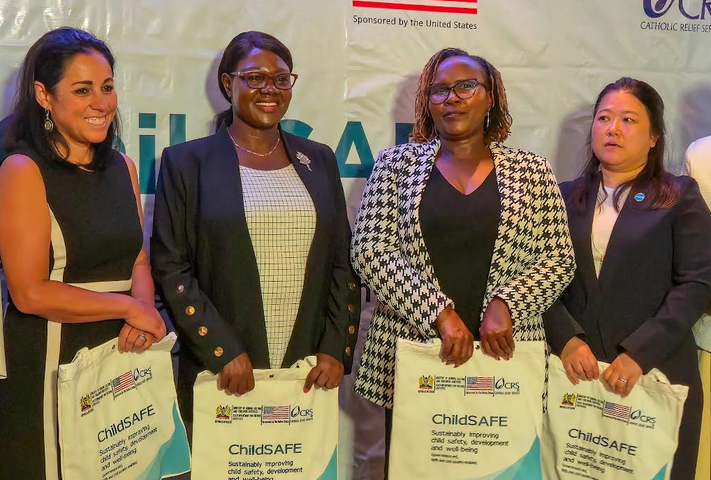
“The efforts have contributed to the mobilisation of a 3.8 million US dollar grant from the United States Department of State, implemented through Catholic Relief Services (CRS) and its partners under the ChildSafe Kenya Project,” Ageng’o stated during the launch of the KSh 623 million ChildSAFE Kenya Initiative in Nairobi.
Notably, the one-year initiative, officially launched in Nairobi on 10th November, 2026 during the launch of the ChildSAFE Kenya Initiative, will support the strengthening of child-protection systems, family support services, and community-based interventions.
It will initially be implemented in Nairobi, Kisumu, Kakamega, Kajiado, Mombasa and Kilifi counties, with the possibility of expansion to all 47 counties depending on funding and evidence generated during implementation.
According to Ageng’o, the Government expects the initiative to reinforce existing public structures rather than establish parallel systems.
“We want this to be a government-led programme,” she affirmed, calling on development partners to align their investments with national priorities and work through established child-protection structures.
The scale of the challenge, she observed, is reflected in the department’s records, which show that 222,267 child-protection cases were reported in the 2025/2026 financial year, with approximately 70 percent involving parental neglect.
To this regard, the PS pointed out that the figures demonstrate the need to address the circumstances that expose children to neglect, abuse, and separation from their parents or caregivers.
She also cited approximately 40,000 children living in 902 children’s institutions across the country, noting that more than 70 percent could be traced to their families.
However, Ageng’o insisted that reintegration must be guided by individual assessments to establish whether returning a child to their family would be safe and, in the child’s best interests.
The Government’s approach, according to the PS, is anchored in the National Care Reform Strategy 2022–2032, a 10-year framework that seeks to reduce reliance on institutional care and promote family- and community-based alternatives.
“These include kinship care, where children are placed with suitable relatives, and foster care, alongside interventions aimed at strengthening families and preventing unnecessary separation,” she outlined.
Through the Positive Parenting Programme, the PS highlighted that parents and caregivers are trained on child development, creating safe environments, positive parenting practices, and responding appropriately to children’s needs from infancy.
Equally, Ageng’o singled out that prevention should be prioritised by addressing challenges within families before they escalate and lead to children being placed in institutions.
In addition, she disclosed that the ChildSafe Kenya Project will also support improvements to the Child Protection Information Management System (CPIMS) to strengthen reporting, case management, and coordination among child-protection actors.
Ageng’o also revealed that the department is exploring digital reporting mechanisms, including an application that would enable members of the public to report concerns and link cases to the relevant children’s officers.
Similarly, the PS also identified the National Child Helpline 116 as a critical response mechanism requiring improvement, citing concerns that some calls are terminated before being received or go unanswered.
She further announced that community child-protection promoters, including volunteers who identify and report cases at the grassroots, are expected to receive additional support and capacity-building to strengthen collaboration with government officers.
Importantly, Ageng’o stressed the Government must also respond to emerging threats, particularly online child exploitation and sexual abuse, through stronger reporting, investigation and referral systems.
The PS referred to the 2019 Violence Against Children Survey, which found that half of children had experienced some form of violence before the age of 18, while 15 percent of adolescent girls had experienced teenage pregnancy.
She said the findings were based on an earlier survey and that the department had recommended a new assessment in 2026, in collaboration with partners and the National Treasury, to establish the current situation and guide policy interventions.
The State Department on the other hand is strengthening its institutional capacity through specialised functions covering child protection, child participation, and partnerships.
The Child Protection Department coordinates prevention and response interventions, while the Child Participation Department promotes children’s involvement in decisions affecting them and equips them to understand and protect their rights. The Partnerships Department coordinates collaboration and resource mobilisation.
In this respect, Ageng’o said children’s cases require timely attention, adding that government officers work around the clock to respond to protection concerns and facilitate psychosocial support for survivors of defilement and other forms of abuse.
She further emphasised the importance of collaboration with the Judiciary to prioritise children’s cases and ensure perpetrators are held accountable.
Following engagements with the Chief Justice, Ageng’o reported that the department is pursuing closer cooperation, including linking child-protection information systems with judicial case-tracking mechanisms to improve the monitoring of cases through the courts.
Meanwhile, the PS outlined key expectations for the project implementation teams, including stronger coordination and accountability, building the capacity of the child-protection workforce, supporting early childhood development and family strengthening, and ensuring sustainability and evidence-based implementation.
She directed that interventions must be documented, locally owned and sustained beyond the project period, while information relating to children must be handled confidentially in accordance with the Data Protection Act, 2019, and the principle of the child’s best interests.
Although the initial implementation will cover six counties, Ageng’o maintained that the Government’s responsibility extends to children in every part of the country, supported by children’s officers and existing structures across all 47 counties.
She reaffirmed that the ultimate measure of the reforms would be the ability of the country’s child-protection systems to prevent abuse, support vulnerable families, and ensure children grow up in safe and caring environments.
By Sharon Njeru and Nancy Omondi