The National Government through National Drought Management Autbority (NDMA) will spend Sh10 million to desilt Kosowe Earth Dam in Nzaui Subcounty with a view to increase its water capacity to 30,000 cubic meters, Makueni County Drought Co-ordinator (CDC) Alice Munyao has disclosed.
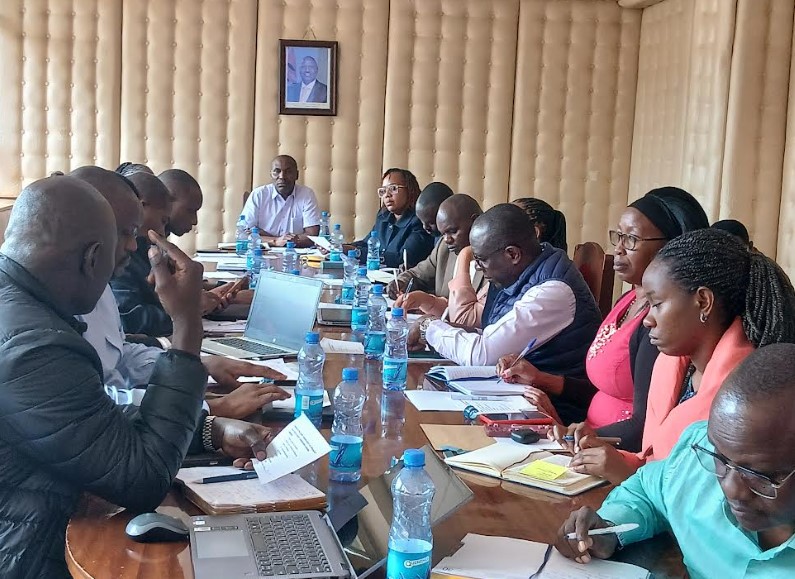
Munyao made the disclosure in a County Steering Group meeting held at the County Commissioner’s Boardroom on Friday where she said that the desilting of the dam will take only three months to complete by October when the short rains are anticipated.
The County Coordinator also revealed that the dam will benefit over 3,000 households with a view to end their perennial shortage of water in the area.
“The works to desilt the Kisowe Earth Dam started on 16th July, and expect to be completed by early October before the short rain season commences,” Munyao said in the meeting that was chaired by the Deputy County Commissioner (DCC) who is also Personal Assistant in the County Commissioner’s office Peter Kimani on Friday.
However, she never gave the name of the contractor undertaking the works at the dam.
Also, she revealed her organization will spend another Sh3 million to purchase 300 Gala Goat that is aimed at improving the breed under the project and benefit 32 Nzakika Community groups.
While saying goats are being procured currently, Munyao said that through the project, seeks to improve low goat productivity and household resilience in the Arid and Semi -Arid (ASAL) area hence help address poor genetics, inbreeding and climate stress with a view to improve the breed.
She further said that the intervention is also expected to enhance growth rates, milk production and market value while maintaining adaptability to the harsh conditions in the area.
The project is being implemented through the Wee Community Based Organization (CBO) in collaboration with NDMA and County Livestock Services at the county government.
“The expected results include higher household incomes, improved nutrition and food security, better herd performance and strengthen community resilience, with sustainability ensured through revolving breeding schemes, skills transfer and strong institutional and community ownership,” she said.
During the meeting the members were taken through the performance of the last rains of March, April and May that came earlier and was fairly distributed but farmers experienced reduced production because the reduction of rains that impacted on the crops.
A Technical Committee was constituted comprising of the departments of Water, Health, Education, Agriculture, Livestock and NDMA to go and evaluate the impact of seasonal rains and other shocks on food and nutrition security and bring a report to be deliberated by the County Steering group on 24/07/2026.
By Patrick Nyakundi