Water, Irrigation and Sanitation CS Eric Mugaa has highlighted the unequal burden borne by women and girls in accessing water, particularly in rural and arid areas.
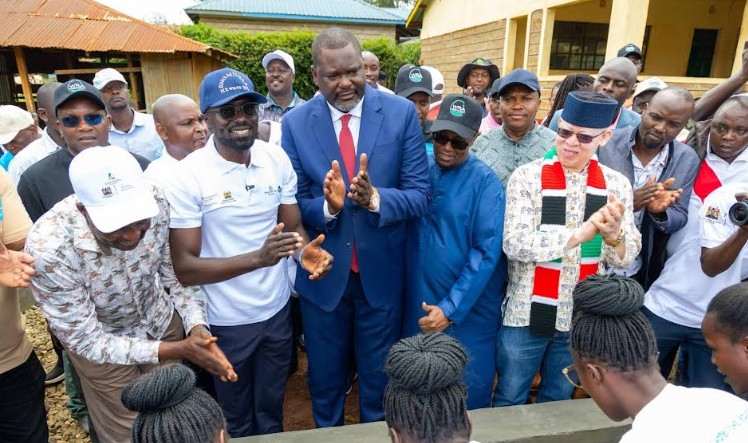
Mugaa was speaking during national celebrations to mark World Water day, held at Mwerongundu Primary School in Igembe North Sub County, where calls to address gender inequality in access to water were renewed.
The theme for this year’s celebrations, “Water and Gender”, with the campaign slogan “Where water flows, equality grows”, highlighted the critical link between water security and gender equality, focusing on the disproportionate impact of water scarcity on women and girls while promoting their leadership in water management.
The CS noted that many women spend hours each day walking long distances to fetch water, limiting their ability to engage in education, business and leadership.
“When water is far away, it is women’s time that is lost. When it is scarce, it is girls whose education is interrupted,” he said.
Mugaa emphasised that access to safe and reliable water is not only a development issue but also a matter of equality, dignity and social justice.
He reaffirmed the government’s commitment to universal access to water and sanitation, as guaranteed under Article 43 of the Constitution.
“According to government data, Kenya remains a water-scarce country, with per capita freshwater availability estimated at about 405 cubic metres annually, well below global water security thresholds.
However, the national water coverage has reached 74 per cent, while access to safely managed sanitation stands at 40.9 per cent,” said Muga.
He added that water services are currently delivered through 95 providers producing about 461 million cubic metres annually, with the sector generating nearly Sh28.9 billion in revenue, though it continues to face challenges such as high levels of non-revenue water, currently estimated at 44 per cent equivalent to about Sh11.9 billion in losses each year.
The CS added that the government is scaling up investments in water infrastructure, including dams, sewerage systems and water supply networks.
Some of the ongoing water projects in the Central Kenya region include the ongoing Meru Sewerage Project, which is expected to benefit close to 100,000 residents upon completion.
Similar projects are underway in neighbouring counties including water and sanitation initiatives in Tharaka-Nithi and Kirinyaga, aimed at improving access for thousands of households.
Mugaa also acknowledged the role of development partners and the private sector in supporting water programmes such as the Kenya Towns Sustainable Water Supply and Sanitation Programme and the Kenya Water, Sanitation and Hygiene Programme.
He urged stakeholders to work together to ensure equitable access to water, noting that improved water availability has far-reaching impacts on health, education and economic development.
“Where water flows freely, opportunity flows with it,” he said, adding that empowering women and girls through better access to water can uplift entire communities.
The water day event was organised by Tana Water Works Development Agency.
Meanwhile, one of the key interventions for dealing with the water challenge in the Igembe region was drilling a borehole at Mwerongundu primary school by Tana Water Works through support from the ministry of water and irrigation.
As part of the intervention they will distribute water tanks to public institutions and community groups.
At the same time, Danco Capital Company is supporting the project through the provision of pipes to enable last-mile connectivity.
The company’s Water Head Lucia Achieng, said the initiative will ensure water is distributed to all the community members, aiming to relieve women and girls of the hurdles of fetching water in an area that doesn’t have a single river.
By Dickson Mwiti