The National Treasury has adjusted the budget preparation timetable for the 2027/2028 Financial Year (FY) to allow Parliament to review and appropriate budget estimates by March 31, 2027, ensuring continuous public service delivery ahead of the August 2027 General Elections.
National Treasury Cabinet Secretary, John Mbadi, stated that the adjusted calendar will provide economic certainty.
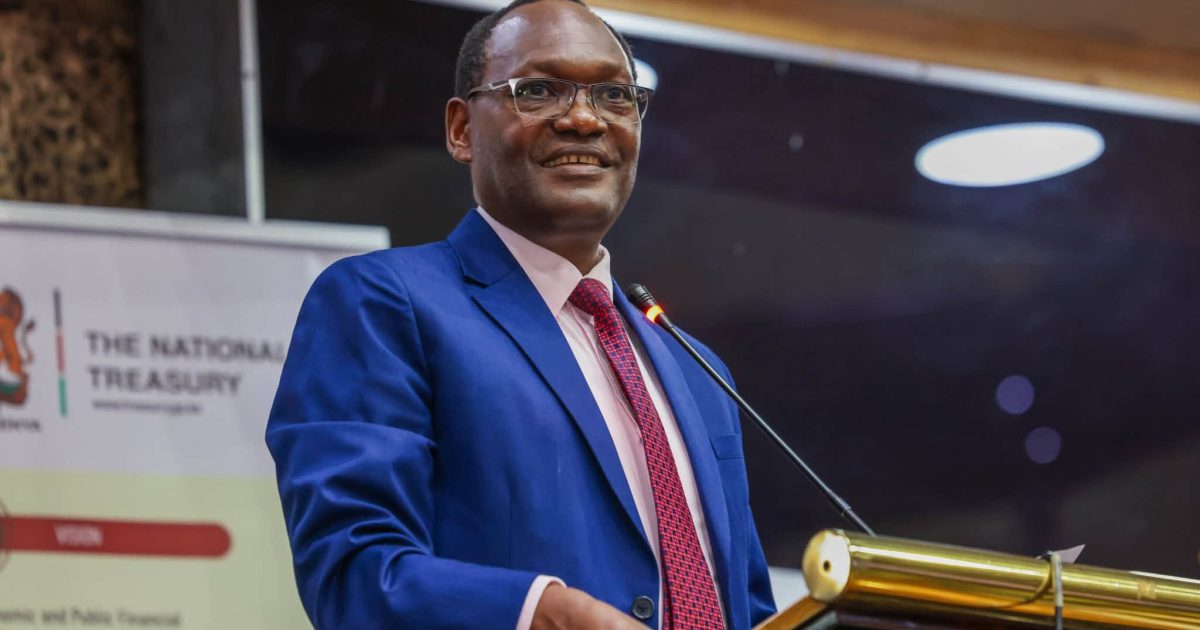
Mbadi, in a speech read on his behalf by the National Treasury Principal Secretary, Dr. Chris Kiptoo, during the official opening of the Public Sector Hearings on the FY 2027/2028 and Medium-Term Budget, noted that public participation remains a constitutional duty under Article 201(a) of the Constitution to maintain openness, accountability, and value for money in public finance management.
“As we prepare the 2027–2028 budget estimates, our fiscal policy will advance the government’s priorities under the Bottom-Up Economic Transformation Agenda (BETA) and the Fourth Medium-Term Plan (MTP4). Our approach is clear: pursue growth while restoring fiscal discipline,” Mbadi stated.
The CS highlighted Kenya’s macroeconomic resilience, noting that the economy grew at an average rate of five per cent between 2022 and 2025, outperforming global and Sub-Saharan African averages, with real Gross Domestic Product (GDP) growth reaching 5.3 per cent in the first quarter of 2026.
Under the government’s fiscal consolidation path, the overall fiscal deficit is projected to decline from 6.8 per cent of GDP in FY 2025/2026 to 5.9 per cent in FY 2027/2028 and further to 4.9 per cent by FY 2030/2031.
Mbadi stated that this framework relies on medium-term assumptions, including real GDP growth of at least 5.3 per cent, inflation maintained within the target range of 2.5 per cent around the five per cent target, a broadly stable exchange rate, and revenue collection of at least 7.4 per cent of GDP while containing total expenditure below 23.6 per cent of GDP.
To boost domestic revenue, the Treasury is implementing the National Tax Policy and Medium-Term Revenue Strategy, broadening the tax base, streamlining tax incentives, and modernising tax administration through digital systems.
Mbadi urged accounting officers to adhere strictly to Treasury Circular No. 10 of 2026, directing them to submit sector budget proposals by October 15, 2026, ahead of submitting the draft Budget Policy Statement (BPS) to Parliament by November 16, 2026.
Principal Secretary for the State Department for Economic Planning, Dr Boniface Makokha, confirmed that all sector proposals have been evaluated against national socio-economic priorities.
Dr. Makokha revealed that implementation of Kenya Vision 2030 currently stands at an overall progress rate of 66.1 per cent.
“The overall progress comprises 88.2 per cent for the political pillar, 61.6 per cent for foundations and enablers, 59.5 per cent for the social pillar, and 55.5 per cent for the economic pillar,” Dr Makokha said.
He added that the department has trained 11,200 national government administrative offices across 36 counties to strengthen grassroots data collection and is conducting Gumzo La Uchumi Mashinani forums to directly consult citizens on national development frameworks beyond 2030.
National Treasury Principal Secretary Dr. Chris Kiptoo outlined key public financial management reforms aimed at managing tight fiscal space, including zero-based budgeting, full integration of e-procurement, and the Single Treasury Account (STA).
Dr. Kiptoo stated that adopting the Single Treasury Account reduced government overdraft interest payments by 58 per cent, lowering costs from Sh7.44 billion in FY 2023/2024 to Sh3.53 billion in FY 2024/2025.
Chairperson of the National Assembly Budget and Appropriations Committee, Samuel Atandi, confirmed Parliament’s commitment to fast-tracking the budget approval process in line with the accelerated timeline.
Atandi urged the National Treasury to ensure sufficient resource allocations for critical institutions ahead of the upcoming election period.
“Given that we have elections next year, we must put more emphasis on the electoral process by ensuring that the Independent Electoral and Boundaries Commission (IEBC) is properly resourced to conduct free, fair, credible, and verifiable elections,” Atandi said.
He emphasised the need to adequately fund security agencies and the judiciary, fully address historical pending bills, refrain from initiating new development projects and focus resources on completing ongoing capital projects, while transitioning eligible commercial ventures to the National Infrastructure Fund (NIF).
By Wasidia Freshwin and Phaeline Motari