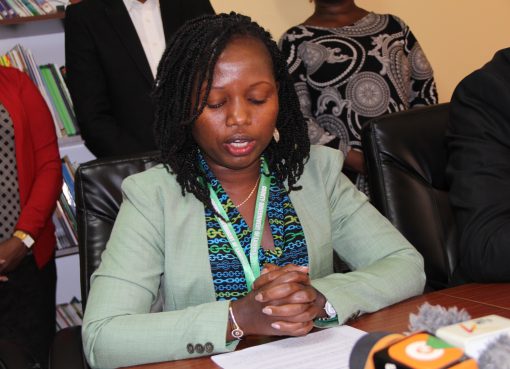
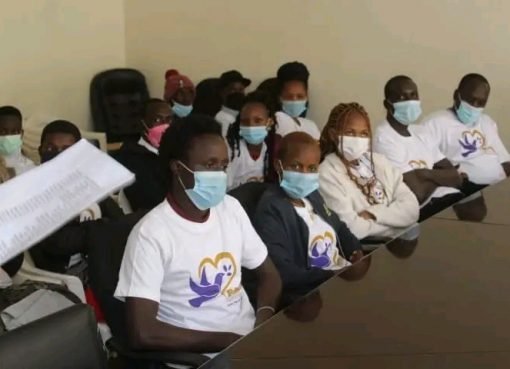
Senior officials from the State Department for National Government Coordination and office of the Prime Cabinet Secretary led by the legal advisor, Dan Ameo paid a courtesy visit to the County Commissioner of Vihiga County, Jeremiah Gicheru, to kick off the verification of National Government projects in different sites across the county.
The aim of the visit was to verify the status of priority projects on the ground and to talk directly to citizens and other stakeholders to get their feedback at firsthand.
Next Generation Delivery System (NGDS) is an online system used to assist in the management and mapping of the state of projects and to get the public take or views towards them. The platform includes a dashboard where data is captured in the system and the public can communicate freely because it captures both positive and negative feedback from citizens.
During the courtesy call, the Vihiga County ICT Officer, Alex Muse Nyongesa, explained everything relating to ICT projects in the county.
Nyongesa explained that ICT infrastructure in Vihiga is being implemented under the Digital Superhighway (DSH), a flagship national programme under the Bottom-Up Economic Transformation Agenda (BETA), approved by Cabinet in early 2023 to expand broadband access across Kenya.
He further said that it is implemented through the Ministry of Information, Communications and the Digital Economy and the ICT Authority, in partnership with the Communications Authority, and financed largely through the Universal Service Fund.
“The programme targets four national outcomes, laying 100,000 km of fibre optic cable countrywide, including along Kenya Power transmission lines, establishing 25,000 public WiFi hotspots in high-footfall areas to give citizens affordable access, setting up 1,450 Digital Village Smart Hubs, one in each ward, for skills, innovation and digital services, and building three national data centres, supported by stronger data protection and cybersecurity systems”, he noted.
Under DSH Phase 2, Nyongesa said, last-mile connectivity is being extended from the fibre backbone to public institutions and community spaces. The target sites are public primary and secondary schools to support digital learning, sub-county and referral hospitals to support health service delivery, market centres for traders and residents, bus stages for travelers, TVETs including technical, vocational and teacher training colleges, court stations to support digital justice services, and government offices such as sub-county, administration and security offices for e-government services.
On the status of Vihiga County, Nyongesa said implementation continues to progress. Under DSH Phase 2, 49 sites are under implementation by Kenya Power across the five sub-counties.
Nyongesa explained that the 54 existing last-mile sites under OGN (NOFBI 2, NOFBI 2E and CCP) are all operational, Public WiFi covers 42 sites, of which 20 are operational and 22 are under implementation.
He further stated that two jitume Digital Hubs are operational, at Kaimosi Friends Polytechnic and Sabatia Technical and Vocational College (TVC).
On digital literacy, Nyongesa said 195 junior schools have been equipped with a smart board and a laptop each under the KDEAP DLP Scale-Up Project, to support the CBE curriculum and integrate ICT into teaching.
Nyongesa said estimated daily public WiFi usage is about 1,000 people daily at the market sites and about 200 people daily at the Deputy County Commissioners’ offices.
He however raised challenges requiring attention, noting vandalism of active equipment has been reported at the Mbale Market and Chavakali Market public WiFi sites.
Nyongesa concluded that Vihiga County’s ICT programmes are well on course, citing the 54 existing last-mile sites are operational, the two Jitume digital hubs are serving the county, and 195 junior schools have been equipped to deliver the CBE curriculum with ICT.
“Under DSH Phase 2, Kenya Power is steadily implementing the 49 sites across the five sub-counties, with 20 of the 42 public WiFi sites already operational, serving an estimated 1,000 people daily in markets and 200 at the DCCs. Completing the remaining sites will extend connectivity to schools, hospitals, markets, TVETs, courts and government offices,” he said.
He finalised that strengthening the security of active equipment at the Mbale and Chavakali market sites will help protect these gains and sustain the county’s progress towards a connected, digitally empowered Vihiga.
On his part, the County Commissioner, Jeremiah Gicheru, assured the visiting team that the National Government Administration Officers (NGAO)is up to the task of coordinating projects on the ground and giving feedback to the government.
He took the team through the status of high priority National Government programs and projects in the county, highlighting the progress and identifying challenges faced.
Gicheru said the county heads departmental meetings every end of the month where they discuss and visit different projects within Vihiga.
He further said that he is working together with his team on daily inspections and airing out major challenges faced.
He said that his NGAO team had been trained earlier on how to use digital gadgets to update the government on project status.
The verification team visited various project sites across the county, engage citizens directly and capture their views on the dashboard to inform government decision-making.
By Florence Oteng’o and Maureen Imbayi