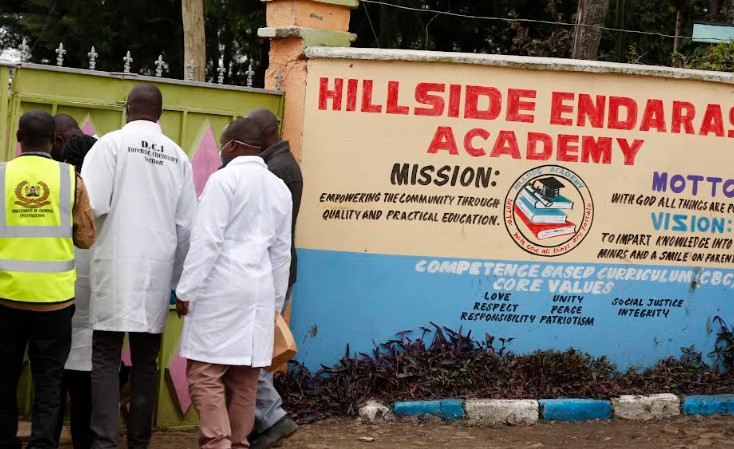
A public inquest into the Hillside Endarasha Academy dormitory fire that claimed the lives of 21 boys on September 5, 2024, Monday, heard that the two dormitories did not have CCTV cameras.
During the inquest which resumed on Monday before Senior Resident Magistrate Mary Gituma, a Closed-Circuit Television (CCTV) installer, James Githinji, told the court that cameras could only capture footage at the entrance of the two gates that led to the boys’ and the girls’ dormitories.
He also informed the court that the cameras at the school were serviced five days prior to the fire incident.
Githinji told the court that it was the school Director David Kinyua, who contracted him to service 11 CCTV cameras in the school compound. However, the scope of his work changed upon discovery that the image quality of five cameras was poor and needed replacement.
The CCTV installer, who has seven years of experience in installing and servicing the surveillance equipment, told the inquest. In addition, he also fitted a new Digital Video Recorder (the core recording system in a CCTV which processes and stores video footage from the camera to a hard drive) and connected a surveillance monitor located in the Director’s office to the power supply.
“One of the five cameras I installed was facing the main gate, another one was facing the kitchen and another was facing the gates that lead to the dorms. I also installed another camera inside the Director’s office and another one at the assembly which was facing the windows of the office and the classrooms that are near the office,” said Githinji.
“The Director informed me that the remaining cameras would be replaced gradually during the school holidays,” he added.
It was his testimony that by the time he left the school compound on August 30, all the cameras and the DVR were in working condition, and the cameras could be monitored from the Director’s office.
The next time he heard about the school was five days later when he received a phone call from one of his customers who resides in the area informing him about the fire incident. By the time he arrived at the school, the fire had already been put out.
Githinji told the inquest that his inspection around the school compound revealed that only one of the freshly installed cameras had been tampered with. He later learned from the first responders that it had been interfered with by the fire engine as it was making its way to the scene of the fire.
“I arrived at 4am, by which time the fire had been put out. The power supply had also been cut off, and upon inquiry, I was told it had been switched off when the fire started. Upon inspection of the cameras, I noticed that one camera that was located at the assembly right opposite the Director’s office had been tampered with. The cable had been cut, and the camera was facing downwards while the wire was dangling. All the other four cameras were intact,” said Githinji.
The inquest is trying to piece together the series of events that took place at the school in September 2024, just two days after the school had re-opened for the third term. The fire is reported to have broken out between 10pm and 11pm on that fateful Thursday night.
In February this year, Dr Grace Atieno, the pathologist who conducted the post-mortems, told the court that the victims inhaled lethal amounts of carbon monoxide in addition to suffering severe burns covering between 74 and 100 per cent of their bodies.
She told the inquest the victims’ organs, including their lungs, liver and kidneys, were severely charred, and some children had parts of their brains completely destroyed by the night inferno.
Her analysis was further backed by evidence from Dennis Owino, an analyst from the Government Chemist, who told the inquest that carboxyhaemoglobin – a highly toxic complex form of carbon monoxide and haemoglobin – was detected in the blood of all the 21 boys who lost their lives.
“This indicates that prior to death, the deceased had inhaled carbon monoxide gas, which could have contributed to their death. No other chemically toxic substances were detected in the post-mortem samples,” he told the court.
Meanwhile, state prosecution has asked the court to issue summons to four experts, among them the immediate former Energy, Petroleum and Regulatory Authority (EPRA) boss Daniel Bargoria, to testify in the public inquest.
The other three include an engineer from the Kenya Power and Lighting Company (KPLC), an analyst from the Government Chemist and a solar technician.
According to State Prosecutor Claudette Obat, five experts had initially been expected to give evidence, but only one appeared in court during the inquest.
“The investigating officer received a communication from KP that indicated that the witness was unwell and was unable to attend court. On the 24th, the IO also received a communication from EPRA indicating that the witnesses who were to come to court were engaged in other official duties and therefore were seeking another date.
The solar technician had, however, indicated that he was taking his child to school and would not be available today. The position from the government chemist is that he is on leave, and therefore we remain with the CCTV specialist who will be present in court,” said Ms Obat.
The inquest will continue tomorrow (April 28) when four witnesses have been lined up to testify.
By Wangari Mwangi