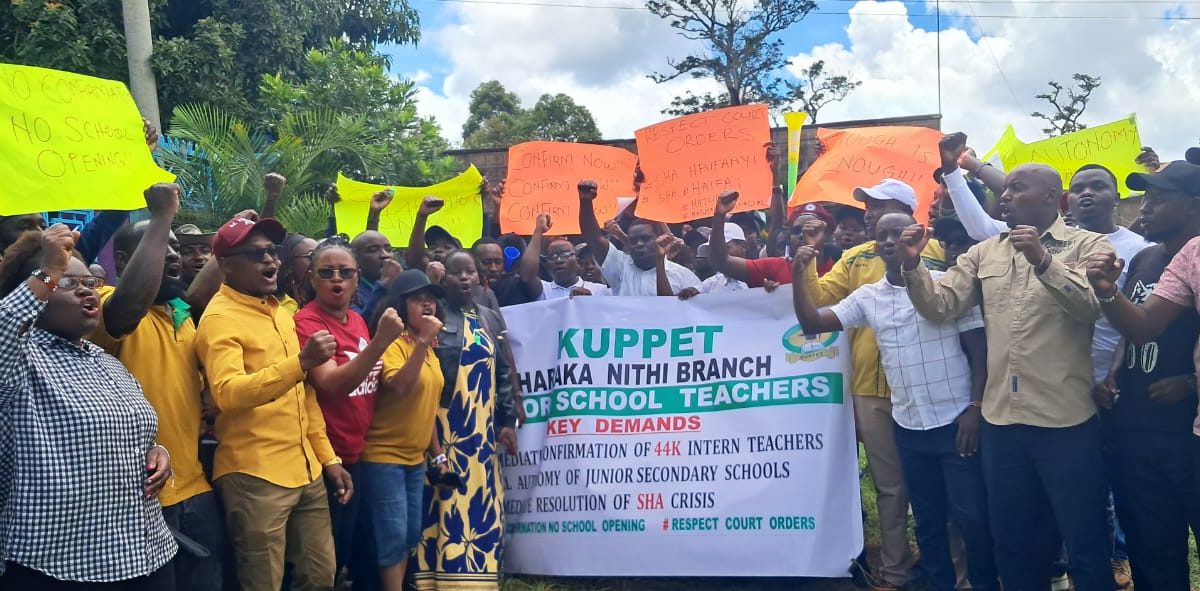
Junior Secondary School (JSS) teachers in Tharaka-Nithi County Monday protested bitterly alleging pay disparities, lack of job security, poor health coverage, and structural challenges in implementing the Competency-Based Curriculum (CBC).
The teachers who met at Dagani near Chuka university to discuss issues affecting them warned of a possible boycott of classes if their grievances are not urgently addressed.
Tharaka Nithi, Kenya Union of Post Primary Education Teachers (KUPPET) Executive Secretary James Jebiu backed the protest while also terming the ongoing teacher internship programme illegal.
He called for the immediate confirmation of the teachers to permanent and pensionable terms citing a Court of Appeal ruling which declared the Teachers Service Commission (TSC) internship programme unconstitutional.
Jebiu argued that qualified and registered teachers should not be employed under internship terms.“If confirmation is not done by the second term, there will be no learning,” he warned.
Tharaka Nithi branch chairman Missian Mambo raised concerns over the Social Health Authority (SHA) medical cover, saying it has failed to meet teachers’ expectations despite being introduced as a comprehensive health scheme.
Under the SHA framework, teachers are entitled to healthcare services that cover both basic and specialised treatment. However, Mambo said the reality on the ground is different, with teachers being forced to pay out-of-pocket when seeking medical services.
“We are paying for medical cover, yet when we go to the hospital, we are asked to top up. Health is critical and must be prioritized,” he said.
JSS Teachers’ Secretary Gilbert Kithinji emphasised that lack of autonomy remains a major challenge affecting the implementation of junior secondary education. He said JSS should be allowed to operate independently with its own management structures.
“No autonomy, no schools. Junior Secondary must operate independently with its own management,” he said.
According to the teachers, placing JSS under primary school administration has created confusion in leadership, co-curricular activities, and learner transition, with some students reportedly unsure of their level within the education system.
A JSS teacher Caroline Kathure said it is unfair for JSS teachers to earn less than their counterparts on permanent terms despite handling the same workload. “We teach the same lessons, but our pay slips are different. That is discrimination,” she said.
On his part, Mr. Gitonga Mutwiri criticized the Sh17, 000 monthly pay for graduate teachers, saying it does not reflect their qualifications or responsibilities.
“We are professionals and deserve permanent and pensionable employment,” he stated.
By Dickson Mwiti and Christine Ngitori