The Judiciary has proposed a Sh50.7 billion budget for the 2027/2028 financial year to expand access to justice, increase the capacity of courts, accelerate resolution of cases and strengthen the institution’s ability to meet the growing demand for judicial services across the country.
The proposed allocation, which comes against an indicative budget ceiling of Sh30.4 billion, leaves the Judiciary facing a financing gap of approximately Sh20.4 billion, equivalent to 40.2 per cent of the resources it has identified as necessary to implement its programmes and constitutional mandate during the financial year.
Held as part of the public participation process, the forum provided an opportunity for members of the public to scrutinise the proposed Judiciary and Judicial Service Commission budget for the 2027/2028 financial year and the Medium-Term Expenditure Framework for 2027/28 to 2029/30, with views sought on expenditure priorities, resource requirements and planned investments in the justice sector.
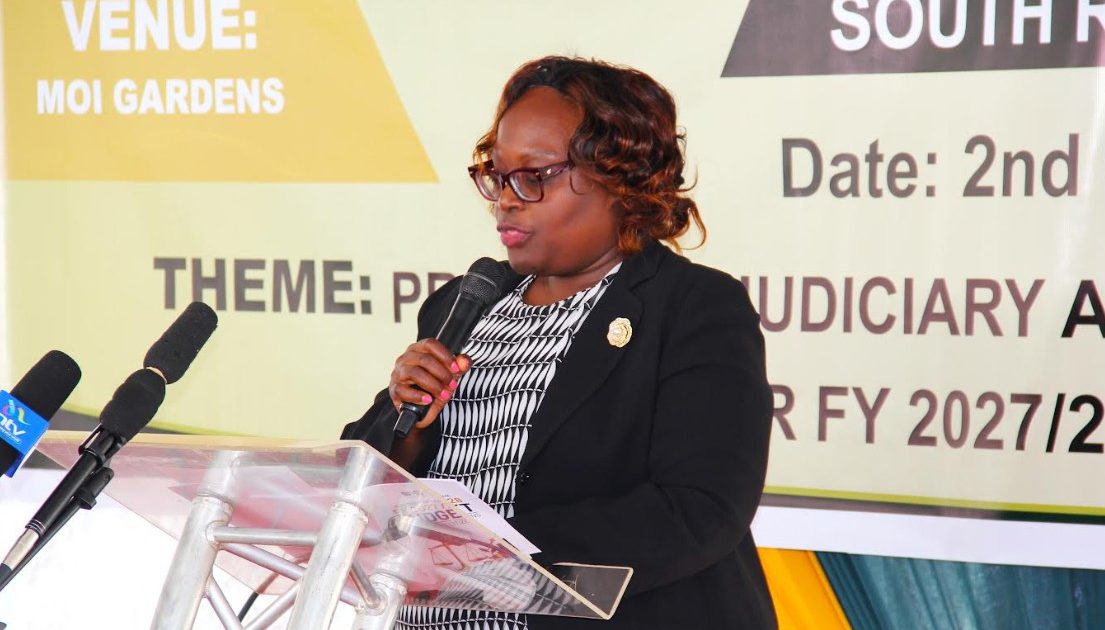
Speaking during the forum at Moi Gardens in Kericho, Registrar of the Environment and Land Court Rose Wakungu delivered a speech on behalf of Chief Registrar of the Judiciary Winfridah Mokaya, who said the public participation process was intended to give Kenyans an opportunity to influence the allocation of public resources towards areas that directly affect access to justice.
“Behind every budget allocation is a citizen seeking justice, a family seeking resolution of a dispute, a survivor seeking protection, a child requiring a safe and responsive justice system, a business seeking to enforce its rights, or a Kenyan looking to the rule of law for protection and certainty,” the speech stated.
Mokaya said presenting the proposed budget to the public was part of the Judiciary’s constitutional obligation to uphold openness, accountability and public participation in the management of public finances, with the exercise providing an opportunity to align spending priorities with the actual justice needs and experiences of Kenyans.
Of the Sh50.7 billion being sought, Sh46.2 billion would cater for recurrent expenditure, while Sh4.5 billion would finance development programmes, covering court operations, human resource requirements, infrastructure, digitisation, information technology, cybersecurity and other investments, aimed at improving justice delivery.
An indicative ceiling of Sh30.4 billion, however, leaves a financing shortfall of about Sh20.4 billion, meaning only about 60 per cent of the proposed resource requirement would be available if the ceiling remains unchanged. Such a gap could affect the pace of implementing planned programmes and capital investments.
For the Judicial Service Commission, Sh1.83 billion has been proposed to discharge its constitutional mandate against an indicative allocation of Sh1.038 billion, leaving a funding gap of approximately Sh795 million, or 43 per cent of its projected requirement.
Beyond the budget figures, the resource constraints have a direct bearing on the judiciary’s ability to establish new courts, widen physical access to justice, modernise its digital systems, secure judicial information infrastructure and recruit and retain personnel as demand for services continues to rise.
Public participation forums held previously have consistently brought forward concerns over case backlog, delays in determination of disputes, long distances to court stations and bottlenecks in succession matters, issues that continue to shape the institution’s expenditure priorities.
Addressing these concerns has seen resources channelled towards expanding the court network and strengthening human resource capacity, with the aim of bringing judicial services closer to communities while increasing the number of matters courts can handle.
Four new law courts, Yala, Kwisero, Nyakach and Chepkemel, were operationalised during the last financial year, while nine more courts have been lined up for operationalisation in the current financial year.
At the appellate level, Court of Appeal stations were established and operationalised in Kakamega and Meru. The number of magistrates’ courts also rose from 143 to 148, while small claims courts increased from 40 to 55.
Alongside the expansion of physical infrastructure came a larger workforce. During the period under review, 1,182 judicial staff, 124 additional magistrates and 53 judges were recruited to strengthen institutional capacity and respond to the growing workload.
Of the 53 judges recruited, one joined the Supreme Court, 15 were appointed to the Court of Appeal, 24 to the High Court and 13 to the Environment and Land Court.
Improved capacity has been accompanied by stronger case disposal performance, with 576,162 cases resolved during the 2025/2026 financial year against 561,580 new cases filed.
That performance produced a case clearance rate of 103 per cent, meaning courts concluded more matters than were filed during the year, even as a stock of cases carried forward from previous years remains part of the workload.
Digital transformation has meanwhile become an increasingly important component of efforts to improve efficiency, reduce administrative bottlenecks and make judicial services more accessible.
Among the automated processes is succession, with various stages from filing to gazettement now handled through the Case Tracking System and e-Judiciary portal. Integration with Government Press has further streamlined publication processes associated with succession matters.
Another technology-driven intervention, Mahakama Popote, enables judicial capacity to be virtually deployed across court stations experiencing heavier caseloads, allowing additional support to reach areas under greater pressure without necessarily requiring physical relocation of judicial officers.
A total of 22,516 matters were resolved through Mahakama Popote during the last financial year, demonstrating how digital platforms and flexible deployment of judicial resources are being used to address variations in caseloads across court stations.
Sustaining such interventions will, however, require adequate and predictable financing as demand for judicial services grows and preparations intensify for the judiciary’s constitutional responsibilities during the 2027 general election period.
Within the proposed budget, the Sh4.5 billion development component would provide funding for infrastructure expansion and other capital investments, while Sh46.2 billion in recurrent expenditure would support personnel costs, court operations and other recurring obligations necessary to keep the expanded judicial network functioning.
Additional financing would also facilitate the operationalisation of new court facilities, expansion of technological infrastructure, strengthening of cybersecurity systems and provision of personnel and operational support required by an increasingly extensive judicial establishment.
Growing reliance on digital platforms and interconnected information systems to manage cases and judicial records has simultaneously elevated cybersecurity and information-system resilience as important components of the Judiciary’s medium-term investment priorities.
Representatives from the judiciary, legal profession, national and county governments, court user committees, judicial staff and members of the public attended the Kericho forum, creating a platform for stakeholders to scrutinise the proposed expenditure priorities and make recommendations.
Wakungu urged participants to submit views that would help refine the proposed programmes and strengthen the budget before it proceeds through the relevant stages of the public finance process.
She said the views collected through the consultations would inform the Judiciary’s strategic priorities and resource allocation decisions, with emphasis on directing available resources towards expanding access to justice, reducing delays, improving efficiency and strengthening accountability in the administration of justice.
By Gilbert Mutai