

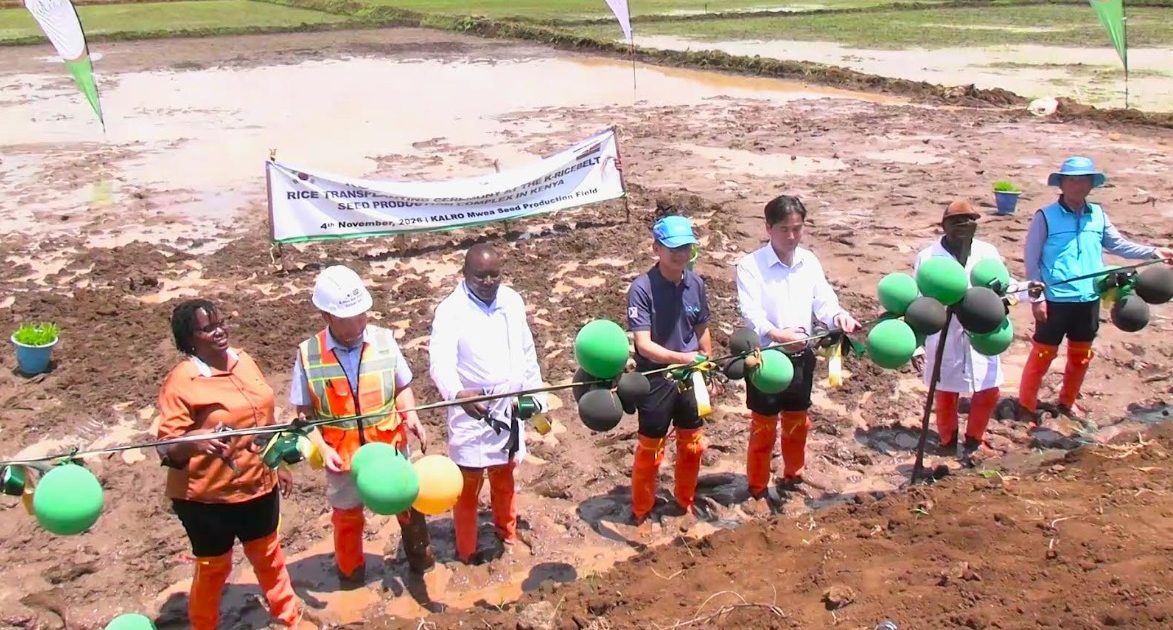
The Kenya Agricultural and Livestock Research Organization (KALRO) has stepped up efforts to boost the production of certified rice seed in a move aimed at increasing local rice production and reducing the country’s dependence on imports by 2032.
Implemented at KALRO’s Mwea Centre in Kirinyaga County, the initiative involves the development of 65 hectares of paddy fields for certified rice seed production, with the first phase covering 7.2 hectares.
The project is expected to significantly increase the availability of quality rice seed to farmers, improve yields and support the government’s ambition of reducing imports.
Speaking during the maiden transplanting exercise, KALRO Director of Crop Production and Seed Systems Benjamin Kivuva described the development as a major milestone in addressing the shortage of certified rice seed in the country.
He said Kenya had for years faced inadequate supplies of certified rice seed, limiting farmers’ ability to maximise production.
“The maiden transplanting of rice seedlings at this rice seed production complex is a great milestone in certified rice seed production. We are opening the first 7.2 hectares for the production of certified rice seed, which will significantly improve its availability to farmers,” said Kivuva.
He noted that KALRO intends to increase certified rice seed production from 152 metric tonnes to approximately 450 metric tonnes, representing nearly a threefold increase.
Kivuva added that improving access to certified seed, expanding land under rice cultivation and investing in irrigation and rain-fed production systems would be critical to achieving national rice self-sufficiency.
“We are importing about 70 percent of rice in this country, producing around 25 percent, this project will go a long way to reduce that importation to maybe around 50 percent. And when it is complete, we might eradicate importation of rice in this country. There is a plan by 2032: we will produce a sufficient amount of rice for this country, and we will stop importing,” he said.
Kivuva attributed part of the progress to collaboration with South Korea, which is supporting Kenya’s efforts to address challenges in rice production and improve the country’s capacity to produce sufficient food locally.
At the Mwea Centre, KALRO Industrial Crops Research Institute Director, Dr Ruth Musila, said the organisation is developing 65 hectares of paddy fields at the Kirogo Farm to support certified rice seed production.
She said approximately 38 acres had so far been developed, with rice transplanting taking place on about 18 acres during the current phase, focusing on improved, high-yielding rice varieties capable of producing 6 to 7 tonnes per hectare under suitable conditions.
Among the varieties being promoted is Kwomboka, one of KALRO’s flagship rice varieties.
Musila emphasized that access to quality seed was one of the most important factors in improving agricultural productivity, warning that farmers using poor-quality planting material risked recording low yields.
“We are ensuring that we produce high-quality seed that is free from diseases and pests and has a high germination percentage. We are also collaborating with the Kenya Plant Health Inspectorate Service (KEPHIS) to ensure farmers receive quality seed,” she said.
She added that farmers who use certified rice seed could achieve yields that are 15 to 20 per cent higher than those using recycled farm-saved seed, urging them to embrace certified varieties to improve productivity and incomes.
The project is also receiving technical support from South Korea through the Korea Partnership for Innovation of Agriculture (KOPIA).
KOPIA Director Dr JiGang Kim said the partnership had supported the development of fields suitable for mechanized rice seed cultivation, with the aim of increasing the volume of certified seed available to farmers.
He said the development of the rice fields had been completed as part of the project’s infrastructure component, with a target of producing 330 metric tonnes of certified seed this year.
“We hope to increase the volume of certified seed and contribute to raising rice self-sufficiency in Kenya,” said Kim.
He observed that while farmers in Mwea had considerable experience in rice cultivation, there was still a need to strengthen their technical skills and introduce improved production technologies.
Kim said the partnership was also considering expanding its support to other parts of the country to improve rice cultivation technology and productivity beyond the Mwea region.
For local farmers, the increased availability of certified seed is already making a difference. Lucy Njeri, a rice farmer in Mwea, said KALRO’s presence had improved farmers’ access to affordable planting materials, which had previously been difficult to obtain.
“Earlier, it was very hard to get seeds. But when KALRO came and started providing us with seeds, we were able to buy them at affordable prices,” she said.
Njeri added that access to the improved seed had helped farmers increase their harvests while making it easier for them to afford planting materials for subsequent seasons.
By Mutai Kipng’etich


