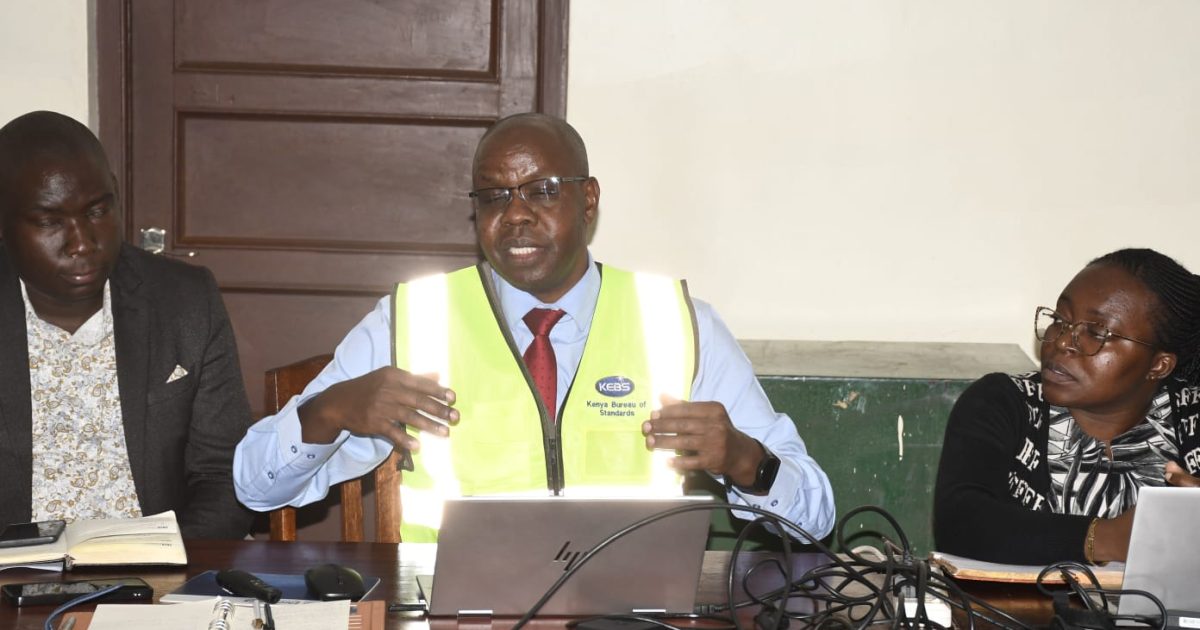
The Kenya Bureau of Standards (KEBS) is in the process of establishing product testing and equipment calibration laboratory units in Kericho town to bring quality services closer to manufacturers, health facilities, farmers and other consumers in the South Rift region.
Deputy Director, Standards, Research and Regulations (SRR) at KEBS, Eng. Josephat Bangi said the proposed facilities would reduce the need for manufacturers and other users to transport samples and measuring equipment to Nakuru or Nairobi for testing and calibration.
Eng. Bangi said the planned facilities would benefit the tea processing industry, dairy farmers and small and medium enterprises (SMEs), while helping protect consumers from substandard and potentially harmful products.
He spoke while presenting a KEBS departmental report during the National Government Development-County Implementation Coordination and Management Committee (NGD-CICMC) meeting, which was chaired by Kericho County Commissioner Mr Omari Ali.
Bangi said KEBS had already established laboratories in Nakuru to cover such areas as temperature, pressure, density, food, agriculture, chemistry and microbiology and was in the process of replicating similar facilities in Kericho.
He added that the planned Kericho laboratories present a potential boost to the county’s manufacturing and agricultural sectors by cutting the distance between producers and quality assurance services.
“What this will mean is that then we will facilitate trade. The people of Kericho will be safe, noting that the laboratories would enable products manufactured in the county to be tested closer to their source, especially black and orthodox tea, analysed more conveniently before they reach consumers and external markets, “Bangi said.
He said the proposed facilities would be particularly important to the tea industry, where temperature and pressure measurements are critical during processing because incorrect temperatures are capable of compromising the quality of tea.
The KEBS official also linked the planned investment to public health, saying properly calibrated equipment was critical in hospitals because inaccurate readings could lead to wrong diagnoses or wrong medication dosages.
He cited medical equipment used to measure temperature, blood pressure, blood sugar, weight, small volumes of medicine and other vital measurements, warning that inaccuracies could expose patients to serious risks.
Bangi gave the example of incubators used for premature babies, saying inaccurate temperature measurements could have devastating consequences, while properly calibrated equipment helps health workers obtain reliable readings and administer appropriate care.
He said KEBS was also concerned about the accuracy of equipment used in laboratories, including centrifuges and instruments for measuring small volumes, stressing that even the amount of medicine administered to a patient depends on accurate measurements.
Bangi said KEBS also carries out market surveillance after products have been certified, including taking samples from shops and supermarkets for laboratory analysis to establish whether manufacturers continue to comply with required standards.
According to KEBS, market surveillance is intended to ensure products in the Kenyan market meet approved standards and do not endanger health, safety or the environment, with enforcement measures available against non-compliant products.
The initiative is also expected to support Small and Medium Enterprises (SMEs), which Bangi described as an important engine of economic growth but face challenges in accessing standards, testing facilities and the financial resources required to comply with quality requirements.
Under the arrangement outlined by Bangi, KEBS would absorb the cost of factory inspection and testing for qualifying small enterprises while providing technical guidance and mentorship to entrepreneurs who lack the expertise needed to bring their products to the required standards.
Bangi said standardisation would also enable locally manufactured products such as wheelbarrows, windows, pangas and jembes to be made to consistent specifications, making them easier to trade, repair and source for replacement parts across the country.
Bangi said a KEBS quality mark gives consumers confidence that a product has met applicable standards while helping manufacturers demonstrate compliance when seeking access to wider markets. KEBS says its certification framework is designed to support industry and facilitate trade through recognised standards and conformity assessment.
The meeting held on Wednesday this week at the CC’s boardroom was attended by among others, the regional and county departmental heads and National Government Administrative Officers(NGAO).
By Dominic Cheres