Kenya is stepping-up efforts to cement its position as Africa’s digital connectivity hub, with the government calling for deeper partnerships with global technology companies, to expand broadband access, strengthen local technical expertise and accelerate the continent’s digital transformation.
Principal Secretary (PS) for Broadcasting and Telecommunications, Stephen Isaboke, said Kenya’s emergence as a service and knowledge-based economy had made digital infrastructure a critical pillar of national development.
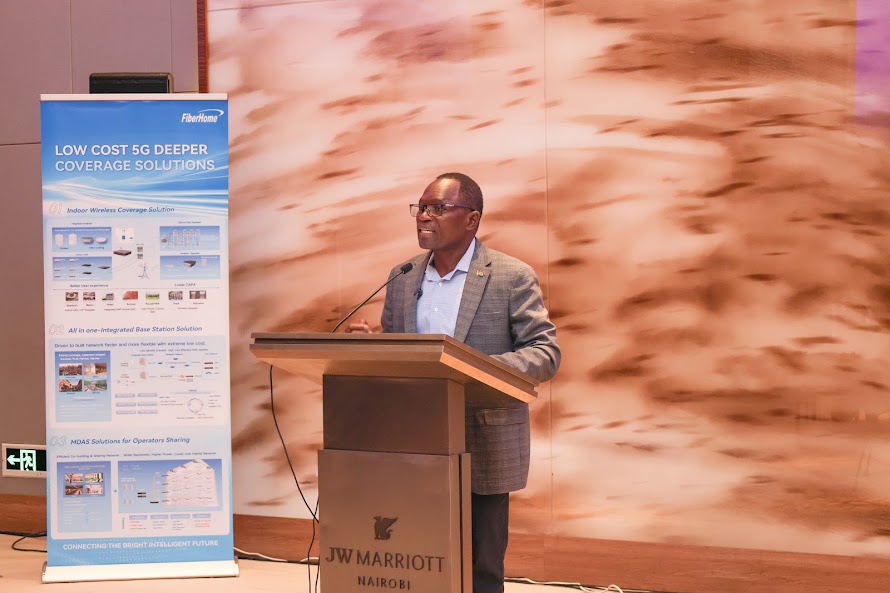
Speaking at the FiberHome World Tour Workshop 2026 in Nairobi, attended by more than 100 representatives from Kenya’s telecommunications industry, Isaboke said the partnership was proof that foreign investment can deliver real, visible impact for ordinary Kenyans.
A key priority is the government’s ambitious 100,000-kilometre national fibre network, which forms part of the country’s broader Digital Superhighway programme. The plan also targets the establishment of 1,450 digital hubs across the country.
“People have seen what Kenya is doing,” Isaboke said, citing discussions at a recent African Telecoms Union meeting in Abuja, Nigeria, where other countries outlined major fibre expansion plans.
Nigeria, he noted, has announced plans to build 90,000 kilometres of fibre, while other African countries are targeting networks ranging between 40,000 and 70,000 kilometres.
Isaboke described broadband infrastructure as a “digital superhighway”, saying reliable connectivity would be essential to the deployment of emerging technologies such as artificial intelligence, the Internet of Things and autonomous systems.
He said applications including driverless vehicles, remote operations and AI-powered services would require reliable, high-capacity and low-latency networks.
“The digital superhighway is the next thing,” he said, warning that inadequate connectivity could leave millions of young Africans excluded from opportunities created by the digital economy.
Kenya has established itself as one of East Africa’s leading digital economies, supported by widespread mobile connectivity, growing broadband access and a mature digital services ecosystem.

Data from the Communications Authority cited at the workshop showed that Kenya had 58.5 million data subscriptions and smartphone penetration of 83.5 per cent as of June 2025.
The government’s agenda includes universal broadband coverage, faster 4G and 5G deployment, resilient optical networks and efforts to reduce the cost of operating digital infrastructure.
Isaboke said 4G already carries more than 80 per cent of national broadband traffic, but acknowledged that challenges remain, particularly the high cost of last-mile deployment, unreliable grid power and rising demand for cloud connectivity.
Beyond infrastructure investment, Isaboke called for technology partnerships that deliver long-term benefits through skills development, technology transfer and greater participation by Kenyan companies.
He cited training programmes that have enabled Kenyan engineers to travel to China for practical exposure to advanced telecommunications technologies.
The government, he said, wants young Kenyan engineers to acquire skills that enable them to compete internationally and eventually design, deploy and maintain advanced technologies locally.
FiberHome International Technologies, which was established in Wuhan, China, in 1974, entered the Kenyan market in 2017.
The company says its annual business volume in Kenya has grown from approximately US$5 million in 2017 to about US$30 million today, representing a sixfold increase.
FiberHome Southern Sahara Africa CEO, Keller Yun, said the growth reflected the company’s expanding role in Kenya’s telecommunications and digital infrastructure sector.
The company says its operations are built around a local-first go-to-market model, with major deployments delivered through Kenyan system integrators.
According to FiberHome, the approach is intended to build local technical capacity, accelerate project delivery and provide long-term in-country support.
One example is the ICT Authority’s Last Mile County Connectivity Project, under which FiberHome and its local partners connected public institutions and community facilities in Kwale County.
The project linked facilities, including government offices, police stations, education institutions, youth centres, registration offices and vocational training facilities across Kinango, Msambweni, Diani, Ukunda and Lungalunga.
FiberHome said several sites achieved same-day commissioning, enabling immediate access to public e-services and high-speed Wi-Fi.
The Company has also worked with the Kenya Pipeline Company, deploying Distributed Acoustic Sensing technology that uses existing fibre infrastructure along oil pipelines as a continuous early-warning system for potential interference.
Yun described Nairobi as a leading African digital centre and said Kenya’s 100,000-kilometre Digital Superhighway ambition could provide a model for other countries seeking to expand broadband connectivity.
Also present were FiberHome International President, Kevin Liu and FiberHome Africa CTO, Michel Wang, part of a growing list of Chinese tech leaders betting big on Kenya’s digital future.
By Joseph Ng’ang’a