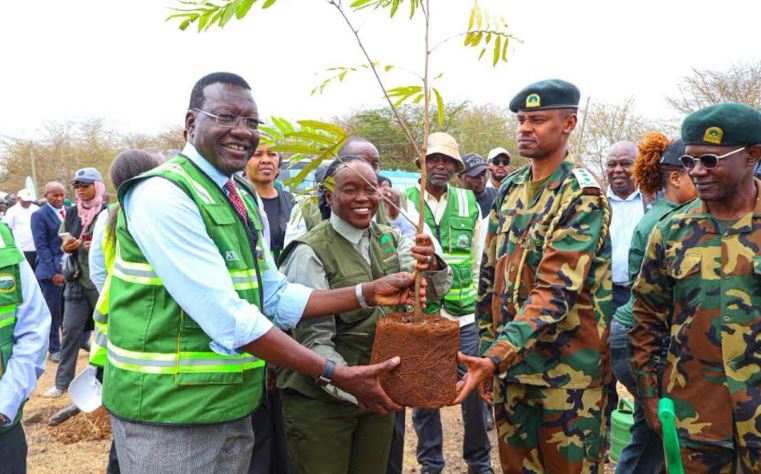
Kenya has intensified nationwide tree-planting and environmental restoration activities, ahead of Mazingira Day 2026, with government agencies, schools, conservation organisations and local communities joining forces to accelerate the country’s ambitious target of planting 15 billion trees by 2032.
Hundreds of thousands of seedlings have been planted across counties as the Kenya Forest Service (KFS) spearheads efforts to restore degraded landscapes and advance the 15-billion-tree target by 2032.
KFS, which is coordinating several of the initiatives alongside government institutions and conservation partners, said the activities are aimed at restoring degraded landscapes, protecting water catchments, conserving biodiversity and promoting environmental stewardship.
KFS in a statement said that the campaign has also extended to major transport corridors, with 10,000 trees planted along the Eastern Bypass under the Mazingira Highway Greening initiative led by Transport Cabinet Secretary Davis Chirchir and Environment Cabinet Secretary Deborah Barasa.
Across the country, schools, wetlands, forests, farms and public institutions have emerged as key sites for the tree-growing drive, with a mix of indigenous, fruit, bamboo and other suitable species being planted to strengthen environmental conservation and support community livelihoods.
In Embu County, the Eastern Conservancy recorded significant activity at Jeremiah Nyaga National Polytechnic, where 4,000 Grevillea robusta seedlings were planted across eight hectares in partnership with KCB.
Additional planting exercises were conducted in Embu North, Embu West, Mbeere North and Mbeere South, involving schools, farms and institutions. The seedlings are expected to support woodlot establishment, boundary planting and conservation efforts.
In neighbouring Kirinyaga County, the Central Highlands Conservancy planted 700 seedlings at Ngaru Primary School, with KFS providing seedlings and technical guidance to support their establishment and maintenance.
The North Rift Conservancy also stepped up activities in West Pokot County, where fruit trees were planted at Chepkorniswo Primary School, while seedlings were distributed to Chepkorniswo Boys High School, Kodos Primary School, Rosary Girls School and Ortum Boys High School.
In Nairobi’s Dagoretti area, three primary schools — Lenana, Kabiria and Muthangari — established fruit-tree woodlots featuring avocado, banana, orange, passion fruit and guava seedlings. The projects are expected to provide long-term environmental and nutritional benefits to learners and surrounding communities.
The Nyanza Conservancy recorded substantial planting activities in Kisumu and Kisii counties, with Ohen Primary School in Muhoroni receiving 3,684 assorted fruit-tree seedlings through a partnership with Menara Self-Help Group.
In Kisii County, 3,000 Markhamia lutea seedlings were planted at Nyanchogochi Primary School, while Getuki Primary School received 1,000 assorted seedlings. Another 500 seedlings were planted at Kebere Primary and Secondary Schools to support woodlot establishment and strengthen conservation within learning institutions.
In Vihiga County, the Western Conservancy oversaw the planting of 2,500 assorted seedlings at the Inavi Block of Maragoli Hills Forest. The exercise brought together KFS, the Community Forest Association and Vihiga Technical Colleges.
Meanwhile, the Northeastern Conservancy planted 600 trees, including neem and fruit trees, at Korakora Primary School in Garissa County as part of efforts to rehabilitate the site.
The activities brought together a broad range of stakeholders, including the National Environment Management Authority (NEMA), Kenya Rural Roads Authority (KeRRA), Kenya Forestry Research Institute (KEFRI), Kenya Wildlife Service (KWS), national government administration officers, the Ministry of Education, the Kenya Red Cross, Botanical Brigadiers and local communities.
Beyond schools and terrestrial forests, the campaign has extended to ecologically sensitive areas, including mangrove ecosystems and wetlands.
In Kwale County, 3,075 Rhizophora mucronata mangrove propagules were planted at Gazi-Uwanja wa Nguruwe through an enrichment exercise involving KFS and other stakeholders.
In Nyeri County, KFS partnered with the Kenya National Highways Authority (KeNHA), the county government, NEMA, KEFRI, national government administration officers, STECOK and Nyeri National Polytechnic in roadside greening activities aimed at creating green corridors, reducing soil erosion and improving the resilience of transport infrastructure.
In Meru County, KeRRA led the planting of 2,100 bamboo seedlings at Kambakia Wetlands. The exercise also included a clean-up campaign to protect a water source serving more than 50,000 people.
The activity was attended by Deputy County Commissioner representative Benson Mbithi and KeRRA Meru County Director Moses Asugo, among other participants.
In Nairobi, KFS partnered with Friends of Karura to organise tree planting, a guided forest walk, conservation trivia and individual pledges to support environmental protection at Karura Forest.
The exercise was led by Munene Edward, overall in-charge of the Karura Forest Ecotourism Facility; Maina, Karura Forest Station Manager; and Peter Njui, operations manager at Friends of Karura.
The activities highlighted the role of public participation in protecting forests and encouraging communities to take greater responsibility for the environment.
As the country prepares to mark Mazingira Day under the theme “Our Environment, Our Responsibility: Collective Action for Tree Growing and Environmental Stewardship”, KFS is calling on Kenyans to participate in planting, nurturing and protecting trees.
The nationwide campaign seeks to ensure that tree-growing efforts translate into lasting environmental benefits, with survival and maintenance of seedlings remaining essential to restoring ecosystems and achieving the national target of 15 billion trees by 2032.
By Joseph Ng’ang’a