The Kerio Valley Development Authority (KVDA) has launched sustainable water and irrigation projects in West Pokot County alongside distribution of mango seedlings in a bid to improve livelihoods, enhance food security, and strengthen climate resilience in the Arid and Semi-Arid region.
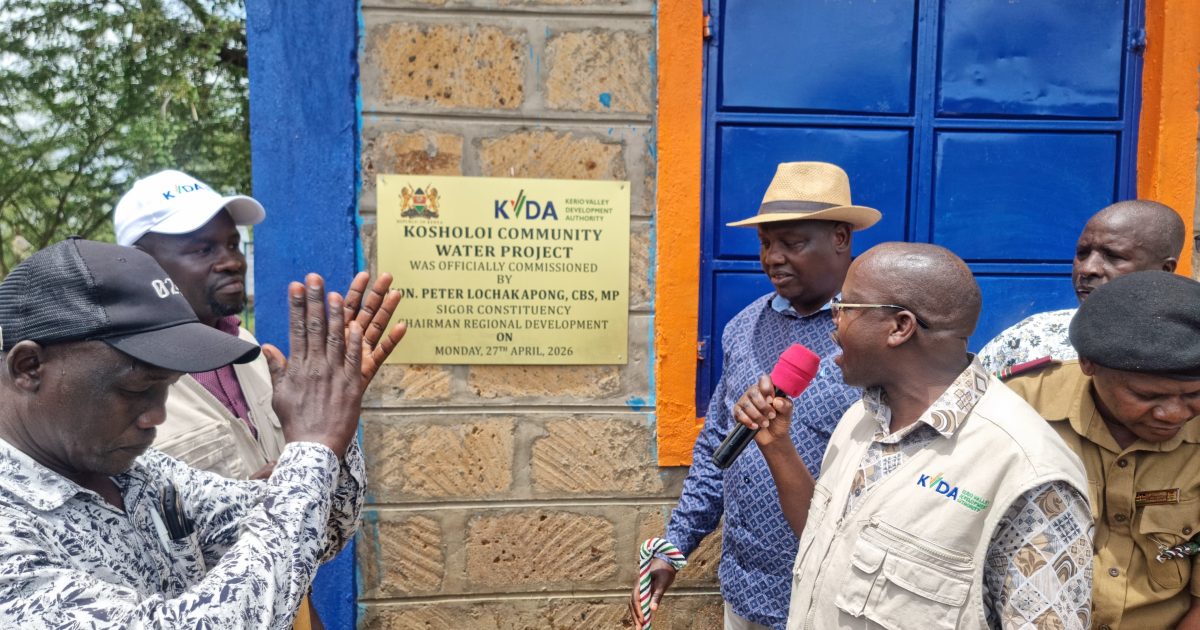
The projects include the commissioning of boreholes in Kosholoi and Kimanau villages, launching of Pachu water pan, distribution of 30,000 mango seedlings under the WeiWei irrigation scheme, and provision of 55 solar-powered water pumps worth Sh9 million to support farming.
Speaking during the launch in Sigor Constituency, KVDA Ag Managing Director Moses Kipchumba said the authority ,under the Ministry of East African Community, ASAL and Regional Development, is committed to transforming livelihoods through sustainable water and agricultural projects.
He said KVDA has implemented more than 33 development projects across West Pokot, focusing on improving access to clean water for domestic and agricultural use.
“At Kasholoi, we have launched a borehole producing over 5,000 litres of clean water per hour. The water has been tested and confirmed safe for domestic use, and will significantly improve the quality of life for residents,” Kipchumba said.
He added that the authority is working closely with communities to promote food security and environmental conservation, including the distribution of fruit seedlings to restore degraded landscapes, particularly along the fragile escarpments.
“These interventions will enhance nutrition, improve food security and create income-generating opportunities through fruit farming,” he said.
Kipchumba noted that farmers are also being supported with capacity-building programs and solar-powered irrigation systems to enable year-round farming through river water abstraction.
He further said that since 2023, KVDA has invested Sh1.4 billion in development projects in West Pokot County, benefiting more than 200,000 residents through initiatives such as the Weiwei Irrigation Scheme.
KVDA Chairman Mark Chesergon said the authority is committed to ensuring effective implementation of government development projects to improve livelihoods in ASAL regions.
He said the government’s goal is to ensure that residents in marginalized areas live dignified lives comparable to other parts of the country through access to water, food production, and income-generating activities.
Sigor Constituency MP Peter Lochakapong welcomed the projects, noting that they have significantly eased water shortages in the region.
He said residents who previously walked long distances in search of water now have reliable access for domestic use and livestock, adding that the projects will also reduce resource-based conflicts in the area.
Lomut Ward, Member of County Assembly (MCA) Jacob Tuong’ole expressed relief, saying the availability of clean water will improve livestock health, enhance productivity, and reduce waterborne diseases.
However, he called for additional intervention, including the construction of dams for rainwater harvesting and expansion of water projects to other underserved areas.
Village elder King’olia Topero of Kosholoi said residents had endured severe water shortages since independence, often walking over 10 kilometres in search of water.
“We thanked the government for this support, but we also requested the construction of dams to harvest rainwater during the rainy season,” he said.
Pastor Pauline Ruto said the projects will benefit households, churches, and schools, noting that women had previously suffered due to long distances travelled to fetch water.
She called for more boreholes to be drilled to serve additional villages and support kitchen gardening and small-scale farming.
Masol called for more boreholes to be drilled to serve additional villages and support kitchen gardening and small-scale farming activities.
Masol Ward Chairlady, Jeparng’er Ng’okumur, also thanked KVDA, saying residents had for long relied on unsafe water sources shared with animals.
She said the new water projects mark a major improvement in access to clean and safe water in the area.
By Anthony Melly