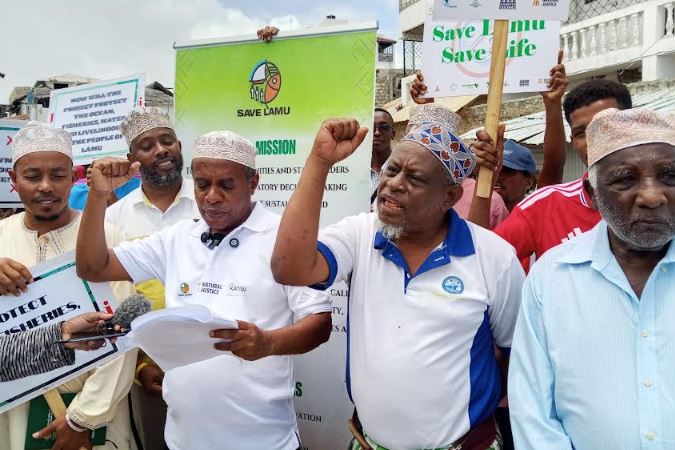
A civil society group based in Lamu County, Save Lamu, has called on the government and the proponents of the proposed Dangote Lamu oil refinery to publicly table documents as proof that the law was followed before the construction moves any further.
Save Lamu Secretary General Mohammed Athman stated that in May, businessman Aliko Dangote said he did not know Lamu, yet four months later he joined President William Ruto to break ground on what they described as one of the largest industrial developments ever proposed in Kenya.
He further noted that the President had promised full government support, adding that the national government will go out of its way to ensure no delays from “administrative bureaucratic stuff“.
Sentiments echoed by Lamu County governor Issa Timamy, who in his remarks at the groundbreaking, they said, questioned the groups and individuals who had fronted court challenges over the project.
Athman, who was flanked by a section of activists drawn from the Lamu Arts and Theatre Alliance, the Lamu Women Alliance and displaced farmers from the Kwasasi area, which is part of the land where the Dangote Oil Refinery construction is being carried out, made claims that the national government had bypassed the public in giving the Aliko Dangote the go-ahead to build his oil refinery venture in Lamu at the Kwasasi, Magogoni area, which he alleged still had landowners who had yet to be compensated.
The NGO official, however, made it clear that they are not opposed to industrialisation or foreign investment but instead criticised the government for not following the law in setting up the Lamu project.
“It is on public record that between May and September is when the decision to set up the Dangote Oil Refinery was hatched, and yet during that period due process was not followed, even by the county government who are custodians of land for the people,” he said.
In a press statement provided by Save Lamu, they cited Articles 10, 35, 42, 69, 70 and 201 of the Constitution, which cover transparency and accountability, access to information, public participation, environmental protection and the accountable use of public money.
The press statement further stated the public had so far seen none of the documents that would show these obligations had been met.
The Dangote Oil refinery project is set to be established in the expansive 7,000 acres of Kwasasi and Magogoni land with which they plant, which will process 700,000 barrels of oil, while also producing a 1,000 MW power plant.
Athman further said no project-specific Environmental and Social Impact Assessment (ESIA) has been published and there is no public record of a NEMA licence or its conditions for the project.
The Save Lamu official revealed that they would be giving the national government, together with the Dangote Oil Refinery, 14 days to respond to fears that Lamu residents have over the establishment of the refinery, or else they will also be proceeding with legal action to get the court’s interpretation of the events that have so far taken place.
“Save Lamu have yet to lose a case that questions the manner in which mega projects are proposed and set up in Lamu, with our organisation winning the landmark 1.76 billion fishermen compensation over loss of fishing grounds when the Lamu Port was set up and by ensuring the Amu Coal Plant was not set up on environmental assessment concerns,” Athman said, adding that the Dangote Oil refinery may well lose their bid to set up in Lamu on the ground that the residents have not been adequately consulted and involved in the process.
Sentiments echoed by Abubakar Twalib, a member of the Amu Beach Management unit and chairman of the fishermen dealers’ association, who questioned the national government’s plans to establish the Dangote oil refinery without explaining or accessing the full ramifications of how the project was likely to affect day-to-day livelihoods of Lamu residents.
“The Dangote Oil Refinery will cover 6000 metres into the Lamu open sea, and yet no one is telling us how the transportation of crude oil over our fishing grounds is likely to affect fishing going forward,” Twalib said.
He further stated that the movement of crude oil is likely to have an impact not only on the fishing grounds but also on the land occupied by Lamu residents already, with pastoralists likely to be affected as well,” he said.
“The county government has decided to go against the rights of the people they claim to represent by allowing landowners to be displaced without compensation, with those opposed to the manner in which the process has taken place being branded enemies of progress,” said Ali Hassan, Lamu Arts and Theatre Alliance coordinator.
He admonished the county government for failing to adequately represent the needs of the Lamu people, citing the youth, whom he said are likely to be shortchanged in terms of getting jobs once the oil refinery becomes operational.
“So far the information coming from both the national and county government has been lacklustre and very general in terms of the benefits that the Dangote Oil Refinery will have for Lamu people, with there being the promise of 1,000 scholarship positions for youths who could be employed at the Lamu Dangote Oil Refinery,” he said.
Hassan said that proponents of the project have so far been non-committal about the actual benefits, failing to specify who will benefit and in which sector.
On her part, Kwasasi landowner Amina Mohammed said that she had been displaced, and so far there had been no word on the way the will be compensated.
“It is unfortunate that some of us as cashew nut farmers have lost out trees with no compensation in sight,” Amina said.
By Amenya Ochieng and Victoria Kitina