Years of unexplained symptoms, misdiagnoses and blood clots eventually led to a devastating discovery for Teresa Wangui.
For Wangui, illness began quietly.
As a child growing up in Aguthi Ward, Gichira Sub-location, Nyeri County, she was an ordinary schoolgirl, determined to complete her education. But in Class Seven, something began to change.
“I started to feel sick. That’s when I started to go to the hospital,” Wangui recalls.
The symptoms were difficult to explain. She suffered from bloating and stomach problems and was treated first for ulcers and later for acidity. At times she felt better, only for the symptoms to return.
The illness interfered with her schooling. She eventually completed secondary education in 2012 and took on different jobs, including working in hotels, as she tried to build a life while living with recurring health problems.
Then, in early 2018, everything changed.
Wangui had become pregnant when she woke one day in severe pain. She took painkillers but soon became dizzy and increasingly unwell.
At a nearby health facility, she was treated for dehydration and given fluids for several days.
But dehydration was not the problem.
Her legs began to feel weak and cold. Severe pain made walking increasingly difficult. She returned to hospital several times as doctors tried different treatments.
One laboratory test suggested arthritis, prompting a change in medication. Her condition continued to deteriorate.
She was eventually admitted to hospital and told she had suffered a stroke.
“Further investigations found blood clots, including a clot affecting my eye and another in my brain,” Wangui recalls.
While the clot-related complications were treated, the crisis in her legs continued. She lost sensation and mobility.
Then she noticed something frightening.
“My leg started to change colour. It began to turn black,” Wangui remembers.
Doctors told her the affected tissue was no longer viable. Her family sought a second medical opinion, but the options were narrowing.
She was eventually referred to Kenyatta National Hospital, where doctors reviewed her history and carried out further investigations.
Scans, Wangui was told, had revealed severe problems involving her blood vessels and blood clots. Doctors explained that removing the clots posed serious risks.
Amputation had become the only feasible option.
“I thought I was going to die.”
The missing clues
For Wangui, accepting the recommendation was almost impossible.
She had spent years trying to understand what was happening to her body. Now she was being asked to agree to an operation that would permanently change her life.
“I went into denial.”
A counsellor spoke to her while doctors continued explaining why the operation was necessary. Eventually, after more conversations with the medical team, Wangui made her decision.
“I told the counsellor, I will sign.”
The operation followed days later.
When she regained consciousness, the reality of what had happened began to sink in. Back in the recovery ward, she remembers uncovering the hospital linen from her waist downwards and confronting the loss of both legs.
“I started to feel very sad,” she recalls, fighting tears. “It was very traumatising.”
The physical change was only part of the challenge. Wangui now had to confront the psychological impact of losing both legs and the prospect of depending on a wheelchair.
For a time, sadness overwhelmed her.
“I didn’t feel any pain. I didn’t feel any heat. The only thing I felt was sadness and hatred.”
Counselling and support from people around her helped her begin the long process of recovery. Her mother, Rose Muthoni, became one of her principal caregivers, helping her with daily needs after she returned home.
“It was not easy at all, but she helped me a lot. So after a while, I started healing slowly,” Wangui remembers.
But returning home brought another difficult reality: the cause of her illness was still unknown.
A hard diagnosis
For years, Wangui and her family had seen individual pieces of a much larger puzzle — stomach problems, pain, pregnancy losses, blood clots and eventually severe damage to the blood vessels supplying her legs.
The underlying condition remained unidentified.
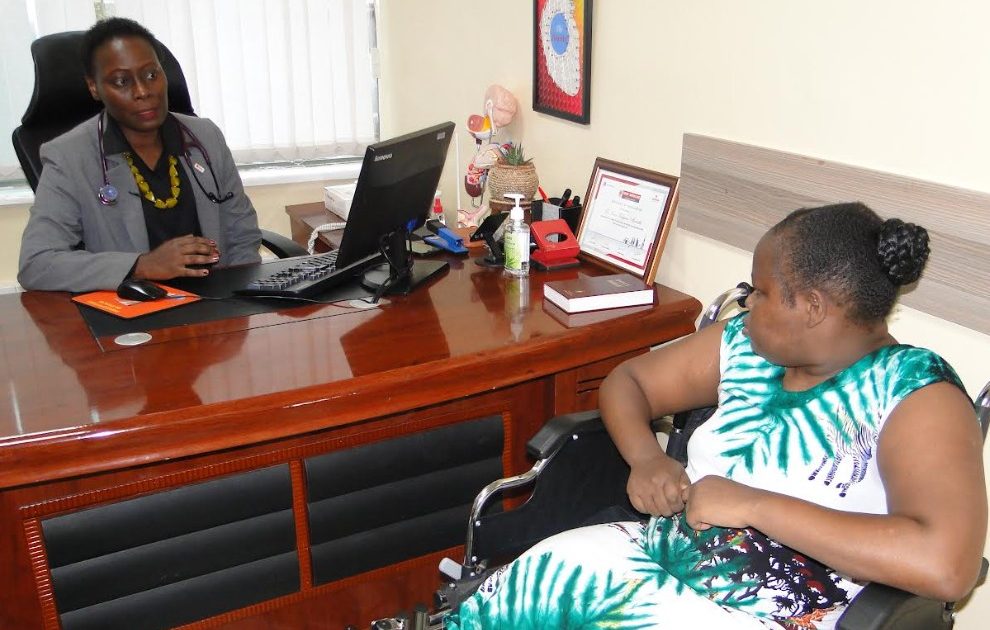
It was only later, when Wambui came under the care of consultant cardiologist Dr Lois Wagana at Outspan Hospital in Nyeri, that doctors began investigating the possibility of an autoimmune disease.
By then, Wangui was using a wheelchair and experiencing widespread pain. She also had a facial rash and appeared physically wasted.
Her history of pregnancy losses and bilateral gangrene raised concern that an autoimmune disorder could be responsible.
Blood tests provided important clues. “Some of the laboratory tests needed include erythrocyte sedimentation rate (ESR) and an antinuclear antibody (ANA),” reveals Dr Wagana.
Wambui’s ESR was significantly elevated, while her ANA test was positive. “A further test for anti-double-stranded DNA antibodies was also positive,” Dr Wagana explains.
Together with Wangui’s clinical history, the findings pointed towards systemic lupus erythematosus, commonly known as lupus.
Lupus is an autoimmune disease in which the body’s immune system mistakenly attacks its own tissues. It can affect multiple organs and systems, including the skin, joints, kidneys, heart and nervous system.
In some patients, the inflammation can involve blood vessels. When inflammation narrows or blocks vessels, tissues beyond the blockage may not receive enough blood and can eventually be damaged.
That process helps explain the severe vascular complications Wangui experienced.
For Dr Wagana, Wangui’s case illustrates why lupus can be difficult to recognise.
The disease does not always announce itself through one obvious symptom. Its manifestations can resemble those of more common illnesses, making it possible for the clues to be treated separately rather than recognised as part of one condition.
Once treatment for lupus began, Wangui’s condition improved. Her pain eased, she gained weight and the facial rash settled.
She is now monitored regularly and receives medication aimed at controlling the abnormal immune response.
Dr Wagana describes her as a patient who has made remarkable progress despite the trauma she has endured.
Life after lupus
Today, Wangui’s life revolves around managing a condition she knows requires long-term care.
She attends regular clinic appointments and seeks medical attention whenever her health deteriorates.
“It is not easy to live with lupus.”
Fatigue remains one of her biggest challenges, with some mornings making it difficult for her to get out of bed.
She has also learnt to protect herself from strong sunlight because of her sensitivity to it. Sunscreen has become part of her daily routine.
Recovery, however, has not meant returning to the life she knew before.
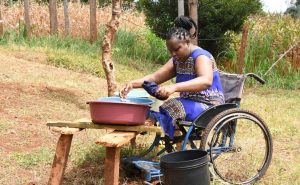
Wangui moves around using a wheelchair and depends on her family for some daily activities. Her mother helps transfer her and ensures that the things she needs are within reach.
Yet she is also rebuilding her independence.
She does some work online and has begun exploring small business activities that could provide an income. She also rears pigs.
Dr Wagana believes Wambui could potentially benefit from an assessment for prosthetic options, although an orthopedic evaluation would first be required to determine whether she is medically suitable.
For Wangui, survival has changed the meaning of what is possible.
The woman who once feared that her illness would kill her now speaks about living with lupus, managing each day and remaining hopeful.
Her faith has played a major role in that journey.
“I really thank God. In fact, the whole story is about God. I can say God has saved my life so much.”
Her experience also carries a warning about a disease that can be difficult to recognise.
Lupus can produce symptoms that resemble those of other conditions. Persistent, unexplained symptoms affecting different parts of the body may require doctors to consider an autoimmune cause rather than treating each complaint in isolation.
For Wangui, the answer came after years of uncertainty — and after irreversible damage had already been done.
She cannot change what happened to her legs.
But she is learning to live with what remains.
By Wangari Ndirangu and William Inganga