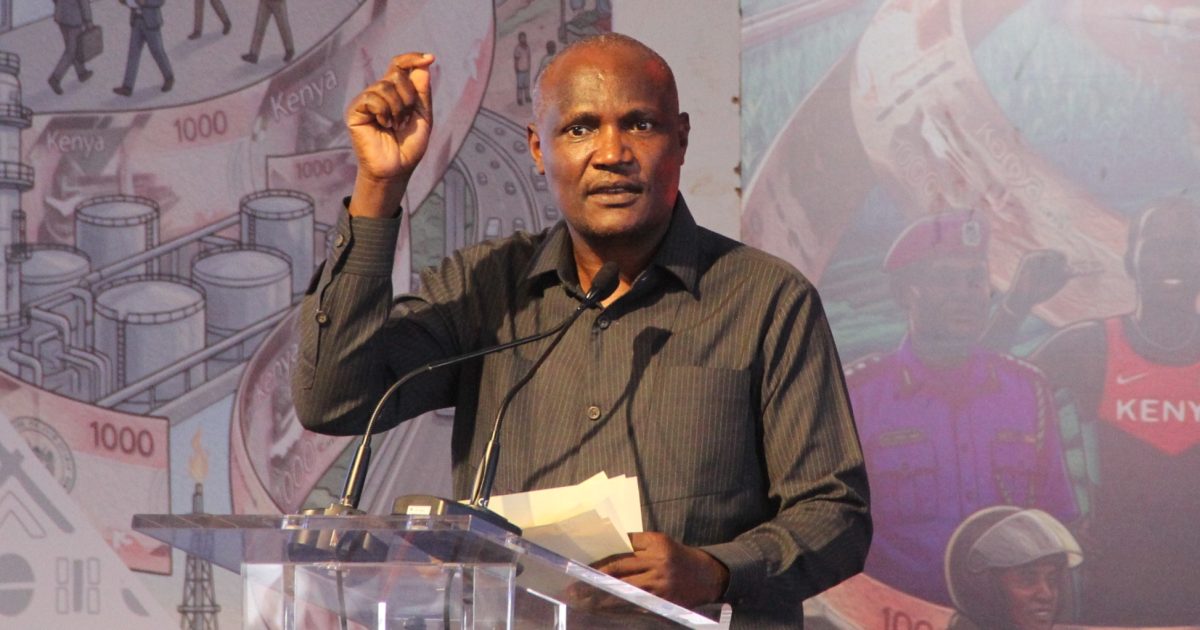
Cabinet Secretary for the National Treasury and Economic Planning John Mbadi has announced plans to introduce an amendment in Parliament to exempt employees earning Sh32,800 and below from Pay As You Earn (PAYE) tax, in a move aimed at easing the financial burden on low-income households.
Mbadi said the proposal, expected to be presented to Parliament in November, was part of the government’s efforts to ensure that the benefits of economic recovery translate into improved livelihoods for ordinary Kenyans.
“In the month of November, we are bringing that amendment to Parliament to tell those Kenyans that we appreciate the sacrifices, however little or however big you have made,” he said.
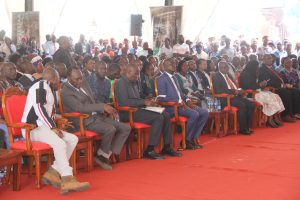
The CS was speaking on Friday at The Eldoret National Polytechnic (TENP) in Eldoret, Uasin Gishu County, where he presided over the opening of the Mashujaa Day 2026 Economy (Finance) Thematic Week, held under the theme “An Economy for the People”.
He also announced that the government was targeting to sustain economic growth at approximately five per cent to create employment opportunities for young people, noting that the economy grew by 5.1 per cent in both the first and second quarters of 2026, compared with 4.6 per cent in 2025.
Mbadi attributed the growth to measures taken by the government to stabilise the economy amid global economic challenges, including pressure on the foreign exchange market and rising international fuel prices.
“It is my firm commitment that we are going to do whatever is possible that we can do to make sure that we steady our economy at about 5% to be able to create job opportunities for our young people,” he stated.
On the cost of living, the CS attributed the recent increase in inflation to rising transport costs, higher wheat prices and reduced milk production associated with the prolonged dry spell.
He observed that the government had maintained Value Added Tax (VAT) on fuel at eight per cent, half the standard rate of 16 per cent, for a further 90 days to cushion consumers against rising fuel prices linked to the conflict in the Middle East.
Mbadi disclosed that the fuel tax relief had resulted in approximately Sh54 billion in foregone revenue over six months, with the amount expected to exceed Sh100 billion over a full year if the relief continued.
“Every Kenyan feels this, from the boda boda rider and the mama mboga, to the farmer taking maize to market and the family that cooks with kerosene,” he noted.
The CS acknowledged that despite improvements in key economic indicators, many households continued to experience financial difficulties, stressing that economic stability alone was insufficient without tangible improvements in living standards.
“Our task in the next phase, together with my team, is to turn stability into prosperity that every household can feel,” he emphasised.
Mbadi further reported that Kenya’s foreign exchange reserves had increased from 2.3 months of import cover in 2022 to 6.1 months, strengthening the country’s capacity to withstand external shocks and meet its international financial obligations.
He added that government borrowing costs had declined from approximately 16 per cent to below nine per cent, while average commercial bank lending rates to the private sector had dropped from 17.2 per cent to 14.4 per cent.
The CS also outlined major road infrastructure projects that the government was pursuing to improve connectivity, facilitate trade and stimulate economic growth, particularly in the Western and Rift Valley regions.
He said the government had worked to find solutions to payments owed to road contractors after construction activities stalled under the previous administration, enabling projects to resume across the country.
Among the projects he highlighted were the Rironi–Mau Summit Road, the Mau Summit–Eldoret–Malaba highway, the South Rift Lake Region Gateway Corridor, the Great Highlands Connections Corridor and the Lake Victoria Ring Road.
Mbadi said the 253-kilometre South Rift Lake Region Gateway Corridor had been finalised with the World Bank, with funding expected the following month and the project scheduled for launch before the end of the year. The road is expected to traverse Nakuru, Kericho, Bomet, Narok and Migori counties.
He added that designs were underway for the Mau Summit–Eldoret–Malaba road, alongside plans for another section through Kisumu.
He also cited the 740-kilometre Isiolo–Wajir–Mandera road as a major project under construction in Northern Kenya, as well as a 245-kilometre economic corridor linking Biretwo, Aror and Chesongoch in Elgeyo Marakwet funded by the African Development Bank.
The CS also cited growth in the capital markets, noting that the value of companies listed on the Nairobi Securities Exchange had risen from approximately Sh1.4 trillion at the end of 2023 to more than Sh4.1 trillion.
On infrastructure financing, Mbadi reported that proceeds from the Kenya Pipeline Company transaction and the partial sale of the government’s Safaricom shares had raised more than Sh310 billion for the National Infrastructure Fund, with over 70,000 Kenyans becoming shareholders.
He explained that the fund would support major infrastructure projects, including the expansion and modernisation of Jomo Kenyatta International Airport and the Nairobi-Mombasa Highway, through partnerships with private investors.
The Treasury CS also highlighted the growth of pension assets from Sh1.8 trillion at the end of 2023 to Sh3.17 trillion in June 2026, describing domestic savings as an important source of financing for national development.
He urged Kenyans to take advantage of the thematic week to learn about tax compliance, government bonds, pension schemes and ways of identifying fraudulent investment opportunities.
Mbadi said the engagement would also provide citizens with an opportunity to contribute to discussions on Kenya’s long-term development beyond Vision 2030, with views gathered during the week expected to inform the national conversation on the country’s future.
The Economy (Finance) Thematic Week is part of activities preceding the 2026 Mashujaa Day celebrations and seeks to deepen public understanding of how the economy works, highlight the role of public finance in national development and encourage wananchi to participate in shaping Kenya’s economic future.
The CS was accompanied by Principal Secretaries Dr. Chris Kiptoo of the National Treasury and Boniface Makokha of Planning, Central Bank of Kenya Deputy Governor Dr. Susan Koech, Head of Presidential Special Projects and Creative Economy Coordination Dennis Itumbi, Kesses Member of Parliament CPA Julius Rutto and other government officials.
by Fredrick Maritim and Brian Seronei