When Chess was introduced to Mr. Josephat Kariuki Kimani while he was a second-year student at Kenyatta University, he did not realize its’ potential impact to transform the economic fortunes of a generation and entire community.
Kimani says he learnt to play Chess from a British soldier who was at the time based at Kahawa Barracks and had volunteered to train students at the neighbouring campus over the weekends for free.
“I did not get involved in the training from the beginning because I was always at the University Student Centre gambling. I had no interest because I was fully engaged in gambling and I was earning some good money,” said Kimani.
He later took some cursory interest in the game and then dropped out; however, the soldier was unrelenting in his pursuit of all who had showed the slightest interest after seeing his potential and insisted on his regular attendance during the training sessions.
“The trainer brooked no nonsense and demanded our attendance with military discipline. I dreaded him because he was a Jonnie (a nickname for British soldiers) and I was afraid he might do something terrible to me, so I dared not slacken anymore,” said Kimani.
Kimani’s father, a trained P1 teacher was posted to a school in Marmanet, in Laikipia West in the early seventies, where he purchased a piece of land and settled the family there, and that is where Kimani, who was born in 1972, was brought up.
After his graduation from KU, Kimani was in 2014 posted to Brethren Day Secondary School in Laikipia County. When he arrived, he had one chess board, and decided to introduce the game to his students but they responded with little interest.
“Residents of the school’s catchment area were from the Turkana community, and the students did not show any interest in Chess,” said Kimani.
He however says the students had great passion for music and proudly introduced him to their rich culture in traditional folk songs from primary school despite the fact that he was not trained in music which he only recalls having some cursory experience from his youth days in church.
He nevertheless got so committed to music that the principal of Brethren School sponsored him for a weeklong training session at Nakuru High School. “After that I became the music and dance adjudicator during Music festivals. Currently, I’m the one who adjudicates music and dance for all primary schools in Kamacharia zone,” Kimani says.
Kimani never got to train anyone in Chess while at Brethren. In 2020, he was transferred to Tigithi Boys Secondary School near Nanyuki Town, still in Laikipia County where he found the school had a Chess board, and endeavored to offer chess training, but again, the principal was not supportive, so his learners never took part in the regional tournament.
The teacher said out of frustration, he got inclined to retrace his roots to Murang’a County, and so asked for a transfer. His desire was to be posted to Murang’a High School or Kahuhia Girls High school, both elite schools where chess was embraced.
However, his scheme backfired; the then Murang’a County Director of Education, Mr. Fredrick Ng’ang’a posted him to the nondescript Kamune Day Secondary, a little-known school in Mathioya sub county where mention of the word chess to learners therein was so outlandish it was like speaking Greek or Chinese.
Kimani said he expressed his reluctance to go, explaining his reasons for choosing the two elite schools was because of his interest in chess and music.
“Mr Ng’ang’a pulled me aside and told me that if I went to the two schools, I would find chess and music already well established, while if I joined Kamune Day, I would have free-rein in introducing the two co-curriculum activities afresh to very eager learners,” said Kimani.
The Chess Masters’ Director said when he reported to Kamune Day, he informed the Principal Mr Charles Gitau about his passion for both chess and music, and the principal gave him leave to introduce them to learners at the school.
“At Kamune Day, I introduced chess to the students a class at a time; some showed some interest, but later got bored and dropped it but I persuaded them about the benefit of chess with almost the same zeal the British soldier relentlessly pursued me during my university days,” Kimani said.
“In 2023, I introduced Music and Chess at the school, and in 2024, my students reached the regional school competitions level with a Kipsigis song I had downloaded from the internet,” says Kimani. “We were number three overall,” he adds.
Kimani has been teaching both chess and music to the students where he added nine chess boards to his own original one that he could reach more of his learners. As the Founder/Director of Chess Masters Club based in Kamacharia Division, Mathoiya sub county in Murang’a, Kimani applies that same dogged pursuit for any student who shows a hint of interest in chess because of its benefits, especially for young people.
The Club Director said that chess is played both as an intellectual sport and a hobby, while at the same time it is also a competitive sport. He noted that chess has twelve modules in which module one involves recognizing the chess board arrangement, movement of the pieces, called capture.
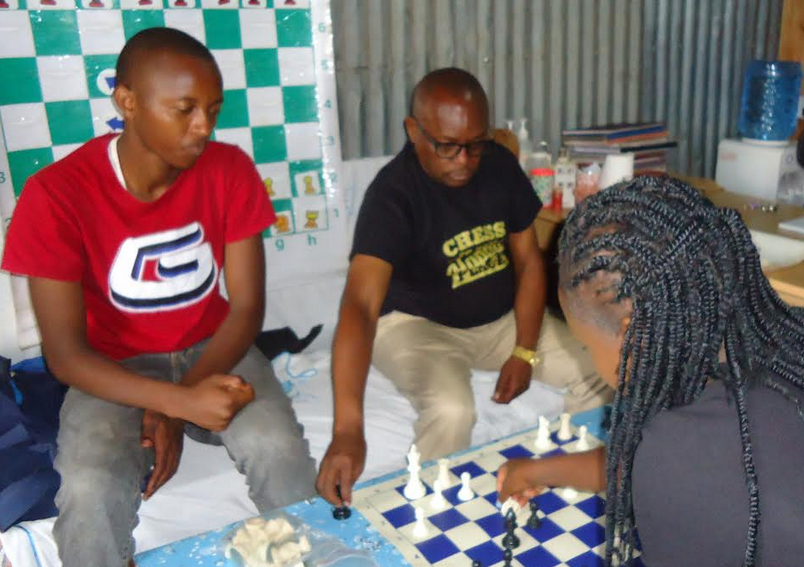
Trainees at the Club range from grade one to adults; anyone who can sit still and concentrate, adding whenever they have new trainees, he is the one who takes them through the introduction, and meets them again in modules 10, 11 and 12.
“Every time we have new players, I train them on what is called ‘the easy win’ in a competition,” said the Director. One of those he has trained is Jane Wangari aka Jane Talented when she was a student at Kamune Day Secondary.
Wangari qualified for the 20th Edition of the African Individual Chess Championship which was held in May, 2025 in Cairo, Egypt but was unable to fulfil her dream to take part in the international tournament due to financial constraints.
Kimani says he formed Chess Masters’ Club where he is Director/Founder while Jane is the Principal to provide structure to the trainings. Since they usually charge a fee when training in private school, they are able to pay themselves a stipend at 30 per cent each, while 40 percent of the income is channeled to the club account.
So, after teaching the introductory module, Kimani hands the players to Wangari, who trains learners from grade one to three, where she trains module two through nine, then she hands them back to him.
He expressed satisfaction that some of his trainees over the years have excelled in their academics to join institutions of higher learning, adding that he is gratified that whenever he pays them visit, he always finds them carrying their chess boards wherever they go.
“Some of those I have trained have moved on to university, and while there they don’t engage in vices such as playing pool, alcohol and drug abuse and other self-destructive behaviours because chess occupies their free time,” said Kimani.
Kimani noted that after the training, learners get the opportunity to compete with Kenyans of their own age and gender; a player is able to gauge their prowess with members of the same gender and age. Players in colleges and universities join Chess Kenya Foundation (CKF) where they are shown where they can train competitively and earn an income.
The Director said that there many opportunities for seasoned chess players to train other people and earn an income. A trainer is able to get good money, so they do not engage in activities like the addictive pool playing and gambling because chess enables them to earn some money.
“In Nairobi, trainees pay Sh500 per person for a two-hour session; one of my trainees who is studying at the University of Nairobi has 13 trainees. With the money he earns, he is able to comfortably support himself while at university,” noted Kimani.
“In 2024, I took seven students for the national chess tournament – three girls and four boys- held at Mangu High school. The three girls qualified to go for the international tournament held in South Africa, but they were unable to go due to financial constraints,” says Kimani.
Kimani said one of the boys from Wahundura High School also qualified to go for the international tournament, and added he was fortunate to get a sponsor for the flight to South Africa.
“The boy is currently studying Software Engineering at the University of Nairobi; during his free time, he trains chess to children and presently he has thirteen of them,” Kimani says. “I’m very proud of him,” he adds.
In 2025, he took 13 of his chess players to the national championship, seven of them were girls including Jane Wangari.
“They all qualified to go and represent Kenya at the international tournaments held in Cairo Egypt; they were each expected to raise Sh200,000 for air fare and other incidentals; given their collective background, this was obviously a tall order, so they did not manage to travel for the tournament,” said Kimani.
So passionate is Kimani about seeing his proteges excel, he says he was tempted to take a loan to sponsor his trainees to fly out.
Kimani said that due to the financial challenges facing young chess players, Chess Kenya Federation decided to lobby the Senate so that Chess can be included into the schools’ co-curriculum activities so that talented learners from disadvantaged backgrounds were not left out of the game. “This has opened the opportunity for every Kenyan child to play chess free of cost,” says Kimani.
He noted chess is an indoor game which does not require a playing field, so the cost of materials is minimal. “The Chairman of the Board of Management at Ngamba Primary school has already purchased chess boards so that the learners at the school can start training immediately,” says Kimani.
The Director said playing chess promotes critical thinking especially in sciences and mathematics. “When I came to Kamune, I realized that many children from this Murang’a County have inherent talents in sports and music, but they have no role models in their homes because most men are lost in alcoholism and drug abuse,” says Kimani.
He said Chess has also contributed in lowering delinquency in the area, adding that school dropout rates were low because when schools close for the holidays, he gathers all the boys and girls from the locality at Kamune Day Secondary School dining hall for a two-hour training session daily for free.
“We spoke to heads of institutions to allow their learners to come to Kamune Day secondary school during their spare time in the afternoon and we train them in chess together with my team,” said Kimani.
Kimani’s wife and two sons live in Embu County where his wife is a contractor with the County Government. Due to his passion for Chess, Kimani spends most of his free time with this community, and his acquaintances always wonder why he spends his free time providing training in chess to the youth.
For those who question what personal benefit he derives from the trainings, Kimani said he gets spiritual satisfaction when he imparts skills to people and they turnout successful and go on to earn a living from the skill.
The Director said so far, chess playing has been under the auspices of CKF which organizes regional and national tournaments for players. A number of players under Kimani’s tutorage have qualified for international tournaments.
“On March 14, 2026, we took 77 participants from local primary and secondary schools, both public and private, to the Mount Kenya Regional Chess qualifiers, 56th edition held at Bishop Gatimu Ngandu Girls’ High school in Nyeri County where all of them qualified for the national tourney to be held in April at Mangu High school,” says Kimani.
With chess now being in the purview of the Ministry of Education as part of the schools’ co-curriculum activities, the work of training trainers has multiplied. Currently, one of his trainees, a teacher at Murang’a High School conducts trainings in Kiharu sub county together with her son, who was also Kimani’s trainee.
“The task is quite overwhelming and since I have my regular job as an English and History teacher at Kamune Day, I can’t meet the demand; that is why I have left the training in Kiharu to my former trainees,” says Kimani.
Seeing how great the task is, Kimani said that all those who qualify to go for the international tournament will be incorporated into Chess Masters’ Club as trainers.
Though they provide training for free for learners in public schools, they do charge a fee to those in private school, and they are able to pay themselves a stipend. They also use part of the income to buy chess boards and sell to parents who express an interest for their children to train in chess.
“One of my trainees had qualified to represent Kenya at the International tournament held in the United States of America. Later on, I met his mother who was a teacher at Kamune Day, she was so excited she asked me to train her as well,” says Kimani.
The same teacher was later transferred to Murang’a high, and together with her son, they started a chess club to train residents of Kiharu sub county. “I have left the teacher to handle Kiharu County because I’m not able to handle Mathioya and Kiharu,” he notes.
Being a pioneer of competitive chess in Murang’a County, Kimani said that at 54 years of age, he does not intend to continue teaching academics once he retires from formal employment. He said chess training is his retirement plan, and plans to start a talent hub for chess and music in Murang’a County.
Sadly, Kimani said his sons do not share his great passion for chess; nevertheless, he did train them and they play it for fun. He also trains elderly people because he said chess keeps mental illness like dementia at bay.
The Club Director noted that many parents of young children are requesting them to sell to them chess boards since they have realised that playing chess boosts concentration and focus in academics, and whenever children are playing chess, they do not go to roam about, hence minimizing parental anxiety.
“The young children will get an opportunity to learn chess at school at zero expense. This will provide the young learners a platform to demonstrate their prowess even as chess improves their concentration and focus in class,” said Kimani.
The Club Director averred that chess also cures attention distractors’ hyperactivity deficiency (ADHD), noting that children who are unable to settle in class due to this condition, once they start training in chess, they are able to settle down and concentrate on their lessons.
Chess Masters Club intends to launch an initiative dubbed ‘Murang’a Chess Mashinani’. In this project, the club trainers will be visiting young people in their local churches where they will fellowship together and after the church service, conduct a two-hour training session for free.
In Kamune, Kimani notes that the local social hall is underutilized, and called on individuals of good will to provide furniture for the hall which can then be used for trainings.“On Sunday, after the youth leave their various churches, instead of lazing idly at shopping centres which are rife with all manner of vices, they can go to the social hall for free training. This will curb idleness as well as turn out to be the panacea for alcohol, drugs and substance abuse among the youth,” he notes.
The Director says that young children are the best to train because their brains are not cluttered with many issues that cause distraction, unlike the youth who have many distractions. He adds that younger children are also known to retain what they learn more than the youth.
“By training the young learners from an early age, it boosts their ego since chess has for a long time been reckoned as the game for whites and the rich. This will have an impact on society because it will harness talent in Murang’a County which will in turn translate to better performance in school.
“Our motto is ‘You cannot undo a move, but you can do better the next move’. This will help inculcate in the young people that choices have consequences and consequences have responsibilities,” says Kimani.
Chess Kenya Federation President Mr, Bernard Wanjala said that the federation trains both children and adults and conducts tournaments for national titles. “Those who excel, are sponsored for international tournaments, both continental and world events,” he said.
Wanjala said although majority of the Chess players are students at different levels of education, the Federation does not conduct events for schools.
He however noted that the Federation has been working hand in hand with the Ministry of Sports, which is the one that provides sponsorship for those who go on to compete internationally.
“We often get many qualifying for international tournaments, so the funds from the Ministry are not sufficient to cater for all of them, and we do look for well-wishers to sponsor some,” said the CKF President.
Wanjala said that chess has found great acceptance among the young people in various schools. He noted that CKF approached the Ministry of Education to adopt chess as one of the competing disciplines among athletics and ball games in both primary and secondary schools.
“Last year, the Ministry of Education invited Chess Kenya Federation to participate as a demonstrative sport in the FEASSA games that took place in August last year in Kakamega,” said Wanjala.
The 22nd Edition of the Federation of East Africa Secondary Schools Sports Associations (FEASSA), Kenya, brought together student-athletes from across East Africa.
Wanjala noted that during those games, chess was one of the competing disciplines, and it was confirmed that beginning this year, competitions for chess will be held (among athletes and ball games) from the zonal level all the way to FEASSA.He noted that with that development, Chess Kenya Federation will only play an advisory role.
“In secondary schools, chess will be managed by the Kenya Secondary Schools Sports Association (KESSA) while the Kenya Primary School Sports Association (KPSSA) will manage the sport in primary schools,” he noted.
Kimani noted that the adoption of the sport by the Ministry of Education as a competing discipline fulfils his dream of enabling every child participate in chess, as well as relieves him the financial burden he has been incurring traversing the Ward offering training for free in public schools.
By Esther Mbuthia