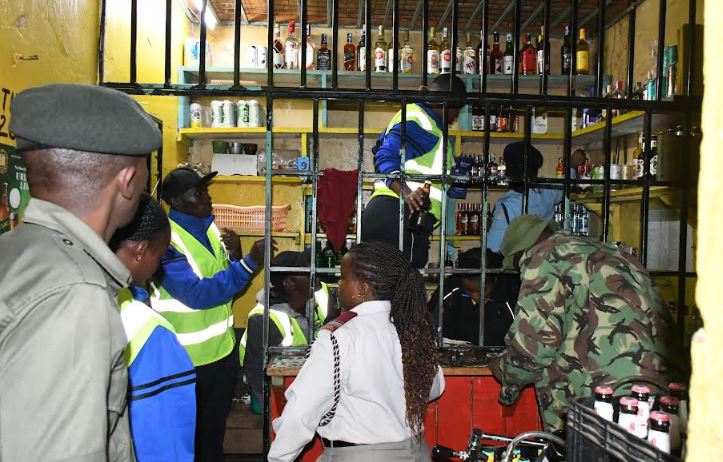
A multi-agency security operation in Ruring’u, Nyeri on Thursday evening targeting unlicensed liquor businesses led to the closure of several bars operated by a businessman who is also suspected of manufacturing counterfeit alcohol.
The operation, led by Nyeri Central Deputy County Commissioner Ngunyi Maina, brought together national government security officers, county government enforcement officers and members of the Nyeri county Alcoholic Drinks Control and Management Directorate.
During the swoop, the team impounded a substantial quantity of an assortment of alcoholic drinks, some of which they suspect could be counterfeit. They also confiscated several gambling machines allegedly being operated illegally at the premises.
According to the administrator, the businessman behind the trade has been operating four bars in Ruring’u without liquor licenses since 2024 and has previously been arraigned before the Nyeri courts for manufacturing counterfeit alcoholic drinks.
Maina also revealed that the businessman has been arrested several times over liquor licensing violations, with four cases reportedly pending before the Nyeri law court. He said the latest operation followed a court ruling in a case in which the businessman had sued the county government over his arrests for operating without a licence.
“He took the county government to court because they arrested him for operating without licences. But the court ruled in favour of the county government based on the compelling evidence that they presented. The court ruled that he should not be given a licence,” said Maina.
“There was even a time we arrested him because of being in possession of ethanol that he was using to manufacture counterfeit alcohol which he would then sell in his bars, and therefore we have decided to close his businesses because, one, you cannot operate without licences, and two, you cannot sell counterfeit drinks to the community,” he added.
Ngunyi said that samples of the seized drinks would be submitted to the government chemist for laboratory analysis to establish their composition and authenticity before further legal action is taken.
He warned that the manufacture and sale of third-generation alcoholic beverages posed a threat to public health and undermined the productivity of the working-age population. The DCC expressed concern over the number of young people reportedly frequenting the establishments to consume alcohol, saying the government was determined to protect communities from potentially harmful products.
“We have even found quite a number of young people who are drinking every day and being desperate. If we fail to deal with these people who are manufacturing counterfeit drinks, then by the end of the day, you’ll find it will affect the working age group within this region,” he noted.
Maina said that public cooperation had become increasingly important in identifying and reporting individuals suspected of engaging in the illegal trade. To help curb the vice, the administration said agencies involved in the campaign, including the Kenya Revenue Authority (KRA) and the National Authority for the Campaign Against Alcohol and Drug Abuse (NACADA), were working together to strengthen enforcement and public awareness.
He at the same time urged residents to remain vigilant and support the authorities in identifying illegal alcohol manufacturers and distributors.
“As a multi-agency, we are working hand in hand with the public, just to enlighten them that going forward, we have to put our signage together so that we do away with these kinds of criminals who are manufacturing counterfeit drinks within our society,” he said.
The raid comes a few days after Deputy President Professor Kithure Kindiki called for fresh inspections of all alcohol manufacturers in the country.
Speaking in Ihururu in Tetu this month, Prof. Kindiki said the government is determined to seal loopholes in the alcohol sector and ensure that manufacturers comply with the set health and quality standards. He directed that all alcohol manufacturers be inspected afresh, warning that those who fail to meet the required health and quality standards will not be allowed to continue operating.
“We cannot allow our people to be affected by illicit alcohol. We will tighten this sector and seal all the loopholes. All alcohol manufacturers must be inspected afresh, and those who do not meet the required health and quality standards will not be allowed to continue,” he said.
The Deputy President linked the government’s action to growing concerns over alcohol and drug abuse among young people. He called on parents, churches and other adults to help young people struggling with alcohol and drug-related addiction problems.
“I want to ask parents, the church and all adults to help us talk to our young people who are struggling with alcohol and drug problems. If we do not do that, we will lose a generation that we depend on to take over from us,” said Prof Kindiki.
By Wangari Mwangi and Kelvin Opiyo