Nyeri Governor Dr. Mutahi Kahiga has asked residents residing in disaster-prone areas to move to safer grounds as the county braces for heavy rainfall in the coming days.
The advisory follows a warning from the Kenya Meteorological Department that Nyeri is among a list of counties expected to record heavy rains between March 19 and March 24. In its routine weather update dated March 18, the Met Department listed a total of 45 counties that will experience heavy rains within the last week of March.
They include Turkana, Samburu, Migori, Nyamira, Nandi, Elgeyo Marakwet, Kisii, Nakuru, Meru, Kiambu, Machakos, Taita Taveta, Kilifi and Garissa among others.
Others are Kirinyaga, Trans Nzoia, Murang’a, Homa Bay, Kitui, Tana River, Siaya and Bomet.
“The rainfall being experienced over several parts of the country is expected to intensify to more than 20 mm in 24 hours from March 19 to March 24, 2026,” read the statement.
Dr Kahiga warned that the enhanced rainfall could trigger flash floods, landslides, river overflows and damage to infrastructure. He particularly cautioned residents in landslide-prone areas of Othaya, Mukurwe-ini and Tetu to remain vigilant.
“Already, during this rainy season, several impacts have been observed in the County, including drowning incidents, particularly at the Gura River, which claimed the life of a Grade 9 boy from Tetu Sub-county and destruction of livelihoods following the canal tragedy at the Gura hydropower plant that affected 25 households,” he observed.
The governor assured the residents that his administration had put in place effective measures to protect lives and property but also cautioned the residents against putting themselves in danger. He advised them to avoid walking and driving through floodwaters and taking shelter under trees when the rains pound the county.
To mitigate the imminent risk, Dr. Kahiga said that the county government had identified high-risk areas, activated early warning systems and pre-positioned emergency supplies. He also directed the Agriculture and water department to inspect all the drainage infrastructure and dams in the county and take urgent action on those with signs of structural weakness ahead of the heavy rainfall.
“I do not want to be a governor who will be saying I was not elected to deal with disasters. It is better to be prepared for a disaster rather than for the disaster to find us totally unprepared,” said Dr Kahiga.
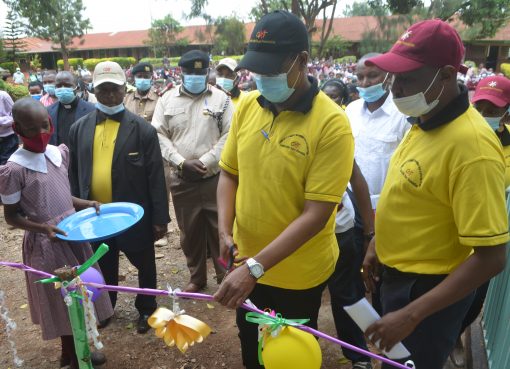
Dr Kahiga spoke during the launch of the county emergency toll-free number,1549, which will offer the residents direct emergency services.
He noted that the free emergency line will eliminate barriers to reporting emergencies and at the same time strengthen the county’s disaster preparedness and response framework.
“I am aware of the fact that when a disaster strikes, seconds matter and cost should never be a barrier to seeking help. It is therefore our duty to put in place systems that are not only responsive, inclusive and technology-driven but also accessible, efficient, and reliable,” he said.
The governor said that the emergency number had come at a time when the county is dealing with a high rate of emergency cases, having recorded a total of 386 incidents in the last one year. The cases include 277 structural fires, 46 bush fires, 46 road traffic accidents, six drowning cases, four emergency aid cases, three vehicle fires, two gas explosion fires, and two search and rescue operations.
Dr. Kahiga revealed that among the reported cases, the county lost 20 people to road traffic accidents and 20 to structural fires. Additionally, 14 bodies were retrieved from water bodies, including wells and pit latrines.
He, at the same time, called for close collaboration between partners, stakeholders, and emergency service providers, saying that disaster management is a shared responsibility.
“I can tell you that when disasters happen, the first people to be blamed are governments. Disasters can only be well taken care of only when you mitigate them, not after they have happened and therefore let us work towards collaboration,” he said.
By Wangari Mwangi and Samuel Maina