The Government’s National Youth Opportunities Towards Advancement (NYOTA) Project is opening new pathways for young people across the country through business support, skills development, mentorship, and savings as part of the national effort to expand employment opportunities, improve incomes, and empower youth to build sustainable livelihoods.
For beneficiaries like 28-year-old Abigail
Located on the outskirts of Kericho town, Tilwet Estate is surrounded by expansive tea farms, lush gardens, and tall trees, offering a quiet contrast to the bustle and activity of the town centre.
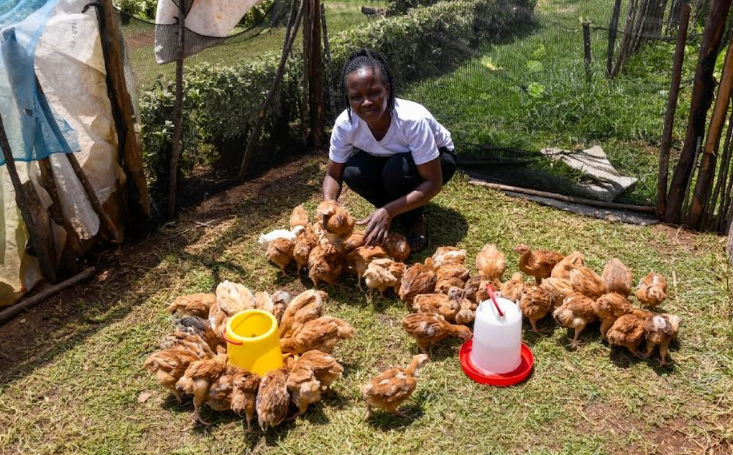
It is here, within the tea-growing landscape, that Chepkoech is nurturing her enterprise from her family homestead, with poultry production now forming an important part of her daily life.
When the Kenya News Agency visited her home, Chepkoech was busy feeding the chicks, assisted by her three boys, who moved around the poultry area as their mother attended to the young birds.
A mother of three, Chepkoech says the enterprise has become an important source of income for her family, while her husband works in the tea farms surrounding their home.
Her entrepreneurial journey received an early boost during the disbursement of the first NYOTA business support funds in Nakuru, where she had the opportunity to greet President William Ruto on the public podium and share her vision for the poultry business.
The President was impressed by her ambition and promised to support her entrepreneurship journey, an encounter that Chepkoech continues to regard as an important encouragement as she works towards growing her enterprise.
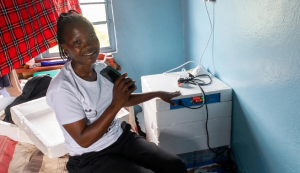
With Sh25,000 as the first amount she received through NYOTA, she purchased an incubator worth Sh18,500, with a capacity of 128 chicks, using it to establish a business producing and selling hatched chicks.
The business has since expanded, with Chepkoech acquiring a bigger incubator worth Sh35,000, capable of producing 256 chicks, enabling her to increase her production capacity as she seeks to serve more customers.
Today, she earns an average profit of Sh40,000 every month from the business, while when she achieves a 100 percent survival rate among her chicks, her monthly profit rises above Sh40,000.
The income has enabled her to sufficiently fend for her family and meet the needs of her three children, giving the poultry enterprise a growing role in the household’s financial wellbeing.
Following the second NYOTA disbursement of Sh25,000, Chepkoech has also diversified her livelihood activities by purchasing equipment to establish a small restaurant, an additional enterprise she hopes will complement her poultry business and create another source of income for her family.
Chepkoech says the support she received through NYOTA was not limited to the financial assistance, noting that the entrepreneurship training also equipped her with practical knowledge that has improved the way she runs the business.
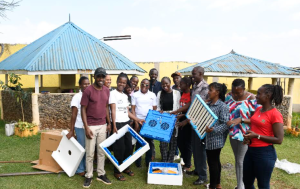
Through the training, she learnt about suitable feeds and vaccines for chicks, as well as record keeping, saving and other business practices that have helped her make more informed decisions.
The knowledge has encouraged her to view poultry production as a business that requires proper planning, financial discipline and reinvestment of profits to sustain growth.
As her own enterprise continues to expand, Chepkoech has also brought together other NYOTA beneficiaries in Chaik Ward who have ventured into poultry keeping.
The group is exploring ways of formalizing its operations and accessing additional government enterprise financing opportunities, including the Uwezo Fund and Youth Enterprise Development Fund, to expand its activities.
The beneficiaries also had an opportunity to meet Agriculture Principal Secretary Dr. Paul Rono, who donated an incubator to the group, providing additional support to their collective poultry venture.
Chepkoech says working as a group gives the young entrepreneurs an opportunity to share experiences, support one another, and explore wider markets and financing opportunities.
For Chepkoech, however, her journey is now focused on taking the enterprise to a much bigger level.
Her ambition is to become one of the biggest suppliers of chicks in Kenya and eventually expand beyond the country’s borders, with a dream of establishing a large depot and developing the capacity to export.
She encourages other young people not to despise humble beginnings, drawing from her own experience of starting with a single 128-chick incubator and gradually expanding her production capacity.
Chepkoech urged young people to start from where they are, remain diligent, and save and invest their profits instead of waiting for perfect conditions before taking the first step.
“If you can be faithful with 10 shillings, you can be trusted with 100 shillings, and you can also manage 1,000. Young people should demonstrate responsibility with every opportunity they receive,” stressed Chepkoech.
For the young entrepreneur in the middle of Kericho’s vast tea farms, the journey that began with one incubator has already changed the fortunes of her household and inspired other young people to venture into poultry farming.
From the quiet homestead in Tilwet Estate, Chepkoech is now looking beyond the 256-chick incubator towards a larger enterprise, a major distribution depot, and eventually international markets.
Her story reflects the wider ambition of NYOTA, to give young people the capital, skills, savings culture, and mentorship needed to turn ideas into productive enterprises and build more secure livelihoods.
“I also want to create employment for many young people in the country through greater initiatives because I know my businesses will flourish. The poultry business and the restaurant that I want to soon open will provide employment to several people who will get an opportunity to earn a living,” added Chepkoech.
And as she continues feeding her chicks, supported by her three sons, Chepkoech remains focused on the bigger picture, building a business that can grow from the tea-growing outskirts of Kericho to markets across Kenya and beyond.
“My dreams are valid.” She said,
Her experience forms part of the wider impact of NYOTA Business Support in Kericho County, where 2,393 young people have received start-up capital after meeting the programme’s training and attendance requirements.
Kericho County Commissioner Omari Ali said NYOTA was making a visible difference in the lives of young people across the county, with beneficiaries using the opportunities provided to develop skills, establish businesses, and pursue more productive livelihoods.
“The programme has given many youths a renewed sense of purpose by engaging them in income-generating activities, helping them move away from idleness and become more economically active members of their communities,” explained Mr. Ali.
The beneficiaries in Kericho County have so far received a cumulative Sh108,800,000, with the financial support being provided in two tranches as part of the programme’s approach to encouraging responsible investment in productive enterprises.
During the first tranche, 1,959 youth received Sh25,000 each, translating to Sh48,975,000, while the second tranche saw 2,393 youth receive Sh25,000 each, amounting to Sh59,825,000.
The programme has also embedded a savings component, with Sh3,000 from each Sh25,000 disbursements automatically channeled into savings through the National Social Security Fund (NSSF).
Beyond financing, beneficiaries are taken through business development services and mentorship sessions designed to strengthen their ability to manage enterprises, identify opportunities, and address challenges that arise as their businesses develop.
Spot checks involving 98 beneficiaries across 25 of Kericho County’s 30 wards found that 70 percent were first-time entrepreneurs, indicating that the programme is reaching many young people venturing into business for the first time.
Agriculture, livestock, forestry, and fisheries emerged as the leading areas of enterprise among the sampled beneficiaries, accounting for 72 percent, followed by wholesale and retail at 24 percent, while fashion and design and beauty and cosmetics each accounted for 2 percent.
The government is also supporting young people through the On-the-Job Experience component of NYOTA, which places trained youth under master craftsmen for five months to acquire practical workplace skills.
Approximately 80 per cent of trained youth have already been placed, providing them with hands-on experience intended to strengthen their prospects for employment and self-employment.
The implementation of the programme has also involved addressing emerging challenges, including the need for continued mentorship, market linkages, and guidance on compliance with relevant regulatory requirements.
For Chepkoech, the journey that began with a modest investment continues to grow, with her sights now set on building an enterprise that can serve markets far beyond her home in Kericho.
From one incubator producing 128 chicks to a larger machine with twice the capacity, she has demonstrated the value of starting small, learning along the way and reinvesting in an enterprise.
Her ambition to establish a major chick-supply depot and eventually export is now the next chapter of a business that began with an opportunity provided through the Government’s NYOTA Project.
By Kibe Mburu