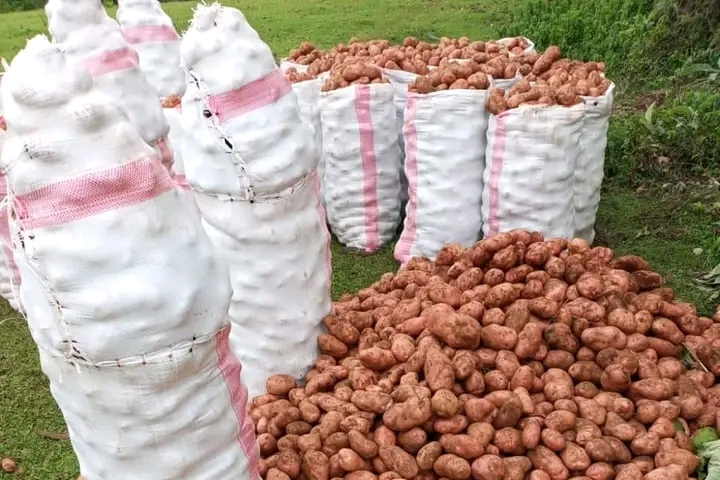
The prolonged dry spell affecting the North Rift region is taking a toll on farmers, traders and consumers, with declining agricultural production and reduced supplies pushing up the prices of essential food commodities, including potatoes, milk and vegetables.
For Paul Kipkorir, a potato farmer, supplier and trader operating in Eldoret City, the dry conditions have significantly reduced his harvest, affecting both his farm earnings and the volume of potatoes he supplies to the market.
“I used to harvest between 15 and 20 bags per acre, but right now, I harvest between eight and 12 bags,” Kipkorir says.
He attributes the declining yields to inadequate rainfall, noting that the cost of maintaining production has also risen due to expensive irrigation, farm chemicals, fuel and transportation.
Kipkorir fears that prolonged dry conditions could further reduce his harvest and make farming increasingly expensive, threatening both his income and the supply of food to local markets.
He hopes adequate rainfall will return soon to ease the cost of irrigation and transportation, enabling farmers to resume more affordable production.
The effects are extending beyond farms to markets, where traders are grappling with dwindling supplies and higher purchasing costs, forcing them to adjust their prices.
At Huruma Market in Turbo Sub-County, milk vendor Amelia Cheptoo says the cost of milk has risen sharply over the past three months as dairy production declines.
“The cows are not producing as much milk as they used to, and dairy companies are not receiving much milk,” Cheptoo explains.
She says she previously bought milk from suppliers at Sh50 per litre and sold it at Sh60, but the purchase price has since increased to between Sh80 and Sh90 per litre, forcing her to sell it at between Sh90 and Sh100.
Cheptoo adds that the quantity of milk she receives from small-scale and large-scale farmers has dropped from 12 gallons to between eight and 10 gallons, affecting her daily sales.
To keep her business running, she has been forced to seek alternative suppliers from different areas while adjusting her selling prices to cover the increased costs.
For consumers, the rising prices mean spending more on food at a time when household budgets are already under pressure.
Mitchell Cherop, a local consumer, says she has had to increase her grocery budget to cope with the rising cost of basic food items.
“In the past, I used to set aside a smaller amount of money for groceries because I could get enough. But right now, I have doubled the amount to ensure it is sufficient,” she says.
Cherop said the situation has forced her to reconsider her spending habits, cutting back on non-essential purchases to prioritise household needs.
She has switched from flavoured milk to unflavoured milk and stopped making impulse purchases as she seeks to stretch her budget and ensure her family has access to essential commodities.
Cherop is calling on local authorities to invest in water storage facilities, affordable irrigation systems and improved transport infrastructure to support agricultural production and stabilise food supplies.
The experiences of Kipkorir, Cheptoo and Cherop illustrate how prolonged dry conditions can affect the entire food supply chain, from reduced farm output and higher trading costs to increased expenditure by households.
The farmers and consumers warn that continued dry conditions could lead to further increases in food prices, placing additional pressure on households and threatening the livelihoods of those who depend on agriculture and food trade.
They say sustained investment in reliable water supplies and affordable farming technologies would help farmers maintain production during dry periods, improve the availability of essential commodities and cushion consumers against sharp price fluctuations.
The situation comes as Kenyans, particularly farmers, look forward to the October–November–December (OND) rains forecast by the Kenya Meteorological Department, hoping the anticipated rainfall will revive agricultural production, improve milk yields and increase the supply of essential food commodities.
The rains are expected to offer relief across the food supply chain, from farms to markets and ultimately households, by improving food availability and easing upward pressure on prices.
by Stanley Kimutai and Patience Chebichii