

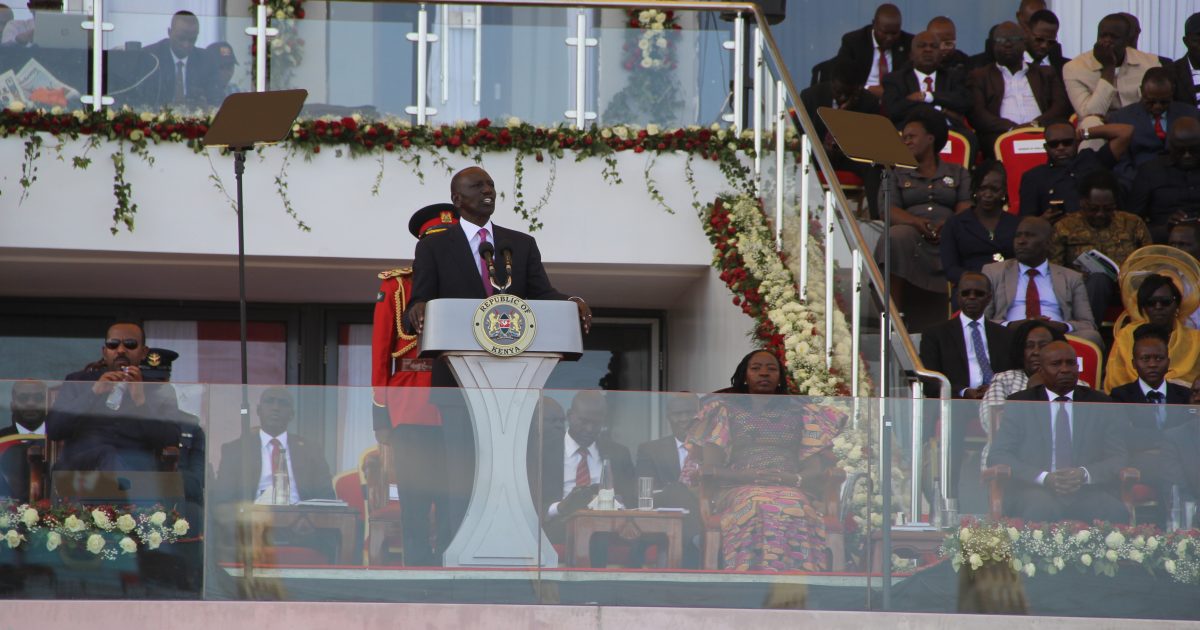
President William Ruto has announced four proposed measures aimed at easing the cost of living, reducing the cost of property ownership, making digital technology more affordable and expanding employment opportunities for young people.
The measures include a proposal to exempt workers earning Sh32,333 or less per month from Pay-As-You Earn (PAYE) income tax, waive stamp duty on land transactions valued at Sh1 million or less, remove the 25 per cent import duty on mobile phones and recruit an additional 50,000 young people into the National Internship Programme from January 2027.
Speaking during the 63rd Mashujaa Day celebrations at Kipchoge Keino Stadium in Eldoret, Uasin Gishu County, Tuesday, President Ruto said the proposals were intended to address economic challenges facing ordinary Kenyans, particularly workers earning modest incomes and young people seeking employment.
He said the National Treasury had prepared proposals on the tax and stamp duty measures, adding that he had directed the Ministry to present them to Parliament the following week.
“For workers on modest incomes, every shilling saved means more money for food, transport, school expenses and the needs of their families,” said the President.
Under the proposed land transaction reforms, the government intends to exempt transactions valued at Sh1 million or less from stamp duty while introducing progressive rates for higher-value transactions.
The President said the proposal would reduce the cost of acquiring and transferring property, particularly for low-income households.
On mobile phones, he said the government would pursue the necessary legal and regional customs processes to remove the 25 per cent import duty, noting that the devices had become essential tools for education, business, banking and access to employment opportunities.
“A mobile phone is no longer a luxury. It is a classroom, a marketplace, a bank and an office for many young Kenyans, a gateway to employment,” he said.
The fourth measure involves expanding the National Internship Programme by 50,000 placements from January 2027 to accommodate graduates from universities, technical and vocational education and training institutions and other colleges.
The President said successful applicants would receive monthly stipends, with placements conducted through a transparent, digital and merit-based system.
He added that the government would introduce incentives to encourage private employers to offer meaningful work experience to young people.
“Too many young people cannot secure employment without experience, yet cannot gain experience without employment,” he said, adding that the programme was intended to provide a pathway from education to the workplace.
President Ruto said the proposals would undergo the necessary legislative, fiscal and administrative processes, with attention to sustainable financing, transparency and effective implementation.
He also outlined the government’s employment targets for the next three years, saying it aimed to expand digital employment opportunities to two million, increase international labour opportunities to one million and generate a further two million employment opportunities through housing and related investments.
The President said the Affordable Housing Programme had 303,000 homes at various stages of development, alongside more than 450 modern markets and student accommodation facilities intended to serve 180,000 students.
He said the projects had generated more than 1.1 million employment opportunities in construction and related industries.
He cited the handover of keys to 2,157 families at the Pioneer Affordable Housing Estate in Eldoret on Sunday as part of the government’s housing programme.
On healthcare, the President reiterated the government’s commitment to expanding access to quality services, saying reforms were intended to ensure Kenyans could receive treatment regardless of their economic circumstances.
He also highlighted infrastructure investments, including the upgrading of the Rironi-Mau Summit Highway, the planned extension of the Standard Gauge Railway towards Kisumu and Malaba, the Isiolo-Mandera Corridor and the modernisation of Jomo Kenyatta International Airport.
The President said the projects were expected to lower transport costs, improve regional trade and connect more communities to economic opportunities.
He further announced that oil exports from the Lake Turkana basin were targeted to begin in December, while noting that private investors had acquired a 25 per cent stake in the Kenya Pipeline Company from public entities.
President Ruto challenged political leaders to present credible development plans and explain how they would finance and implement their proposals, saying the country needed a political contest based on ideas, policies and programmes rather than ethnic mobilisation and personal attacks.
He said government programmes should remain open to scrutiny over their costs, financing, environmental impact and public value, adding that no leader was beyond accountability.
The President also paid tribute to Kenya’s freedom fighters, members of the security services and sports personalities, saying their sacrifices and achievements had contributed to the country’s development and international standing.
He called on Kenyans to uphold constitutional freedoms, respect their differences and work together to build a country where every citizen had a fair opportunity to prosper.
“Progress must never become an excuse for complacency. The true measure of leadership is whether we are prepared to do more where our people continue to demand,” he said.
Also in attendance were First Lady Rachel Ruto, Prime Minister of the Federal Democratic Republic of Ethiopia Dr. Abiy Ahmed, Deputy President Prof. Kithure Kindiki, Uasin Gishu Governor Jonathan Bii, among other leaders and senior government officials.
By Fredrick Maritim and Ekuwam Sylvester

