Agriculture and Livestock Development has launched an initiative to accelerate sunflower, soybean, and other oil‑crop production.
Kenya currently consumes roughly 600,000 metric tonnes of edible oils each year, yet more than 90–95 percent of that demand comes from imports, a costly reliance that the government says must change.
Speaking during the opening of the Kilimo Biashara Expo 2026 at Kenya Agricultural Livestock Research Organization (KALRO) Seeds headquarters in Thika, Agriculture Cabinet Secretary Mutahi Kagwe said scaling up production of these crops can cut imports, build local agro-processing, and raise farmer incomes
“We spend as a nation about half a trillion shillings every year importing food, soy, wheat, rice, edible oils. You can imagine what that does to our balance of payments balance of trade and our exchange rates”, he added
Kagwe explained that the idea of import substitution is first to create security for ourselves because of the changing circumstances in the world, giving an example of war, which affects the importation of crops such as wheat, thus the need to grow the crops ourselves, which means food stability, sustainability, and independence.
“Food independence is the most important thing that we should be thinking about as a nation,” the CS told farmers, researchers, and business partners attending the two-day expo.
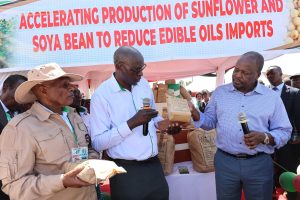
The continuing push to showcase industrial crops like sunflower and soybean is part of efforts by the government to lessen the country’s heavy reliance on imported edible oils.
Dr. Alice Murage, the Deputy Director General in charge of Crops Research in KALRO, said that currently the country imports a lot of edible oil, and KALRO is currently promoting the use and adoption of edible oils.
“We are promoting and launching today the sunflower and the soya bean plants that we have here in Kenya so that farmers can embrace and plant in mass to increase productivity and produce edible oils locally and help the government reduce the oil imports,” she added.
Dr. Murage said that there are four varieties of the sunflower and two varieties for soybeans that KALRO is promoting.
KALRO Board Chairman, Dr. Thuo Mathenge, thanked KALRO scientists for the work they are doing in terms of ensuring food security in the country.
He challenged the youth to also visit KALRO centers and also the expos to learn more on agriculture and have proper information so that they engage in the agriculture space and make money.
According to data, 90 percent of edible oil is imported; thus, the urgency of promoting domestic production.
Kenya currently consumes roughly 600,000 metric tons of edible oils each year, yet more than 90–95 percent of that demand comes from imports, a costly reliance that the government says must change. In 2022 alone, the country spent over KSh 145 billion on imported edible oils, underlining the size of the opportunity for local farmers and agribusiness investors.
The government is partnering with KALRO and other stakeholders to develop and distribute high‑yielding seed varieties; strengthen seed multiplication and dissemination systems; support farmer groups and cooperatives; encourage private investment in processing and value addition; and strengthen market links between farmers and processors.
With strong emphasis on technology, training, and market connections, the initiative launched at KALRO is positioned as a significant step toward lowering the edible‑oil import bill and expanding opportunities for farmers, youth, women, and agribusiness entrepreneurs across Kenya.
By Wangari Ndirangu