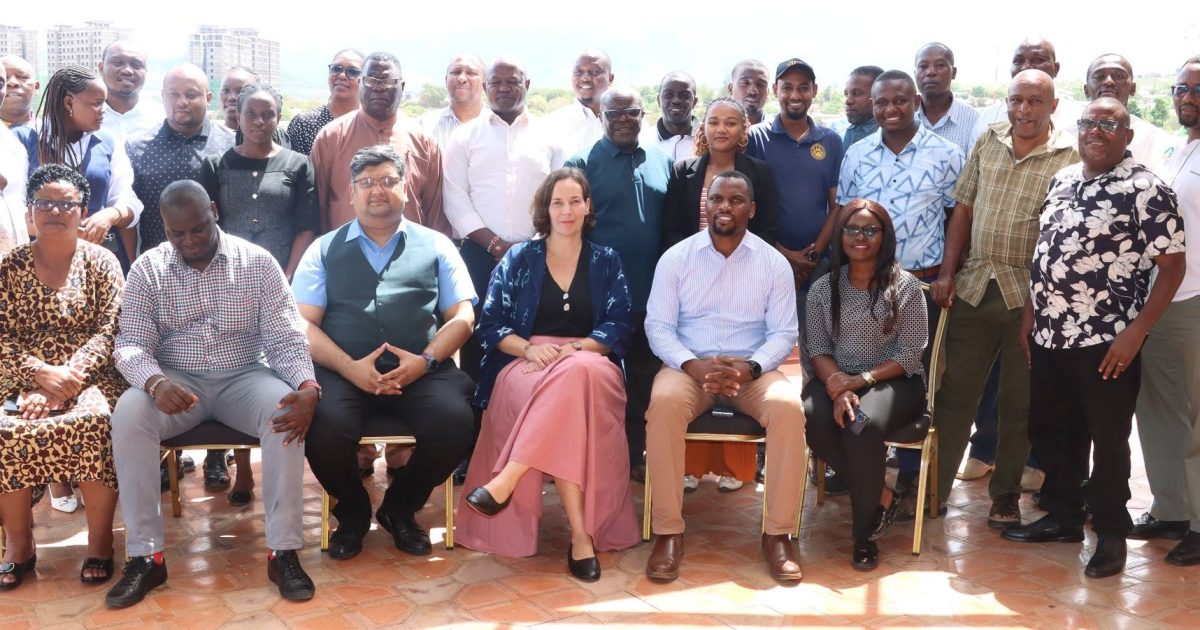
The County Government of Taita Taveta has intensified efforts to strengthen climate resilience through climate finance literacy training targeting county staff, Ward Climate Change Planning Committees (WCCPCs) and community representatives.
The initiative, implemented in partnership with GIZ Kenya and the Cities Forum, seeks to equip local actors with skills to access, manage, and implement climate financing opportunities, amid growing climate-related challenges.
About 40 participants attended the 2 1⁄2-day training at Voi, aimed at improving understanding of climate finance mechanisms, project development and locally led climate adaptation.
Taita Taveta County Executive Committee Member for Water, Sanitation, Environment, Climate Change and Natural Resources, Grantone Mwandawiro, said the training comes at a critical moment, when counties are increasingly expected to spearhead climate action despite financial and logistical constraints.
“The vastness of the county makes it expensive to coordinate climate-action projects,” said Mwandawiro.
Climate finance refers to local and international funding directed towards climate adaptation and mitigation efforts including water projects, renewable energy, ecosystem restoration, drought response, and climate-smart agriculture.
Kenya has increasingly emerged as one of Africa’s leading countries in devolving climate financing to the grassroots through county-led initiatives such as the Financing Locally-Led Climate Action (FLLoCA) programme.
According to recent National Treasury data, counties received over Sh6.97 billion, under the County Climate Resilience Investment grants to support locally driven climate projects.
Further, the National Treasury announced the release of Sh11.2 billion in climate resilience funding to 46 counties for the 2025/2026 financial year through partnerships involving the World Bank, Germany’s KfW, and county governments.
However, experts say that while financing has improved, climate finance literacy remains low at the grassroots level, limiting communities’ ability to develop bankable projects and directly benefit from available opportunities.
According to a 2025 report by the Stockholm Environment Institute, public funding allocated to climate adaptation in many counties in Kenya remains low, accounting for only 20 to 25 percent of total public funding despite rising climate vulnerabilities.
The report further noted that marginalized and rural communities continue to face barriers in accessing climate finance due to limited technical capacity and insufficient awareness on funding frameworks.
Project Lead for Promoting Climate Strategies and NDC Implementation at GIZ Kenya, Andrea Denzinger, said the training aims to bridge the knowledge gap and help communities build sustainable climate projects capable of attracting funding support.
“The target is to build community resilience by scaling up and supporting sustainability in project development at the grassroots level,” she said.
Senior Climate Finance Policy Expert at Cities Forum, Hrishikesh Mahadev, who led the training, said counties play a central role in helping Kenya transition towards a low-carbon and climate-resilient economy.
“The goal is to help counties build a more digital, climate-resilient and sustainable future,” he said.
Kenya’s approach aligns with global trends that increasingly emphasize locally led climate action and direct financing to vulnerable communities.
International climate frameworks, including the Paris Agreement and outcomes from recent global climate summits, have pushed governments to strengthen local institutional capacity and accountability in climate financing.
Data from the FLLoCA programme shows that over one million Kenyans have directly benefited from climate resilience projects, while an estimated 2.5 million people have indirectly benefited through investments in water access, agriculture, disaster preparedness, and natural resource management, with women accounting for about 56 percent of the beneficiaries.
Additionally, more than 500 climate resilience sub-projects have already been completed across the country, with hundreds more underway.
Despite the gains, funding gaps remain a major concern. Last year, stakeholders warned that proposed reductions in climate change allocations could undermine adaptation efforts and expose vulnerable communities to increased risks from floods, drought, and food insecurity.
At the grassroots level, local leaders say climate finance literacy is already beginning to transform how communities approach climate adaptation.
Mahoo WCCPC Chairman, Angelo Mwamburi, said participants will cascade the knowledge to communities to enable residents to develop locally led climate projects and seek funding opportunities.
“The training has closed a climate finance knowledge gap amongst us and we are ready to go back to society and engage in diverse ways of seeking funds,” added Chawia WCCPC Chairman Richard Mghosi.
Climate experts note that strengthening climate finance literacy at ward and community levels could significantly improve counties’ ability to absorb funding, implement resilient projects and reduce dependence on emergency relief caused by climate-related disasters.
By Arnold Linga Masila