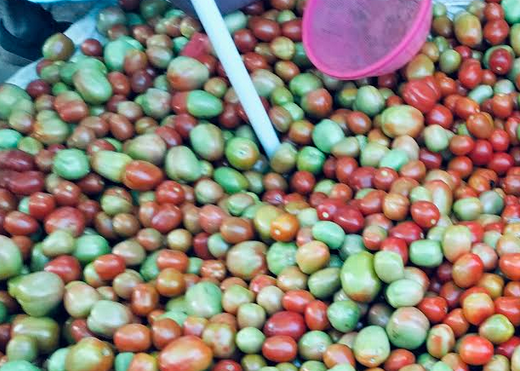
Just three months after farmers grappled with a tomato glut that pushed prices to record lows, markets across Murang’a and the larger Central Kenya region are now experiencing an acute shortage, with prices sharply skyrocketing.
Currently, a 60kg crate of tomatoes is retailing at between Sh6,800 and Sh7,000, a significant jump from as low as Sh1,000 in January.
A kilo now goes for about Sh100, compared to Sh20 during the glut period.
The current prices mark the highest levels recorded in the past two years, leaving both traders and consumers struggling to cope.
A trader at Wairia Market, Kenol, Daniel Mugambi, said the sharp rise has disrupted business.
“I have not sold tomatoes at Sh100 per kilo in the last two years, but that is where we are now. We are buying them at very high prices, and sometimes they are not even available,” he said.
He noted that customers have reduced their purchases due to the high cost.
“Most customers are now buying only basic items. Tomatoes have suddenly become a luxury in many homes,” he added.
The situation is a sharp contrast to January, when farmers in Central Kenya, particularly in Kirinyaga, Nyeri and Laikipia counties, counted heavy losses due to oversupply.
During the glut, a 60kg crate of Grade One tomatoes dropped to as low as Sh1,000, while Grade Two sold for as little as Sh500. At the farm gate, prices fell further to between Sh300 and Sh500 per crate, leaving farmers unable to recover production costs.
Kirinyaga farmer John Muthii had earlier decried the losses.
“The cost of seeds, labour and irrigation was very high, but I could not even recover production costs. Some of the tomatoes ended up rotting or being fed to livestock so I was not able to grow them again ” he said.
Similarly, Murang’a farmer, Beatrice Wanjiku, said she was left with thousands of kilograms of unsold produce.
“Buyers were scarce, and those who came offered very low prices. Many of us lost money on transport and labour,” she noted.
Agricultural experts now attribute the current shortage to the earlier glut, which discouraged farmers from planting in subsequent cycles, coupled with seasonal changes affecting production.
A soil analyst, Bernard Ndung’u, attributed the sharp shift from glut to scarcity to seasonal production patterns and changing weather conditions.
“The tomatoes that flooded the market in January were planted around October and largely relied on rainfall, which resulted in oversupply,” he explained. “
The tomatoes currently in the market were planted in January, a dry period, and are mainly irrigation-fed, which limits the scale of production.”
Ndung’u added that the rainy conditions that supported the earlier crop also contributed to increased pest and disease infestations, reducing the shelf life of tomatoes and affecting overall quality.
“Rainfall promotes the spread of pests and diseases, which shortens the lifespan of tomatoes and contributes to post-harvest losses. This, combined with reduced planting, has led to the current shortage,” he noted.
He recommended investment in greenhouse farming as a long-term solution to stabilise production and shield crops from extreme weather conditions.
“Greenhouse technology can help farmers regulate growing conditions, reduce pest-related losses and ensure a more consistent supply throughout the year,” he said.
He is now urging farmers to also try and adopt better planning strategies, including staggered planting, irrigation for off-season production, and cooperative marketing to stabilise supply and prices.
” I would also recommend investment in value addition, such as processing tomatoes into paste and sauces, to reduce post-harvest losses and cushion farmers against market fluctuations,” Ndung’u added.
By Florence Kinyua