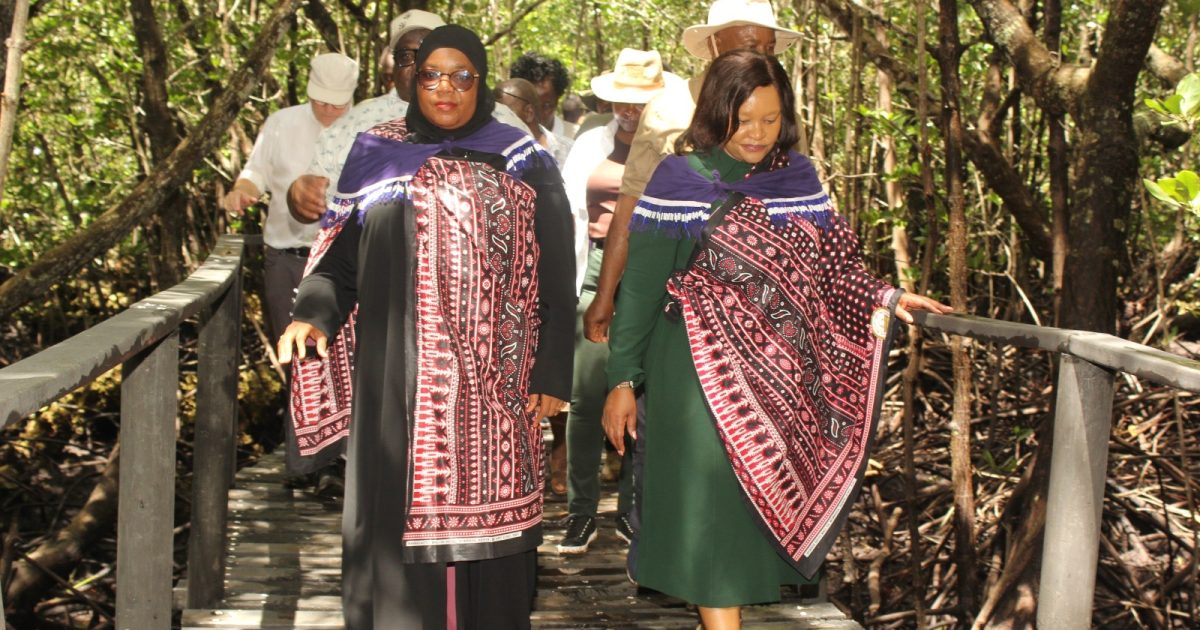
Tourism and Wildlife Cabinet Secretary, Rebecca Miano, has launched the Chale Community Boardwalk and mangrove planting campaign in Kwale County, describing it as a model for community-led conservation and sustainable tourism.
Speaking at the event in Kwale County, Miano said the project reflects successful collaboration between government, partners, and local communities under the Bottom-Up Economic Transformation Agenda championed by President William Ruto.
“I am honored to join you in these initiatives that underscore our collective commitment to sustainable development, environmental conservation, and community empowerment,” she said.
Cabinet Secretary for Tourism and Wildlife Rebecca Miano (R) and Kwale Governor Fatuma Achani at the Chale Community Boardwalk shortly after its official launch, where they toured the mangrove ecotourism site and highlighted ongoing efforts to promote conservation-driven tourism and community empowerment along Kenya’s Coast.Cabinet Secretary for Tourism and Wildlife Rebecca Miano (R) and Kwale Governor Fatuma Achani at the Chale Community Boardwalk shortly after its official launch, where they toured the mangrove ecotourism site and highlighted ongoing efforts to promote conservation-driven tourism and community empowerment along Kenya’s Coast.
The project, implemented by the Wildlife Research and Training Institute (WRTI) with support from the UNEP Go Blue Project, aims to protect mangrove ecosystems while creating livelihoods through ecotourism.
Miano noted that the boardwalk will reduce environmental degradation while opening opportunities in blue carbon, tourism, and nature-based enterprises. She added that tourism remains a key employer, especially for young people, and a major contributor to the economy.
“This is only the beginning. We must work together to fully realize this project so that it delivers maximum benefits to the community,” she said, urging support for Phase two, which will expand the boardwalk and add facilities such as a floating restaurant and community enterprises.
She also linked the initiative to the national tree-growing programme, noting that over 10,000 mangrove seedlings had been planted during the exercise.
“Mangroves are among the most valuable ecosystems in the world. By planting them here in Chale, we are protecting our coastlines, supporting fisheries, and strengthening the blue economy,” she said.
In his remarks, Patrick Omondi, Director and CEO of WRTI, emphasized the role of science in guiding the project.
“This is science in action showing that conservation is not a cost, but an investment,” said Omondi citing findings that identified over 28 ecosystem services in the Chale marine ecozone.
He called for increased support to expand the project, noting it will boost incomes, strengthen resilience to climate change, and position Chale as a leading ecotourism destination.
Community members welcomed the project expressing optimism about its potential to transform livelihoods.
Suleiman Ronga, a Project Manager of the Chale Boardwalk project said the initiative brings together multiple community groups, including conservation organizations, Beach Management Units (BMUs), and Kaya Forest communities, while also ensuring inclusion of vulnerable groups and minority communities such as the Makonde.
“This project is meant to help us conserve our environment, including the ocean, mangrove forests, and kaya forests, while also creating opportunities for our youth to gain skills in conservation and other livelihoods,” he said.
He added that the community plans to showcase mangrove ecosystems, cultural heritage, and local products to visitors.
“Many people hear about mangroves but have never seen what is inside. We also want to promote our cultures, our dances, clothing, and traditional foods so that the whole community benefits,” he explained.
Ronga noted that the project, which currently features a 100-metre boardwalk constructed at a cost of Sh 5.7 million, is expected to grow into a major ecotourism hub but requires further support.
“We need government support in marketing this project globally and improving infrastructure such as roads, water, and electricity. As a community, we can do our part, but some things require government intervention,” he said.
He also highlighted conservation efforts, including plans to promote sustainable crab farming and protect fish breeding areas, while addressing illegal mangrove logging.
“The presence of this project will enhance security and reduce illegal logging because there will always be people on site,” he added.
On her part, local beneficiary Rehema Kubambanya, a treasurer of Chale Muungano group, said the project will empower women economically.
“This project will help us as women because we will earn income to support our children. We will sell our products here, including clothing and handmade items,” she said.
She added that the group plans to charge entry fees of about Sh 200 for local visitors and Sh 500 for international tourists as the project begins operations.
The initiative is expected to boost ecotourism, strengthen conservation efforts, and position Chale as a growing destination along Kenya’s Coast, while improving livelihoods for local communities.
by Chari Suche