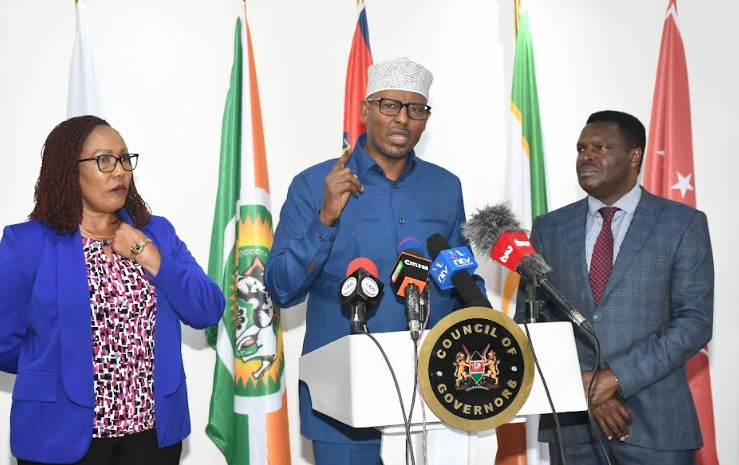
The Council of Governors has protested what it termed as attempts to arrest governors over their failure to appear before the Senate County Public Accounts Committee, describing the move as unwarranted and a threat to constructive intergovernmental relations.
Addressing the press in Nairobi on Tuesday, the Chair of the Council of Governors and Wajir Governor Ahmed Abdullahi expressed concern over actions allegedly taken by the National Police Service following reports of plans to arrest Nairobi Governor Johnson Sakaja for failing to appear before the Senate committee.
Abdullahi said the council viewed the matter as a collective institutional issue rather than an individual governor’s defiance of parliamentary oversight.
“Members of the press and citizens of Kenya, the Council of Governors brings to your attention with utmost concern the actions by the Office of the Inspector General of Police in what appears to be an unwarranted and disproportionate exercise of force in the attempt to arrest the Nairobi Governor following his failure to appear before the Senate’s County Public Accounts Committee,” Abdullahi stated.
He clarified that the decision by some governors not to appear before the committee stemmed from a resolution adopted collectively by the Council following concerns about the conduct of certain members of the committee.
“This matter is not a personal issue concerning one governor but a collective decision made by the Council of Governors following continuous extortion, unnecessary harassment and intimidation by four members of the same committee,” Abdullahi said.
According to the council chair, the Governors had sought dialogue with Senate leadership to address the grievances but had not yet received a satisfactory resolution.
He noted that pursuing arrests while allegations against some committee members remained unresolved would only worsen the standoff between the two institutions.
“It is regrettable to single out a few governors for coercive action in a grave matter that remains unresolved between the committee of the Senate and the Council of Governors,” he remarked.
Abdullahi disclosed that a total of 29 governors had been summoned by the committee on the previous day, but only two appeared. The two governors who attended declined to engage in substantive proceedings in solidarity with the council’s position until the dispute between the governors and Senate leadership is resolved.
“We demand the immediate withdrawal of the alleged warrants of arrest or any coercive measures against governors pending an impartial determination of this matter,” Abdullahi said.
He also urged the Office of the Inspector General of Police to carefully verify the circumstances surrounding the matter to avoid actions that could lead to a miscarriage of justice.
“We urge the Office of the Inspector General of Police to establish the veracity of all matters to avoid being used to perpetuate political or personal injustices,” he stated.
The chair further reaffirmed the council’s commitment to accountability, transparency and adherence to the Constitution, adding that the governors remain open to constructive dialogue aimed at resolving the impasse.
Abdullahi revealed that as many as 43 out of the 47 governors had earlier signed a memorandum raising concerns about alleged extortion, harassment, intimidation and embarrassment during appearances before Senate committees.
“These are very serious matters because when 43 out of the 47 governors append their signatures to a document raising concerns about the conduct of Senate committees, particularly the Public Accounts Committee, then those issues must be taken seriously,” he said.
He explained that the council had deliberately chosen to seek internal dialogue rather than escalate the dispute publicly in order to safeguard the integrity of Parliament and county governments.
“We have raised serious issues, and as a minimum we need to have a relationship with the Senate. We are not here to destroy institutions but to ensure mutual respect between them,” Abdullahi noted.
While acknowledging the Senate’s constitutional mandate to summon governors for oversight purposes, Abdullahi argued that the exercise of such authority must be conducted with decorum and fairness.
“We are not disputing the powers of the Senate to summon governors, but respect and professionalism must guide the conduct of such proceedings,” he said.
Abdullahi also maintained that the situation should be treated as a political and institutional disagreement rather than a criminal matter requiring police action.
“This is a political standoff. When it becomes a legal matter, we will address it in court. But for now, the focus should be on dialogue and resolution,” he added.
The council chair reiterated that governors continue to honour summons from other Senate committees and that the current disagreement specifically concerns issues raised about the conduct of certain members of the Public Accounts Committee.
He emphasised that resolving the dispute through dialogue would help preserve public confidence in oversight institutions and strengthen cooperation between national and county governments.
“For the sake of this country, we must address these issues through dialogue and respect for institutions,” Abdullahi concluded.
By Nicholas Ochieng