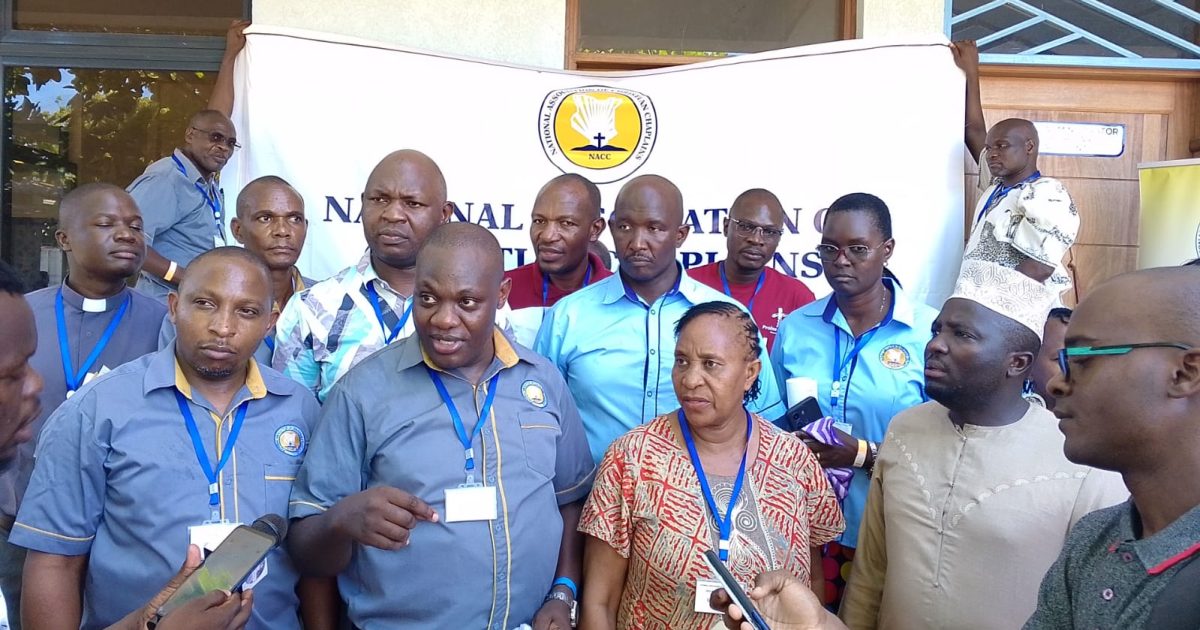
The National Association of Christian Chaplains (NACC) has called on the government to formally recognize and fund chaplaincy services across public institutions, warning that excluding school chaplains from the government payroll undermines holistic learner development.
Speaking at the close of the Association’s 16th Annual National Conference in Mombasa, NACC Communication Committee member, George Wagoya Odhiambo, said chaplains serving in schools, hospitals, correctional facilities, security services, and corporate institutions required structured government support to remain effective.
“We are asking that chaplains be given a budget allocation from the Ministry of Education, to enable our annual conference to be better supported and to grow the numbers attending,” Wagoya said, adding that the Association sought timely communication of chaplaincy activities across all counties and regions.
The three-day conference, held under the theme “Faithful Witness in a Digital and Polarised Society,” brought together chaplains from across the country to discuss professional development, digital ministry, crisis response, and national cohesion ahead of the 2027 general election.
NACC Board member John Gatu highlighted a legislative gap in the Basic Education Act of 2013, which currently prohibits government payment of school chaplains, even as chaplains in hospitals, the police, and the military receive state funding.
“We ask the government, as it revises the Education Act. It should ensure that even in institutions forming the society of tomorrow, chaplains are supported,” Gatu said.
The Association also endorsed the Competency-Based Education (CBE), describing it as more inclusive than the former 8-4-4 system and calling for chaplaincy to be formally integrated into its implementation.
“The new CBC curriculum is very good because every child leaves school knowing there is something they can do. There is no failure,” Gatu said, adding that chaplains were prepared to work alongside guidance and counselling departments in every institution.
Dr Sheikh Hassan Kinyua, Vice-Chairman of the Chaplaincy Committee in the Ministry of Education, said Muslim and Christian chaplains had agreed to collaborate across institutions while fully respecting religious diversity.
“If you are a Muslim chaplain in a school where there are Christians, you should not force those Christians to become Muslims. And if you are a Christian chaplain in a school where there are Muslim children, you will give them their rights,” Dr Kinyua said.
The Conference also addressed the role of chaplains in combating drug abuse and social media misuse, with delegates urging Kenyans to use digital platforms responsibly and avoid content that incites divisions along ethnic or political lines.
NACC called on faith-based organisations to prioritise chaplaincy training and discipleship programmes, and urged educational institutions to include chaplaincy in their budgets as part of a collaborative approach to youth development.
By Sadik Hassan