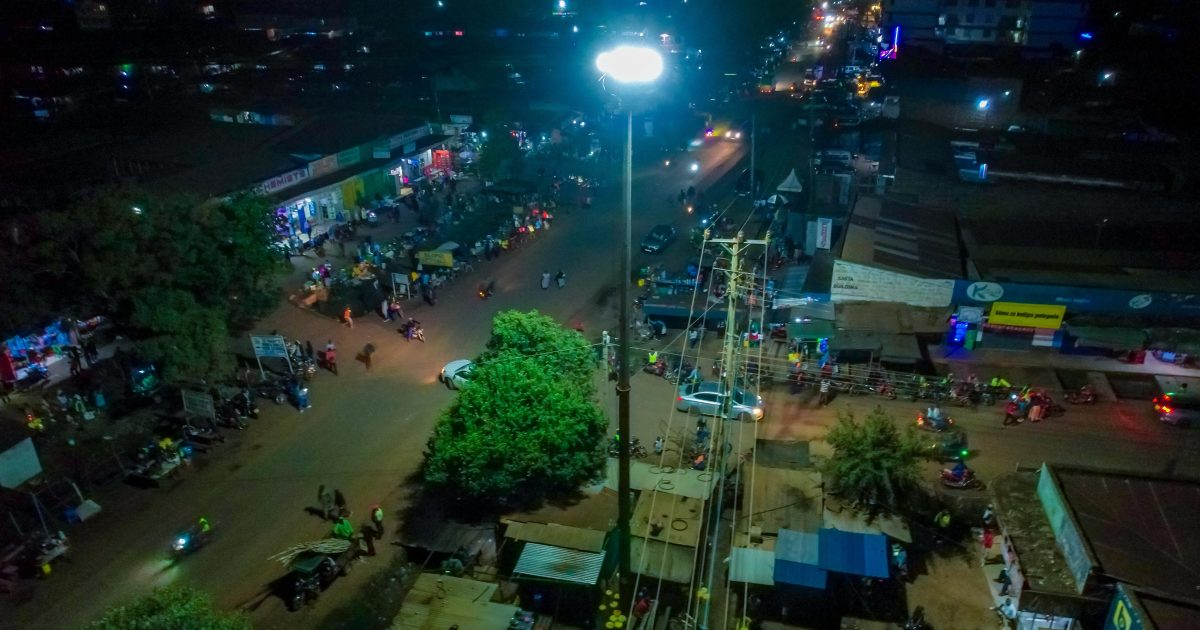
Kirinyaga County is witnessing bustling night-time economic activities following the installation of streetlights and floodlights across major markets and trading centres, in a development that is steadily transforming the county into a vibrant 24-hour economy.
The lighting programme, which is being rolled out across key towns and growth centres, has significantly improved security, extended business hours and created a more enabling environment for trade, with residents now able to move and transact safely even late into the night.
More than 165 floodlights have so far been installed across major towns, shopping centres and markets, opening up spaces that were previously deserted after dusk and turning them into active economic zones. The intervention is now directly translating into higher earnings for traders, more working hours for transport operators and increased economic circulation within local communities.
The programme, implemented through the Department of Transport, Roads, Public Works and Housing, has led to longer business hours, with some traders now operating up to midnight while others have embraced round-the-clock operations.
This shift is not only changing how business is conducted but also redefining the economic potential of small towns within the county, many of which previously relied on daytime trade.
Governor Anne Waiguru said the lighting project forms part of her administration’s broader strategy to stimulate economic growth, enhance urbanization and empower small-scale traders who form the backbone of the county’s economy.
She noted that towns where floodlights have been installed are now experiencing increased business activity at night, with more traders setting up and customers gaining confidence to shop beyond traditional hours.
“Residents and traders in Kagio, Kutus, Kerugoya, Kianyaga and Wang’uru can testify that it is now easier to transact business for longer hours at night. We intend to continue expanding this programme,” Waiguru said.
The Governor emphasized that improved lighting is not just about visibility, but about unlocking opportunities, enhancing safety and enabling residents to maximize their economic potential. She added that the county government is focused on ensuring that development projects directly benefit ordinary wananchi by creating practical opportunities for income generation.
County Executive Committee Member for Roads, Transport, Public Works and Housing Jared Migwi said the programme is designed to create a conducive business environment by enhancing security, reducing crime and extending trading hours.
“The objective is to light up the county to support business, improve security and ultimately boost livelihoods and the local economy,” Migwi said.
Migwi added that the county is working closely with the Kenya Power and Lighting Company to support electricity connectivity and ensure sustainability of the project.
He said the lighting programme complements other flagship projects, including the ongoing Sagana Industrial Park, which is expected to create employment opportunities, attract investors and further strengthen Kirinyaga’s economic base.
According to Migwi, such infrastructure investments are key in positioning the county as a competitive hub for trade and investment within the region.
Across the county, the impact of the lighting programme is already evident, with traders, transport operators and residents reporting improved safety, increased customer flow and rising incomes.
In towns such as Kagio, Wang’uru, Kutus, Kerugoya, Kianyaga and Sagana, business activity now extends well into the night, with hotels, retail shops, kiosks, food vendors, and transport services benefiting from the extended hours. The increased human activity has also contributed to a more vibrant and lively atmosphere in these centres, reversing the trend where towns would go quiet immediately after sunset.
For many traders, the project has marked a turning point in their businesses, offering them an opportunity to recover lost time and maximize daily earnings without necessarily increasing costs.
At Ngurubani market, Jennifer Waruguru said cases of theft, which were common before, have reduced significantly, allowing traders to operate without constant fear of losing their goods.
“We now feel safe doing business even at night because insecurity has reduced. Customers are also coming in large numbers because they feel safe,” she said.
She added that the improved lighting has encouraged more traders to remain open for longer, creating a chain effect where increased activity attracts even more customers.
Eunice Kiragu echoed her sentiments, noting that the lighting has given traders flexibility and confidence to extend their operations.
“I am able to leave my belongings without worry and still find them safe. We can now close at 10pm or even beyond, unlike before when we used to close by 7pm,” she said.
She added that the extra hours have translated into more sales, helping traders meet daily needs, pay school fees and improve their household incomes.
According to her, the difference in earnings before and after the installation of lights is noticeable and has brought new optimism among traders.
The impact is also being strongly felt in the transport sector, particularly among bodaboda operators who play a critical role in connecting people and goods within the county.
At Karima in Kariti Ward, Bodaboda Association Chairman Benson Karimi said the lights have significantly improved both security and operations.

“Before, there was a lot of mugging due to darkness and we could not stay late, closing by 7pm. But now we operate 24 hours and our earnings have improved,” Karimi said.
He noted that the improved lighting has not only increased income but also restored confidence among riders and passengers, making night travel safer and more reliable. This has in turn supported other businesses that depend on transport, including hotels, shops and late-night vendors.
In Kagio town, Nancy Njeri said the improved lighting has led to an increase in late-night customers, boosting her daily sales and overall business performance.
“I can now operate even at midnight without fear as insecurity has significantly reduced. Customers are more comfortable coming at night,” she said.
She observed that the extended hours have allowed her to serve a new category of customers who were previously unable to shop during the day due to work commitments.
Jecinta Muthoni, a banana seller, said the lighting has improved visibility, customer trust and business efficiency.
“Customers trust what they can see. Now they come in large numbers, which means more business and more income,” she said.
She explained that before the installation of floodlights, poor lighting made it difficult to display produce properly, often leading to losses as customers avoided buying goods they could not clearly see. With proper lighting, she is now able to arrange her produce attractively and serve customers more effectively.
By David Wandeto