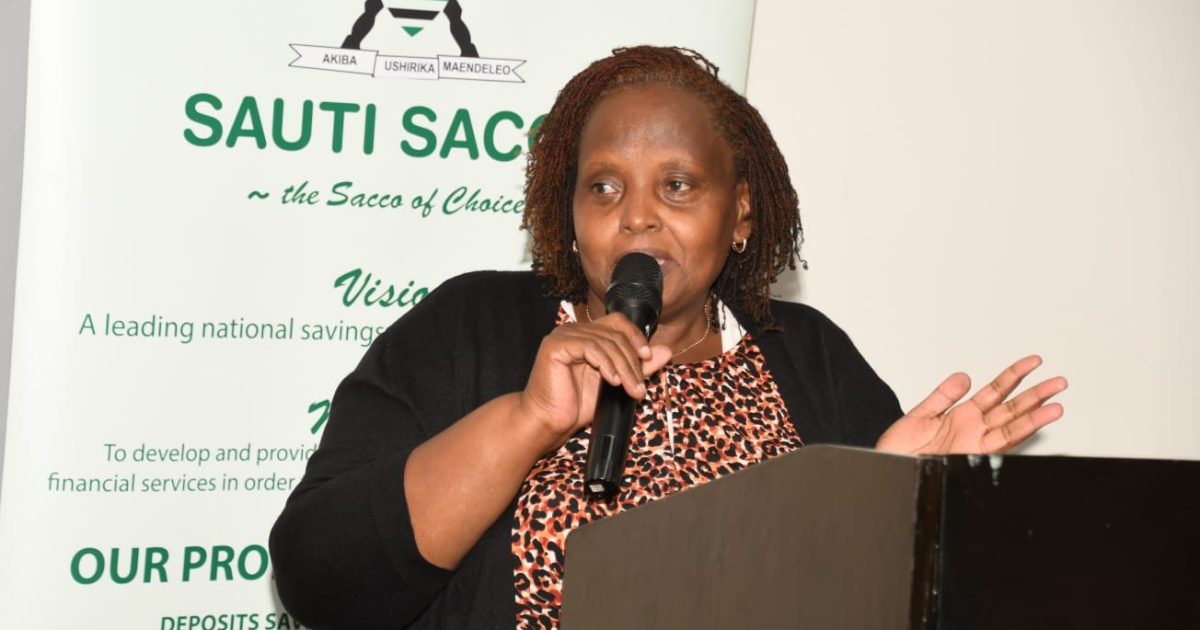
Sauti Sacco members have been challenged to intensify membership recruitment drives to restore the vibrancy and glory of the half-century-old society patronized by media practitioners in the country dating back to the early 70s.
Nairobi Sub County Cooperatives Officer Rosaline Mwithiga asked delegates to embark on serious recruitment campaigns to bridge the shrinking numbers of active members by introducing attractive products aligned to the needs of loan applicants.
She told the Sauti Sacco annual delegates meeting at a Nairobi hotel that the society must set achievable targets for delegates to woo new active members into the fold, saying the increasing numbers of dormant and retired members were a concern for the future of the SACCO.
Mwithiga attributed the dwindling numbers of active members to low loan uptake and deposit; thus, the need to deliberately revamp and strategically market the 53-year-old SACCO to youthful members for posterity.
“The loan uptake went down in 2026 from 132 in 2025 to 124 while members’ deposits declined from 187 million to 181 million shillings during the same period,’ she said.
Mwithiga highlighted the ongoing reforms in the cooperative movement, terming them critical in streamlining good governance to enhance and tighten accountability issues in the corporate sector.
The Co-operative Bill 2025 has gone through the Parliament and also the Senate, and now it’s at the mediation stage, and we are hoping that very soon it will be able to come out as a law, so that we can be able now to enforce it as a government,” she said
She further stressed that the Sacco Societies Regulatory Authority (SASRA) was mandated to forestall standards by strengthening financial stability to offer some insurance to members and protect their savings
“The SASRA, through the reforms, now requires that audited accounts of SACCOs be signed by not only the board but also the management contrary to the earlier practice where only board members had the final say,” she said.
Mwithiga also underscored the need for auditing of systems to authenticate their performance and transparency of transactions, adding that other reforms, including the inclusion of a QD code on audit reports, were key to establishing the registration status of the auditor.
The cooperative officer reiterated that key among other reforms in the pipeline is the establishment of the Deposit Guarantee Funds to cushion members’ savings from unforeseen losses, adding that the draft review law is pending in the Senate.
Sauti Sacco Chairman Elly Ndwiga expressed optimism that the society was headed in the right direction, saying dividends had gone up this year by 1 percent from 6 to 7 percent on deposits while shares remained at 10 percent.
“This year we are paying dividends, and we are declaring a dividend of 10 percent and an interest on deposits of seven percent, which is quite impressive considering the business we are doing right now and when we have members not taking as much loan because this is the core business of lending to members,” he said.
He assured delegates that the society had embarked on a major restructuring exercise to ensure that more members were brought into the fold towards the realization of the envisaged 10 percent dividend on deposit in subsequent years.
Ndwiga, however, said the board had instituted reforms and targets to curb the worrying trend of low loan uptake through the implementation of a strategic plan that included the introduction of new products and expanding the loan repayment period with loan top-up offers.
Others, he said, included the inception of digital platforms such as mobile banking and expansion of guarantees to include collaterals and other related properties as security.
The chair said the opening of the SACCO’s common bond rule had seen the society widen her scope of recruitment of fresh members from the informal sector, whose membership fraction currently stands at thirty percent.
By Wangari Ndirangu