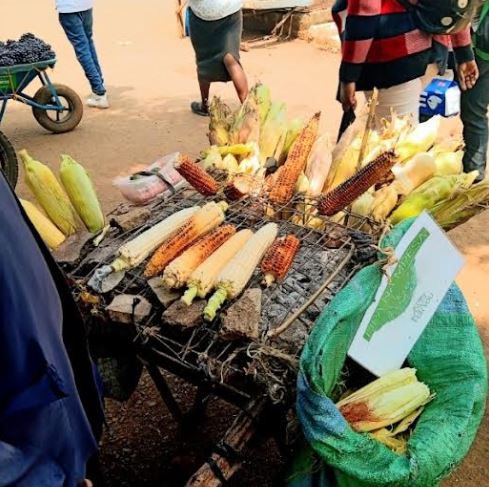
Kiambu County continues to emerge as a hub for youth entrepreneurship, with many young people turning to small-scale street food businesses as a source of livelihood and independence. From boiled eggs and smokies to roasted maize and sugarcane vending, these enterprises are offering unemployed youth a chance to earn an income, build resilience, and contribute to the local economy.
The Food and Agriculture Organization (FAO) under the United Nations defines street food as ready-to-eat foods and beverages prepared and/or sold by vendors and hawkers, especially in street and other similar public places. Such businesses are mostly found in clusters around places of work, schools, hospitals, railway stations, and bus terminals.
“They are inexpensive when compared to food from the formal sector and in fact are often less expensive when compared to home-cooked food,” FAO adds.
For 24-year-old Nelson Kung’u, operating a boiled eggs and smokies business in Kiambu Town has become a stepping stone toward financial independence. Until recently, Nelson worked at a local butchery, but he felt limited by low wages, irregular working hours, and stiff competition among workers.
Seeking better opportunities, he ventured into self-employment through street vending, a sector increasingly attracting young people because of its low startup costs and flexible nature.
“I prefer being self-employed because the government helps in cleaning our places of work and ensuring a stable environment for business,” said Nelson.
His business has proven profitable within a short period. Nelson buys a tray of eggs at Sh450, boils them, and sells each egg at Sh30, earning about Sh900 per tray and making a profit of approximately Sh450.

Despite the promising returns, Nelson acknowledged that street food vending comes with challenges, particularly due to limited regulation and inconsistent support structures.
“The street food sector still lacks enough regulation and control, which sometimes makes expansion difficult,” he said.
Even so, he remains optimistic about the future and hopes to grow his business into a stable long-term source of income.
Another youth entrepreneur making strides in Kiambu is Enoch Anyoli, a roasted maize vendor operating within the busy Kiambu Market. Enoch ventured into street vending five years ago after leaving the construction industry, where work was unpredictable and physically demanding.
According to Enoch, the uncertainty of casual labour pushed him to seek a business he could manage independently while maintaining flexibility in his daily schedule.
“This business allows you to work according to your own schedule and adjust your time depending on your needs,” he said.
His roasted maize business attracts a steady flow of customers within the market area, enabling him to support himself.
Enoch noted that the business requires relatively low capital compared to many other enterprises. His main expenses include transport costs for sourcing maize from Nairobi and purchasing charcoal, which is readily available within the Kiambu Market.
The affordability of the venture has made it attractive to many young people seeking self-employment opportunities without requiring large startup capital.
Similarly, 24-year-old Evan Mukami has found opportunity through sugarcane vending, a business he started four months ago after leaving his previous hustle of hawking sweets and biscuits at the Kiambu stage.
Evan said the earlier business generated inconsistent income, prompting him to explore alternatives with better returns and more stability.
“I realised sugarcane vending was more reliable and profitable compared to what I was doing before,” he said.
Unlike many traders who incur transport expenses, Evan operates within his residential area, allowing him to minimize costs and maximize profits. He explained that starting the business required only a wheelbarrow and access to a reliable sugarcane supplier.
Within a short period, the venture has enabled him to achieve financial independence while meeting his daily needs.
The growth of such youth-led enterprises has also been supported by government efforts to maintain cleanliness, order, and security within trading spaces. Proper waste management and organized market environments have helped create conducive conditions for small businesses to thrive.
Meanwhile, the government has continued encouraging youth to take advantage of structured empowerment initiatives such as the Uwezo Fund and the National Youth Opportunities Towards Advancement (NYOTA) programme.
The Uwezo Fund, launched in 2013, provides interest-free loans to youth, women, and persons with disabilities organized in registered groups. Beneficiaries are required to register groups, open bank accounts, and undergo vetting before accessing funding.
Speaking to the Kenya News Agency in an earlier interview, Kiambu County Director for Youth Affairs, Mr Mwangi, expressed optimism about the NYOTA programme, which equips unemployed youth with technical and vocational skills and then offers financial support.
Beneficiaries receive structured training in fields such as plumbing, electrical work, and hairdressing, alongside monthly stipends and a Sh25,000 grant upon completion of the On-Job-Experience programme.
Mwangi urged young people to prioritize skills acquisition and entrepreneurship, noting that practical skills and small businesses can provide sustainable economic empowerment and long-term stability.
By Collins Okware