When squatters settled in Solio villages, Laikipia County, in 2010, it was just a parched, expansive piece of earth with no vegetation.
But 15 years later, efforts by various stakeholders led by Habitat for Humanity-Kenya have brought a big transformation, where locals now live on fertile land, following a vigorous tree planting campaign that is now bearing fruits.
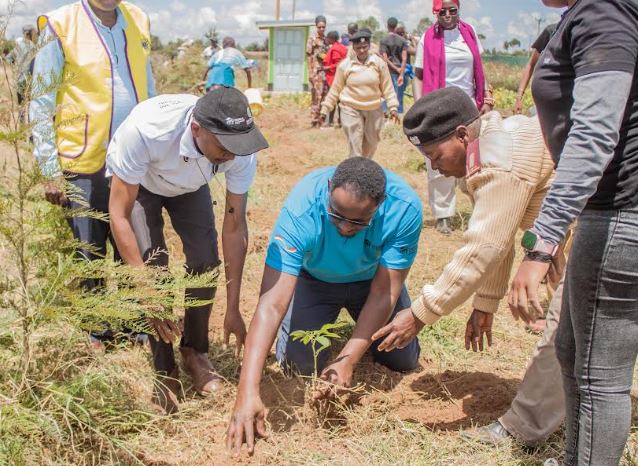
Through such restoration initiatives this rainy season, locals in partnership with Habitat for Humanity Kenya have planted over 20,000 indigenous trees and fruit tree seedlings.
Consequently, once the degraded land is actively catching up with other regions with residents embracing the tree programmes, even at homestead levels.
According to the stakeholders, they started climate adaptation programs three years ago, aimed at promoting agroforestry in the area.
“In the past three years, we have been implementing climate adaptation actions to help build community resilience. Tree planting is one of those activities; we have planted over 20,000 tree seedlings so as to increase tree cover in the area,” said Justin Atemi, an officer with Habitat for Humanity Kenya.
Atemi said other interventions include promoting of Safi latrine models, revealing that with climate change the area is prone to flooding and could affect residents’ hygiene.
“We are building flood resilience pit latrines now that we have climate change impact in this area, when it floods, latrines become a problem, hence we are pioneering the safi latrine model so that the community won’t be building latrines every rainy season,” he revealed.
He added that they were working closely with hygiene promoters in sensitizing residents in embracing safer methods of cushioning them from sanitation-related ailments like diarrhoea, typhoid and cholera.
Bahati sub-location assistant chief Regina Kivoi praised the initiative, highlighting that it was in line with government efforts in restoring degraded lands through planting of 15 billion trees by 2032.
She noted that schools in the area had adopted the tree planting initiatives, a move that has seen positive climate change compared to previous years.
Kellen Wangui, a Solio resident, on her part said that through land restoration programmes, they had also ventured into farming, where they generate income by selling vegetables to the local restaurants.
By Muturi Mwangi