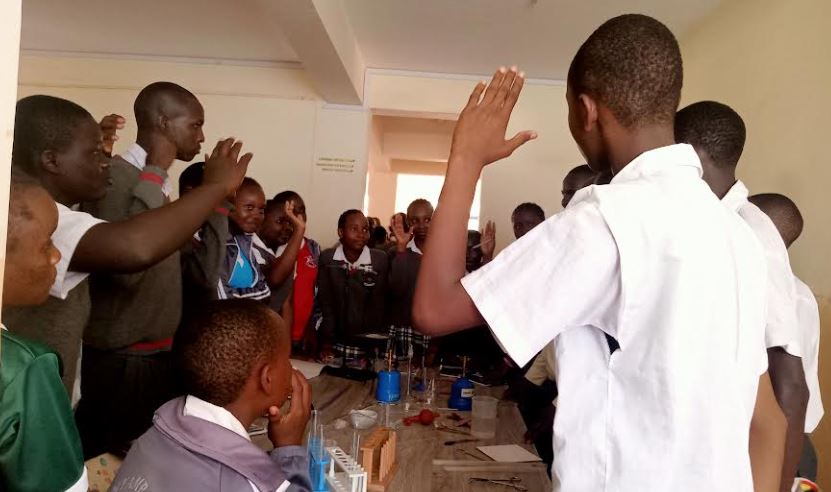
At Mwanyambo Junior School, a group of Grade 9 learners gather around science apparatus, mathematical puzzles and practical demonstrations with visible excitement.
For many of them, it is their first close interaction with hands-on STEM learning.
The atmosphere inside the classroom is lively and curious; far removed from the fear and intimidation that science and mathematics subjects often inspire in many rural schools struggling with limited facilities and inadequate exposure.
This week, Centre for Mathematics, Science and Technology Education in Africa (CEMASTEA) brought that transformation to several junior schools across Taita Taveta County through a nationwide mentorship and outreach programme aimed at increasing uptake of Science, Technology, Engineering and Mathematics (STEM) subjects in primary and junior schools.
From Mwanyambo Junior School in Voi Sub-county to Mengo Junior School and now Mlilo Junior School, the message delivered to learners has remained consistent: STEM is possible, practical and within reach for every learner regardless of background.
The programme has already reached 11 counties and is increasingly becoming a bridge between well-established schools with stronger facilities and rural schools often left behind by infrastructure and resource gaps.
For five days in Taita Taveta County, a team of 18 CEMASTEA officers is working directly with learners and teachers, introducing practical and student-centred approaches designed to build confidence and interest in STEM pathways.
The initiative comes at a critical moment in Kenya’s education transition under the Competency-Based Education (CBE), where the government is targeting at least 60 percent of learners to pursue the STEM pathway in senior secondary school.
The broader goal is to equip young Kenyans with skills needed to support industrialization, digital transformation and innovation under Kenya Vision 2030.
But beyond examination performance, education stakeholders say the push toward STEM represents a deeper attempt to reshape how learners think about education and work.
For decades, success in Kenya’s education system was largely associated with formal white-collar employment. Today, policymakers increasingly want schools to produce innovators, entrepreneurs and problem-solvers capable of creating solutions within their own communities.
At Mwanyambo Junior School, that shift is beginning to take shape. Grade 9 learner Reaynold Mwambanga now sees science differently.
“Physics can help us solve electricity problems locally,” he says confidently. “STEM can help us become entrepreneurs and solve problems in society.”
His classmate Wendy Kalegha says the programme has strengthened her dream of becoming a dentist.
“I used to fear mathematics,” she admits. “But now I feel empowered to pursue STEM subjects like chemistry and biology in senior school.”
Similar excitement was evident at Mengo Junior School in Mwatate Sub-county, where Grade 9 learners Dowel Mwangala and Margaret Mwandoe said the practical sessions had made science subjects feel easier to understand and more connected to everyday life.
Their growing confidence reflects the mission CEMASTEA says it is pursuing across the country: making STEM more accessible, practical and less intimidating for learners, especially in rural areas.
According to CEMASTEA Coordinator for STEM Mentorship and Outreach, Joseph Kuria, the programme focuses on exposing learners to competencies such as critical thinking, creativity, collaboration, self-efficacy and digital literacy.
“We want learners to develop interest in STEM early enough so they can confidently transition into senior school and later contribute meaningfully to the economy,” he says.
The mentorship also targets teachers through in-service training sessions aimed at strengthening practical and student-centred teaching methods.
For pre-technical studies teacher Christine Mwatati, the programme is helping dismantle long-held stereotypes surrounding science subjects.
“Many learners think STEM is only for very clever students,” she says. “That mindset creates fear before they even attempt the subjects.”
But practical exposure is slowly changing attitudes.
“When learners interact with equipment directly, STEM becomes enjoyable and relatable. They become more open-minded and willing to try.”
Teachers, too, are learning new approaches aligned with CBE, which emphasizes collaboration, creativity and problem-solving rather than rote memorization.
Still, significant challenges remain.
Many rural junior schools continue to operate without laboratories, enough science equipment or specialized STEM facilities needed to sustain hands-on learning after mentorship teams leave.
Kuria says such inequalities may undermine implementation of the STEM pathway if investments are not made.
“We need more infrastructure support and STEM centres at county level so that rural learners are not disadvantaged,” he says.
Recent education assessments have shown that while learner interest in STEM careers remains high, infrastructure readiness in many schools remains low; a gap that threatens to widen inequalities between urban and rural learners.
That reality is precisely why programmes like the one unfolding in Taita Taveta are becoming increasingly important.
Inside the classrooms, however, the transformation is already visible. Learners who once viewed science as difficult, unreachable or reserved for a few “gifted” students are beginning to see it differently.
Not just as school subjects, but as tools for building solutions, creating opportunities and shaping their futures.
By Arnold Linga Masila