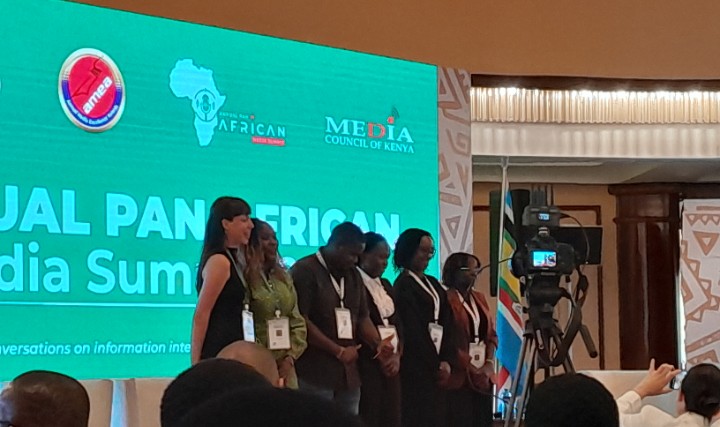
Young people are increasingly consuming news through social media platforms, podcasts and short-form video content, a trend media experts say is rapidly reshaping journalism, while exposing audiences to the growing threat of misinformation.
Speaking during a panel discussion on youth engagement and information consumption, Nairobi Leo, Managing Director, Martin Wachira said most young people now prefer accessing news through digital platforms because of widespread smartphone use, affordable internet access and the convenience of social media applications.
Wachira noted that while social media has expanded access to information, it has also amplified the spread of inaccurate and misleading content as technology companies prioritise engagement-driven algorithms.
“Most young people are now consuming content through social media platforms, but it does not mean all the information is accurate,” he said.
The MD explained that such platforms often promote highly engaging content regardless of its credibility, making it necessary for digital publishers and journalists to uphold professional standards and accountability.
Wachira urged online publishers to register with professional regulatory bodies such as the Media Council of Kenya to strengthen ethical journalism and improve the quality of information disseminated online.
He added that despite the rapid growth of digital media, radio remains a powerful source of information across Africa due to its affordability and use of local languages.
“In the African context, radio still plays a major role because it is affordable and accessible through vernacular languages,” he said.
According to Wachira, changing audience behaviour has forced digital publishers to adopt shorter and more engaging formats such as short videos, digital cards and concise articles to match shrinking attention spans among online audiences.
He stressed that speed in publishing should not compromise credibility and accuracy.
“As people with digital platforms, our role is to ensure that we produce content that is credible, accurate and timely because that is what young people are consuming,” he stated.
Wachira further warned that the monetization of false information online remains one of the biggest challenges facing digital journalism, ahead of future elections, noting that fake content creators often profit from misleading narratives.
He, however, acknowledged efforts by technology companies to combat misinformation through artificial intelligence tools and partnerships with fact-checking organisations.
At the same forum, Kenya Television Network (KTN) journalist Beatrice Njeri said young audiences no longer rely on a single source of information, but instead consume news across multiple platforms simultaneously.
“Young people today consume information in a very fluid manner. They do not just rely on one single source of truth,” she said.
Njeri observed that Gen Z audiences often encounter stories first on platforms such as TikTok, Instagram or X before verifying them on digital news websites, discussing them on WhatsApp and later seeking deeper analysis through television broadcasts or podcasts.
She described modern news consumption among young people as “mobile-first, personality-driven, video-driven and community-based.”
According to Njeri, social media influencers and digital creators are increasingly shaping public discourse because young audiences relate more easily to personalities who communicate in familiar and accessible language.
“In Kenya, young people follow creators who present information in a manner they can understand and relate to,” she said.
She cited the growing popularity of podcasts and audiovisual storytelling, referencing the Reuters Digital News Report 2025, which found that younger audiences increasingly prefer watching news content instead of reading traditional articles.
Njeri also highlighted the role social media played during the 2024 and 2025 Gen Z protests in Kenya, saying digital platforms were used not only to consume information, but also to organize, distribute and create content around civic movements.
Deputy Editor at Africa Check Makinia Juma called for stronger collaboration between governments, media organisations, technology platforms and young people in the fight against misinformation and disinformation.
Juma said fact-checking goes beyond simply labelling information as true or false, explaining that access to reliable public data remains a major challenge across Africa.
“When we are doing fact-checking, we engage everyone in the information ecosystem because if information is wrong, we must ask where the sources are coming from,” she said.
She noted that limited access to official data often makes verification difficult for journalists and fact-checkers, underscoring the importance of equipping young people with verification skills.
“That is why we train journalists and university students, so that they can become a fact-checking army online,” she said.
Juma warned that misinformation spreads rapidly online because disinformation actors have mastered the use of engaging visuals, graphics and emotionally driven narratives that appeal to social media audiences.
She explained that disinformation campaigns increasingly disguise falsehoods as opinions, making them harder to regulate or directly fact-check.
“As fact-checkers, we are not allowed to fact-check opinions, but we can verify the data being used to support those opinions,” she explained.
Juma further cautioned that weakening partnerships between fact-checkers and technology companies could worsen the spread of false information online.
“If platforms stop supporting fact-checking, misinformation will thrive,” she warned.
The speakers agreed that while digital platforms continue to transform how young people access information, strengthening media literacy, ethical journalism and collaborative fact-checking efforts will be critical in safeguarding public trust and protecting the integrity of information in the digital age.
By Nyawira Githinji and Nicholas Ochieng