In the dusty plains of Kenya’s far north, where generations grew up feeling distant from the country’s political and economic centre, a new chapter is unfolding with remarkable symbolism.
For the first time since independence in 1963, Kenya’s national Madaraka Day celebrations will be held in Wajir County on June 1, 2026 — a historic milestone that many residents here describe not simply as a state function, but as a long-awaited moment of recognition.
Across Wajir town, the signs of transformation are impossible to miss out.
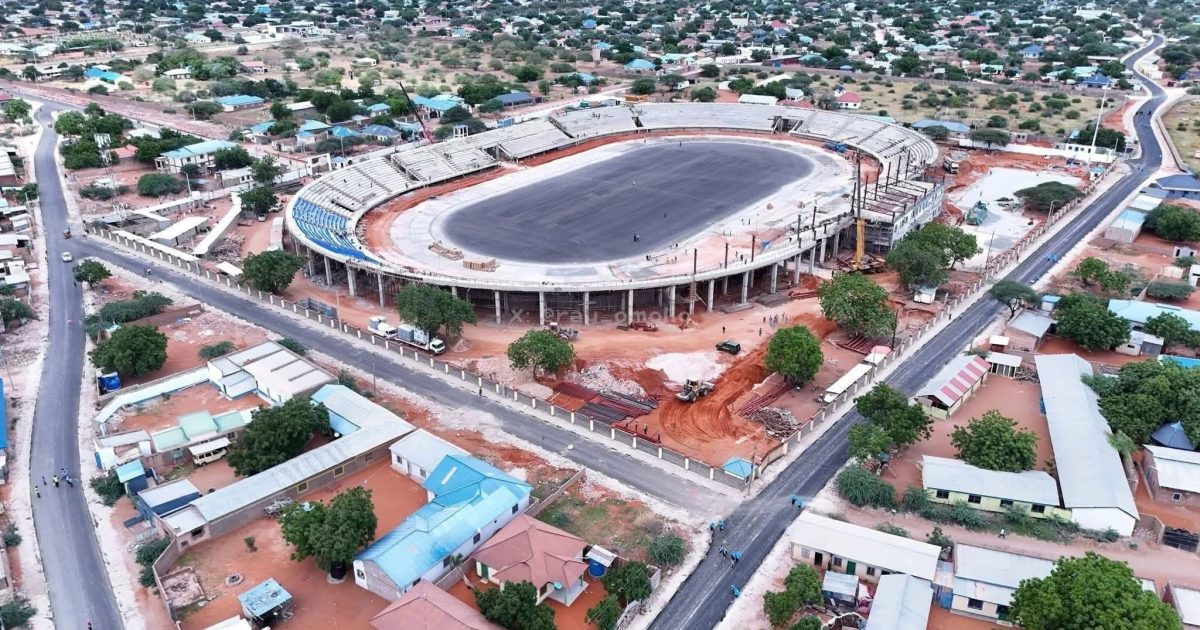
Freshly paved roads cut through neighbourhoods that once struggled with poor accessibility. New streetlights illuminate roads that traditionally fall silent after sunset. Construction crews work around the clock putting final touches on infrastructure projects as traders, youth groups and local residents prepare to welcome thousands of visitors expected from across the country.
At the heart of this transformation stands the newly built 10,000-seater stadium — now the most visible symbol of Wajir’s emergence onto the national stage.
For many residents, the celebrations carry emotional and political significance beyond ceremony.
“This is bigger than a national holiday,” said a local elder in Wajir town. “It is the first time many people here truly feel embraced by the rest of the country.”
For decades, Northern Kenya has often existed at the margins of national development conversations, shaped by historical neglect, insecurity, recurring drought and limited infrastructure. Successive governments faced criticism over uneven development implementation between Kenya’s central regions and the arid north.
But this year’s Madaraka Day celebrations are being interpreted by many residents as an attempt to redraw that narrative.
The President William Ruto’s decision to host the national event in Wajir has been welcomed by leaders across the county as a symbolic gesture of inclusion and national cohesion.
County officials say the preparations have accelerated investment not only in Wajir town, but across the county’s six constituencies through road works, urban upgrades, airport improvements and expansion of public services.
The modernization of Wajir’s civilian airstrip is expected to improve regional connectivity and unlock new economic opportunities in trade, tourism and logistics. Local business owners say the improvements are already beginning to attract outside interest.
Hotels are recording increased bookings ahead of the celebrations while small-scale traders are preparing for a surge in business activity.
For young people, the stadium represents something even more personal: possibility.
Youth leaders say the facility could transform sports and talent development in a region where recreational infrastructure has long remained limited.
Beyond Madaraka Day, county leaders envision Wajir hosting national tournaments, cultural festivals and government conferences — opportunities once unimaginable for the region.
Yet amid the palpable excitement, residents remain acutely aware that symbolism alone will not solve the long-standing challenges facing Northern Kenya.
Many hope the national attention generated by Madaraka Day will translate into sustained investments in education, healthcare, water access, digital connectivity and climate adaptation and resilience initiatives in a region heavily affected by drought and economic vulnerability.
Nevertheless, optimism dominates the mood across Wajir.
Community leaders, religious elders and political figures have repeatedly called for unity during the celebrations, urging residents to avoid divisive politics and instead embrace the occasion as a collective achievement for the region.
In markets, schools and government offices, conversations increasingly revolve around what hosting Madaraka Day means for the identity of Wajir itself.
For years, Northern Kenya was often viewed through the lens of hardship and marginalization. Today, many residents say they want the country to see the flip side of the coin, something different — resilience, hospitality, culture and untapped opportunity.
As Kenya marks 63 years since attaining internal self-rule, Wajir is preparing not only to host the nation, but also to redefine how the nation sees Northern Kenya.
And as the final countdown to June 1 begins, one sentiment echoes across the county with growing confidence:Wajir is no longer on the periphery of Kenya’s story. It is now firmly at its centre.
By Hamdi Buthul