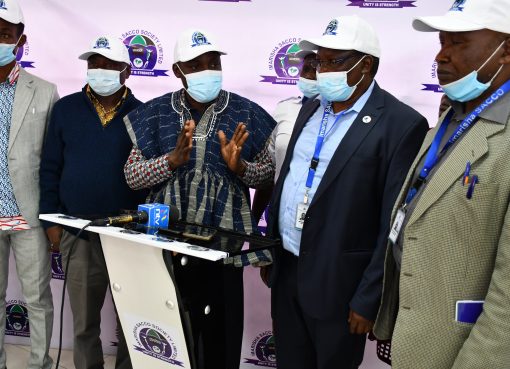
The Prime Cabinet Secretary (PCS) Musalia Mudavadi has underscored the importance of maintaining hygiene and decent housing in the fight against jiggers and other poverty-related diseases in the country.
Mudavadi said maintaining clean living conditions remains one of the most effective ways of protecting vulnerable families, especially children and the elderly, from jigger infestation and other preventable infections.
Speaking Monday during the launch of the Ahadi Kenya Trust Jigger Archive and Community Resource Centre in Murang’a town, the PCS said the fight against jiggers should remain a collective responsibility to ensure no Kenyan continues to suffer from the painful condition.
He noted that the establishment of the archive and resource centre marks a major milestone in Kenya’s journey towards eliminating jigger infestation, a condition that mainly affected poor rural communities across the country.
Mudavadi observed that the centre will help preserve the history of Kenya’s efforts in combating jiggers while also serving as a learning and research facility for future generations.
“This is a defining moment to celebrate the tremendous gains achieved in suppressing the jigger menace and to honour the resilience of survivors and affected families whose courage inspired a national movement for dignity, healing and restoration,” he said.
The PCS recalled that nearly two decades ago, more than three million Kenyans were affected by jiggers, with some of the worst-hit areas recording severe suffering among children and elderly people.
“We are here to archive the painful chapter of the long fight against jigger infestation. In the worst affected areas, children frequently missed school, families lived in pain and shame, communities suffered in silence and victims were isolated and stigmatized,” said Mudavadi.
He added that some victims lost mobility while others died due to complications associated with severe infestation.
He praised Ahadi Kenya Trust, the Ministry of Health, Murang’a County Government and other partners for initiating and sustaining the anti-jigger campaign since 2007.
He said the programme, which started in Murang’a County, later spread to other regions with high jigger prevalence rates including Central, Coast, Eastern, Rift Valley and Western Kenya.

The PCS further noted that the government has strengthened efforts towards a jigger-free nation through policies and public awareness initiatives.
He pointed out that the annual National Jigger Awareness Day marked every March 3 has helped deepen public understanding on prevention and treatment of jiggers.
Mudavadi also lauded the Ministry of Health’s Epuka Uchafu Afya Nyumbani campaign launched in 2006, saying it has significantly promoted cleanliness practices among Kenyans.
At the same time, the PCS urged Kenyans to remain vigilant against Ebola following reports of cases in neighbouring countries.
He called on citizens to embrace preventive measures similar to those used during the COVID-19 pandemic, including proper hygiene to stop the spread of the deadly disease.
“The same cleanliness and health measures that helped us contain coronavirus should now help us prevent Ebola from spreading into the country,” he said.
Meanwhile, Ahadi Kenya founder and Chief Executive Officer Dr. Stanley Kamau said the organization has made major strides in the fight against jiggers through partnerships with different institutions and community groups.
Kamau said Ahadi Kenya has invested heavily in awareness campaigns, hygiene promotion, rehabilitation programmes, empowerment initiatives and training of stakeholders involved in jigger eradication efforts.
“To date, we have achieved 90 percent success in the eradication of jiggers in Kenya,” he remarked.
He added that the organization has been documenting the country’s anti-jigger journey for the last 19 years, leading to key milestones such as the formulation of national policy guidelines on prevention and control of jiggers and the establishment of National Jigger Awareness Day.
According to Kamau, the newly launched resource centre will also preserve samples of jiggers and jigger-causing fleas collected over the years for research and educational purposes.
He said the facility will offer students, researchers and the public an opportunity to learn more about jigger eradication and the progress Kenya has made in restoring dignity to affected communities.
By Bernard Munyao and Purity Mugo