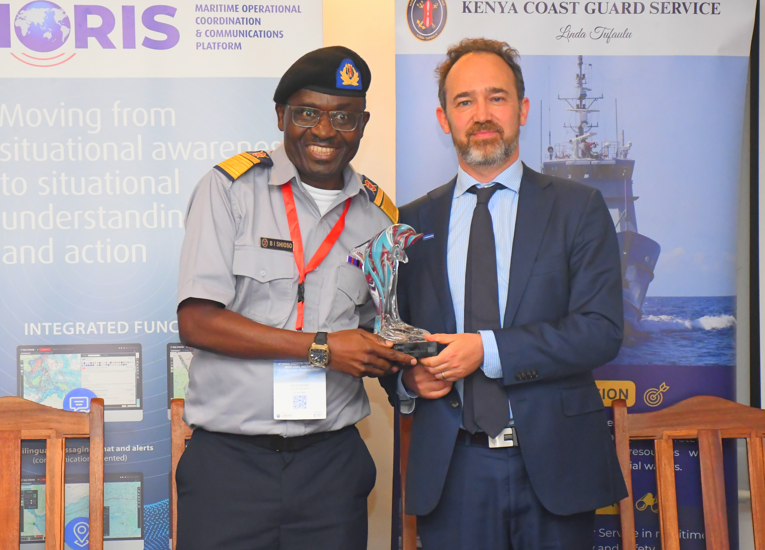
As the curtains fall on the Fourth Indo-Pacific Regional Information Sharing (IORIS) Steering Committee High-Level Meeting, nations have been urged to strengthen collaboration and information sharing to effectively tackle emerging maritime threats and safeguard global trade routes.
IORIS is a neutral and secure digital platform developed under the European Union’s (EU) Critical Maritime Routes Indo-Pacific (CRIMARIO) project.
The platform enables national agencies and regional partners to jointly plan and coordinate maritime operations, including crisis and incident management, while enhancing information sharing and strengthening inter-agency collaboration at both national and regional levels. It also provides advanced surveillance capabilities.
Currently, more than 150 national and regional maritime organisations and entities from over 50 countries across the Indo-Pacific region use the IORIS platform.
Speaking during the closing ceremony, Director General (DG) of the Kenya Coast Guard Service (KCGS), Bruno Shioso, affirmed that collaboration remains the key to achieving safer and more secure seas that facilitate global commerce.
“Whereas landward security is well demarcated, this remains an exception, as with the vast oceans and her resources. Policing oceans goes beyond one agency or nation, and for that matter, it calls for collaboration and deliberate building of synergies of purpose with one goal in mind: free and accessible oceans for all,” said the DG.
“Yet this vulnerability gets compounded by global crises, especially with the ongoing tensions in the Middle East and, in particular, contestations over the right of passage through the Straits of Hormuz. With such tensions and maritime threats abounding, the world becomes fragile.”
Shioso underscored the need for nations to work together and pursue common solutions to shared challenges. “We must act concertedly, since in unity, more is achieved with less at hand,” he stated.
He lauded the EU CRIMARIO project for co-hosting the high-level meeting in Kenya. The three-day meeting brought together 80 organisations from 40 countries across the Indian, Pacific and Atlantic oceans to discuss maritime safety and security.
The DG noted that information sharing lies at the heart of collaboration and partnerships among Indo-Pacific nations, helping to build secure networks and platforms for cooperation.
“Sharing critical information and intelligence in real-time is what shall keep our oceans free and accessible to all. It is what shall keep away pirates and armed robbers at sea,” he said.
He added, “It is what shall leverage the protection of marine resources for responsible extraction. It is what shall interdict maritime organised crime. And above all, it is what shall keep our international sea lanes free for navigation and global trade.”
Antoine Hanin, Programme Manager – EU CRIMARIO, said IORIS is more than just a technological platform; it is a community and network of trust and collaboration that spans continents, connecting agencies, navies, coast guards and maritime authorities in ways that were unimaginable just a few years ago.
“This is not just about data or digital tools; it is about people working together to address challenges that no single nation can solve alone,” stated Hanin.
During the meeting, he said participants explored how IORIS can evolve to address emerging threats, ranging from shadow fleets and risks to critical maritime infrastructure to counter-narcotics operations and port security in an increasingly complex maritime environment.
The Programme Manager further explained that two critical documents adopted during the meeting will shape the future of the IORIS platform.
“The framework for extractable IORIS statistics will allow us to measure our impact while safeguarding operational security, ensuring that we can demonstrate the value of this tool without compromising the trust that underpins it,” stated Hanin.
“Meanwhile, the updated policy framework clarifies how EU CRIMARIO can continue to support real-time operations, always with the understanding that national sovereignty and local ownership remain paramount,” he added.
The use of Artificial Intelligence was among the key highlights of the meeting, with participating nations proposing investments in Endpoint Detection and Response technologies to safeguard the platform against cyberattacks.
The Programme Manager noted that finalising the IORIS Associate Licensing Arrangement will enable new partners to join in a controlled yet meaningful way, while updates to the Steering Committee’s governance framework will ensure that all voices are heard and that leadership remains strong and equitable.
By Sadik Hassan