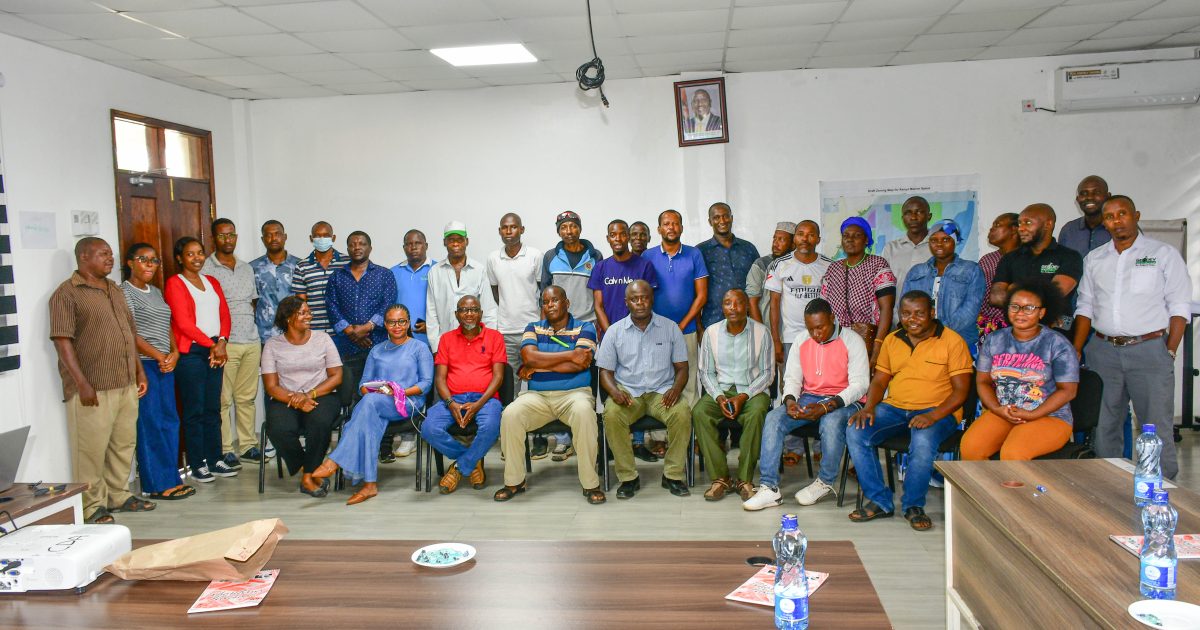
Marine stakeholders have convened in Kilifi County to review and validate proposals that will inform the draft Marine Spatial Plan, aimed at balancing economic development, environmental conservation and social interests, while minimizing conflicts among users of marine and coastal resources.
Speaking during the validation forum, Kilifi Deputy County Commissioner and Personal Assistant to the Kilifi County Commissioner, Simon Kaithungu, underscored the need for sustainable and environmentally friendly economic activities along the coastline to ensure harmonious coexistence among resource users.
“There is need to have this spatial plan in place so as to ensure all ocean users work with harmony and it is through it that more economic activities will be initiated,” he said.
Kaithungu lauded the proposed zoning framework and sea-use management regulations, noting that they provide clear guidelines for sectors including fishing, sand harvesting, sports, hospitality, agriculture, tourism, transport and forest conservation.
He said the framework would promote discipline and order in the utilization of marine resources, while creating opportunities for more sustainable economic activities.
“The proposed zoning framework will ensure that different sectors operate in an organized manner, reducing conflicts and enhancing productivity,” he said.
Sokoke Forest Association chair James Mranga emphasized the importance of collaboration among stakeholders, particularly government institutions, in strengthening the Blue Economy sector, which remains a key pillar of the coastal economy.
Mranga commended the State Department for Blue Economy and Fisheries through the Kenya Marine Fisheries and Socio-Economic Development (KEMFSED) Project for facilitating an inclusive process that captured stakeholders’ views in the draft plan.
“The involvement of all stakeholders in developing the draft plan is a major step towards ensuring sustainable management of marine resources,” he said.
Kilifi County Beach Management Unit (BMU) Network Chairman Samuel Kapombe welcomed the initiative, saying it would improve the livelihoods of local ocean users, especially fishermen, whose concerns had been incorporated into the plan.
“As fishermen we are very happy because our pleas have been considered in the plan and this is a great milestone to us because the local fisherman has been involved in formulating a long-term government plan,” said Kapombe.
Meanwhile, Coast Regional Coordinator for Very Marginalized Groups (VMGs), Jacob Kokani urged both national and county governments, as well as development partners to prioritize implementation of the proposed guidelines.
Kokani observed that Kenya has often developed sound policies and laws, but faced challenges in implementation, which has hindered economic development.
“It is my hope that this time round we will be patriotic because we have been having a tendency of formulating very good laws and policies but very poor at implementation,” he said.
The Marine Spatial Plan is a 20-year framework designed to guide the sustainable and integrated use of Kenya’s approximately 250,000 square kilometres of ocean space, while promoting environmental sustainability, economic growth and social inclusion along the coast.
By Stephen Mrira